World Food Books' programme is largely produced on Kulin Nation land. We acknowledge the Wurundjeri people of the Kulin Nation as the first and continuing custodians of this land, and pay respect to their Elders past, present, and emerging.
World Food Books is an arts and special interests bookshop in Naarm / Melbourne. Founded in 2010, World Food Books is devoted to the presentation of a rotating, hand-selection of international art, design, literary and counterculture publications with an emphasis on the anti-traditional, the experimental, the avant-garde, the heretic, the marginal.
Presenting new titles alongside rare and out-of-print books, catalogues and journals spanning the fields of modern and contemporary art, design, photography, illustration, film, literature, poetry, cultural theory, philosophy, sexuality, popular and underground culture in its many radical forms, World Food Books wishes to encourage adventurous, thoughtful and open-minded reading, looking, writing, and exchange of publishing and ideas, both current and historical.
As well as our bookshop, located in Melbourne's historical Nicholas Building, all of our inventory is available internationally via our online mail-order service.
World Food Books semi-regularly co-ordinates "Occasions", a programme of exhibits and events at the bookshop and in partnership with other hosts (such as museums and art galleries) that develop out of the activities, relationships and content of the bookshop itself.
World Food Books
The Nicholas Building
37 Swanston Street
Room 5, Level 6
Melbourne 3000
Australia
SHOP HOURS:
Thu–Fri 12–6, Sat 12–5
WEB-SHOP OPEN 24/7
World Food Books
Postal Address:
PO Box 435
Flinders Lane
Victoria 8009
Australia
Art
Theory / Essay
Architecture / Interior
Graphic Design / Typography
Photography
Fashion
Eros
LGBTQ+
Fiction / Poetry
Weird / Speculative / Science Fiction / Horror
Transgressive / Visceral / Abject
Symbolism / Decadence / Fin de siècle
Film / Video
Painting
Sculpture / Installation
Performance / Dance / Theater
Drawing
Sound / Music
Curatorial
Group Shows / Collections
Periodicals
Out-of-print / Rare
Posters / Ephemera / Discs
Signed Books
World Food Books Gift Voucher
World Food Book Bag
Australian Art
Australian Fiction
Australian Science Fiction / Speculative Fiction
Australian Poetry
Australian Photography
Japanese Photography
Conceptual Art
Minimal Art
Dada
'Pataphysics / Oulipo
Fluxus
Concrete Poetry
Pop Art
Surrealism
Arte Povera
Arte Informale / Haute Pâte / Tachism
Nouveau Réalisme / Zero / Kinetic
Situationism / Lettrism
Collage / Mail Art / Xerox Art
Art Brut / Folk / Visionary / Fantastic
Illustration / Graphic Art / Bandes Dessinées
Furniture
Italian Radical Design / Postmodernism
Textiles
Ceramics / Glass
Counterculture
Protest / Revolt
Philosophy
Psychoanalysis
Anthropology
Anarchism
Socialism / Anarchism / Communism / Capitalism
Literary Theory / Semiotics / Language
Feminism / Women's Studies
Gender Studies / Sexuality
Anthropology
Fetishism / BDSM
Drugs / Psychedelia
Crime / Violence
Animal Rights / Veganism
Occult / Esoterica
Ecology / Earth / Alternative Living
Whole Earth / Crafts
All prices in AUD (Australian dollars)
Pick-Ups
Pick-up orders can be collected in our bookshop during opening hours after order date. Please collect any Pick-up orders within 2 weeks of ordering as we have limited storage space. Orders will be released back into stock if not collected within this time. No refunds can be made for pick-ups left un-collected. If you cannot make it in to the bookshop in this time-frame, please choose postage option.
Return Policy
All sales are final. We do accept returns (for refund or exchange) for items received in error. All our orders are packed with special care using heavy-duty padding and cardboard book-mailers or bubble mailers (for smaller books), using reinforcement where required. We cannot take responsibility for any lost, stolen or damaged parcels.
Insurance
Should you wish to insure your package, please email us directly after placing your order and we can organise this at a small extra expense. Although all standard/express tracked packages are very safe and dependable, we cannot take responsibility for any lost, stolen or damaged parcels. We recommend insurance on valuable orders.
Interested in selling your old books, catalogues, journals, magazines, comics, fanzines, ephemera? We are always looking for interesting, unusual and out-of-print books to buy. We only buy books in our fields of interest and specialty, and that we feel we can resell.
We base these prices on desirability, market value, in-print prices, condition and our current stock levels. We offer cash, store credit, and can take stock on consignment. All
about 25% of the price we expect to get when we sell them, or 30% in store credit. We base these prices on desirability, market value, in-print prices, condition and our current stock levels.
Sell your books any day of the week. You can drop them off and return later. If you have a lot of books, we can visit your Sydney home.
We buy books that we feel we can resell. We offer about 25 % of the price we expect to get when we sell them, or 30% in store credit. We base these prices on desirability, market value, in-print prices, condition and our current stock levels.
Philadelphia Wireman
03 August - 01 September, 2018
World Food Books is proud to announce our next Occasion, the first presentation of sculptures by Philadelphia Wireman in Australia.
The Philadelphia Wireman sculptures were found abandoned in an alley off Philadelphia’s South Street on trash night in 1982. Their discovery in a rapidly-changing neighbourhood undergoing extensive renovation, compounded with the failure of all attempts to locate the artist, suggests that the works may have been discarded after the maker’s death. Dubbed the "Philadelphia Wireman" during the first exhibition of this work, in 1985, the maker’s name, age, ethnicity, and even gender remain uncertain. The entire collection totals approximately 1200 pieces, all intricately bound together with tightly-wound heavy-gauge wire (along with a few small, abstract marker drawings, reminiscent both of Mark Tobey and J.B. Murry). The dense construction of the work, despite a modest range of scale and materials, is singularly obsessive and disciplined in design: a wire armature or exoskeleton firmly binds a bricolage of found objects including plastic, glass, food packaging, umbrella parts, tape, rubber, batteries, pens, leather, reflectors, nuts and bolts, nails, foil, coins, toys, watches, eyeglasses, tools, and jewellery.
Heavy with associations—anthropomorphic, zoomorphic, and socio-cultural responses to wrapped detritus—the totemic sculptures by Philadelphia Wireman have been discussed in the context of work created to fulfil the shamanistic needs of alternative religions in American culture. Curators, collectors, and critics have variously compared certain pieces to sculpture from Classical antiquity, Native American medicine bundles, African-American memory jugs, and African fetish objects. Reflecting the artist’s prolific and incredibly focused scavenging impulse, and despite—or perhaps enhanced by—their anonymity, these enigmatic objects function as urban artefacts and arbiters of power, though their origin and purpose is unknown. Philadelphia Wireman, whatever their identity, possessed an astonishing ability to isolate and communicate the concepts of power and energy through the selection and transformation of ordinary materials. Over the course of the past two decades, this collection has come to be regarded as an important discovery in the field of self-taught art and vernacular art.
Presented in collaboration with Fleisher-Ollman Gallery, Philadelphia, and Robert Heald, Wellington.
Susan Te Kahurangi King
02 February - 10 March, 2018
Susan Te Kahurangi King (24 February 1951 - ) has been a confident and prolific artist since she was a young child, drawing with readily available materials - pencils, ballpoint pens and felt-tip markers, on whatever paper is at hand. Between the ages of four and six Susan slowly ceased verbal communication. Her grandparents William and Myrtle Murphy had developed a special bond with Susan so they took on caring responsibilities for extended periods. Myrtle began informally archiving her work, carefully collecting and storing the drawings and compiling scrapbooks. No drawing was insignificant; every scrap of paper was kept. The King family are now the custodians of a vast collection containing over 7000 individual works, from tiny scraps of paper through to 5 meter long rolls.
The scrapbooks and diaries reveal Myrtle to be a woman of great patience and compassion, seeking to understand a child who was not always behaving as expected. She encouraged Susan to be observant, to explore her environment and absorb all the sights and sounds. Myrtle would show Susan’s drawings to friends and people in her community that she had dealings with, such as shopkeepers and postal workers, but this was not simply a case of a grandmother’s bias. She recognised that Susan had developed a sophisticated and unique visual language and sincerely believed that her art deserved serious attention.
This was an unorthodox attitude for the time. To provide some context, Jean Dubuffet coined the term Art Brut in 1945 to describe work created by self-taught artists – specifically residents of psychiatric institutions and those he considered to be visionaries or eccentrics. In 1972 Roger Cardinal extended this concept by adopting the term Outsider Art to describe work made by non-academically trained artists operating outside of mainstream art networks through choice or circumstance. Susan was born in Te Aroha, New Zealand in 1951, far from the artistic hubs of Paris and London that Dubuffet and Cardinal operated in. That Myrtle fêted Susan as a self-taught artist who deserved to be taken seriously shows how progressive her attitudes were.
Susan’s parents Doug and Dawn were also progressive. Over the years they had consulted numerous health practitioners about Susan’s condition, as the medical establishment could not provide an explanation as to why she had lapsed into silence. Dawn educated herself in the field of homeopathy and went on to treat all twelve of her children using these principles – basing prescriptions on her observations of their physical, mental and emotional state.
Doug was a linguist with an interest in philosophy who devoted what little spare time he had to studying Maori language and culture. To some extent their willingness to explore the fringes of the mainstream made them outsiders too but it was their commitment to living with integrity and their respect for individuality that ensured Susan’s creativity was always encouraged.
Even though Susan’s family supported her artistic pursuits, some staff in schools and hospitals saw it as an impediment to her assimilation into the community and discouraged it in a variety of ways. Her family was not always aware of this and therefore did not fully understand why Susan stopped drawing in the early 1990s. However, rather than dwell on the challenges that Susan faced in pursuit of her artistic practice, they prefer to highlight her achievements. In 2008 Susan began drawing again in earnest, after an almost 20 year interruption, and her work is now shown in galleries around the world.
Susan grew up without television and has been heavily influenced by the comics she read as a child. She is absolutely fearless in the appropriation of recognizable characters, such as Donald Duck and Mickey Mouse, in her work. She twists their limbs, contorts their faces, compresses them together, blends them into complex patterned backgrounds - always imbuing them with an incredible energy. Although Susan often used pop culture characters in her work they are not naive or childlike. These are drawings by a brilliant self-taught artist who has been creating exceptional work for decades without an audience in mind.
Mladen Stilinović
"Various Works 1986 - 1999"
02 February 16 - September 10, 2016
Various works 1986 - 1999, from two houses, from the collections of John Nixon, Sue Cramer, Kerrie Poliness, Peter Haffenden and Phoebe Haffenden.
Including: Geometry of Cakes (various shelves), 1993; Poor People’s Law (black and white plate), 1993; White Absence (glasses, ruler, set square, silver spoon, silver ladel with skin photograph and wooden cubes), 1990-1996; Exploitation of the Dead (grey and red star painting, wooden painting, black spoon with red table, red plate), 1984-1990; Money and Zeros (zero tie, paintings made for friends in Australia (Sue, John, Kerrie), numbers painting), 1991-1992; Words - Slogans (various t-shirts) - “they talk about the death of art...help! someone is trying to kill me”, “my sweet little lamb”, “work is a disease - Karl Marx”; Various artist books, catalogues, monographs, videos; Poster from exhibition Insulting Anarchy; "Circular" Croatian - Australian edition; Artist book by Vlado Martek (Dostoyevsky); more.
Thanks to Mladen Stilinović and Branka Stipančić.
Jonathan Walker
Always Will Need To Wear Winter Shirt Blue + Ochre Small Check Pattern
21 August - 21 September, 2015
Untitled
I am not a great reader of poetry but I always return to the work of Melbourne poet, Vincent Buckley (1925- 1988). Perhaps I find his most tantalising piece to be not a finished poem but a fragment left on a scrap of paper discovered on his desk after the poet’s death.
The poetry gathers like oil
In the word-core, and spreads
It has its music meet,
Its music is in movement.
This fragment is more the shell left behind from a volatile thought than a finished poem. I find the last two lines honest but awkward whereas the first two lines work like an arrow. Most likely he could not find a resolution so it was left. Still, in its present form, it remains an eloquent testimony to the ultimate failure of a medium to express mobile thought and sensation, in Buckley’s case, through verbal language. It’s an important matter because this is something all artists have to deal with regardless of the medium.
I have never written a poem, however, I am forever copying fragments from books on paper scraps in a vain effort to fix certain notions in my head. At first, they function as bookmarks that are sometimes returned to when I open the book. But before long, as they accumulate, they fall out littering the table interspersed with A4 photocopies, bills, books and medications.
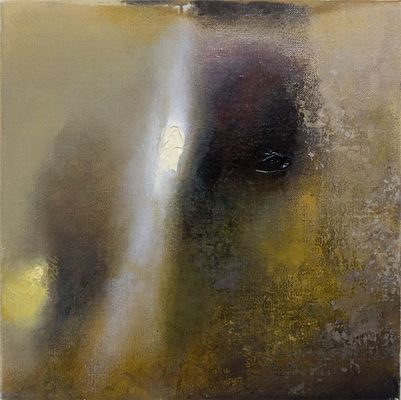
To return to Buckley’s fragment, the first two lines very much evoke how I paint nowadays. As you age, detail diminishes and patches of light become more luminous and float. I feel the most honest way of dealing with this is by smearing the oil paint on the canvas with the fingers and working close-up, blind. Only if the patches coalesce into an approaching image can the work gain a life.
-
Jonathan Walker was born in Melbourne, Australia and brought up on a dairy farm in Gippsland. In the 1970’s he studied painting at RMIT and won the Harold Wright Scholarship to the British Museum, London. During the 1980’s he exhibited at Pinacotheca Gallery, Richmond and had work shown at the NGV and Heidi City Art Gallery. Over the same period he designed the cover for the “Epigenesi” LP by Giancarlo Toniutti, Italy and conducted a mail exchange work with Achim Wollscheid, Germany. The work with artists through the post resulted in an article published in the bicentenary issue of Art and Australia 1988. He showed in artist run spaces such as WestSpace in the 90’s and 2000’s, and until 2012, taught painting at Victoria University, which is where we (Colleen Ahern and Lisa Radford) as organisers of the exhibition, among many others, had the privilege of being his student.
Walker’s knowledge was imparted to students through the careful selection of music, literature, and artists found in books that he himself had ordered for the library. Walker’s strategy was the generosity of sharing his vast knowledge with references specific to each student and their context.
Walker’s paintings share a similar focus and intimacy.
This exhibition presents a small selection of recent paintings alongside a publication that includes Walker’s writing. Observational and analytical, Walker’s work is a type of material notation — the time of day, colour and how it is blended, the both specific and fleeting location of a reflection on lino or the question of whether a chair leg should be included in a painting.
Please join us on Friday August 21 between 6-8pm to celebrate the opening of the exhibition.
Curated by Colleen Ahern and Lisa Radford.
B. Wurtz
Curated by Nic Tammens
March 26 - April 4, 2015
B.Wurtz works from a basement studio in his home on Manhattan’s Lower East Side.
This local fact is attested to by the plastic shopping bags and newsprint circulars that appear in his work. As formal objects, they don’t make loud claims about their origins but nonetheless transmit street addresses and places of business from the bottom of this long thin island. Like plenty of artists, Wurtz is affected by what is local and what is consumed. His work is underpinned by this ethic. It often speaks from a neighborhood or reads like the contents of a hamper:
“BLACK PLUMS $1.29 lb.”
“Food Bazaar”
“USDA Whole Pork Shoulder Picnic 99c lb.”
“RITE AID Pharmacy, with us it’s personal.”
“H. Brickman & Sons.”
“Sweet Yams 59c lb."
Most of the work in this exhibition was made while the artist was in residence at Dieu Donne, a workshop dedicated to paper craft in Midtown. Here Wurtz fabricated assemblages with paper and objects that are relatively lightweight, with the intention that they would be easily transportable to Australia. This consideration isn’t absolute in Wurtz’s work, but was prescriptive for making the current exhibition light and cheap. Packed in two boxes, these works were sent from a USPS post office on the Lower East Side and delivered to North Melbourne by Australia Post.
Wurtz appears courtesy of Metro Pictures, New York.
Thanks to Rob Halverson, Joshua Petherick, Sari de Mallory, Matt Hinkley, Helen Johnson, Fayen d'Evie, Ask Kilmartin, Lisa Radon, Ellena Savage, Yale Union, and "Elizabeth".
John Nixon
"Archive"
December 15 - January 20, 2014
The presentation of John Nixon's archive offered a rare showcase of this extensive collection of the artist's own publications, catalogues, posters, ephemera, editions and more, from the mid 1980s onwards, alongside a selection of his artworks.
Organized by John Nixon, Joshua Petherick and Matt Hinkley.
<a href=http://wfb.public-office.info/artist/john-nixon>All titles by John Nixon
"Habitat"
at Minerva, Sydney (organised by Joshua Petherick and Matt Hinkley)
November 15 - December 20, 2014
Lupo Borgonovo, Janet Burchill & Jennifer McCamley,
Lewis Fidock, HR Giger, Piero Gilardi, Veit Laurent Kurz,
Cinzia Ruggeri, Michael E. Smith, Lucie Stahl, Daniel Weil, Wols
Press Release:
“...It contained seven objects. The slender fluted bone, surely formed for flight, surely from the wing of some large bird. Three archaic circuitboards, faced with mazes of gold. A smooth white sphere of baked clay. An age-blackened fragment of lace. A fingerlength segment of what she assumed was bone from a human wrist, grayish white, inset smoothly with the silicon shaft of a small instrument that must once have ridden flush with the surface of the skin - but the thing’s face was seared and blackened.”
William Gibson, “Count Zero”, 1986
"Autumn Projects Archive"
Curated by Liza Vasiliou
March 6 - March 15, 2014
World Food Books, in conjunction with the Virgin Australia Melbourne Fashion Festival 2014, presented the Autumn Projects archive, consisting of a selection of early examples in Australian fashion with a particular interest in collecting designers and labels from the period beginning in the 1980’s, who significantly influenced the discourse of Australian Fashion.
Curated by Liza Vasiliou, the exhibition provided a unique opportunity to view pieces by designers Anthea Crawford, Barbara Vandenberg, Geoff Liddell and labels CR Australia, Covers, Jag along with early experimental collage pieces by Prue Acton and Sally Browne’s ‘Fragments’ collection, suspended throughout the functioning World Food Books shop in Melbourne.
H.B. Peace
presented by CENTRE FOR STYLE
November 14, 2013
"Hey Blinky, you say chic, I say same"
Anon 2013
H.B. Peace is a clothing collaboration between great friends Blake Barns and Hugh Egan Westland. Their pieces explore the divergences between 'character’ and ‘personality’ in garments....etc
Special Thanks to Joshua Petherick and Matt Hinkley of WFB and Gillian Mears
and a Very Special Thank you to Audrey Thomas Hayes for her shoe collaboration.
Janet Burchill & Jennifer McCamley
"Aesthetic Suicide"
May 10 - June 8, 2013
The first of our occasional exhibitions in the World Food Books office/shop space in Melbourne, "Aesthetic Suicide" presented a body of new and older works together by artists Janet Burchill & Jennifer McCamley, including videos, prints, a wall work, and publications.
During shop open hours videos played every hour, on the hour.
$.00 - Out of stock
The eternal clean out! New items weekly.
https://worldfoodbooks.com/category/sale
Published by World Food Books / Melbourne
$20.00 - In stock -
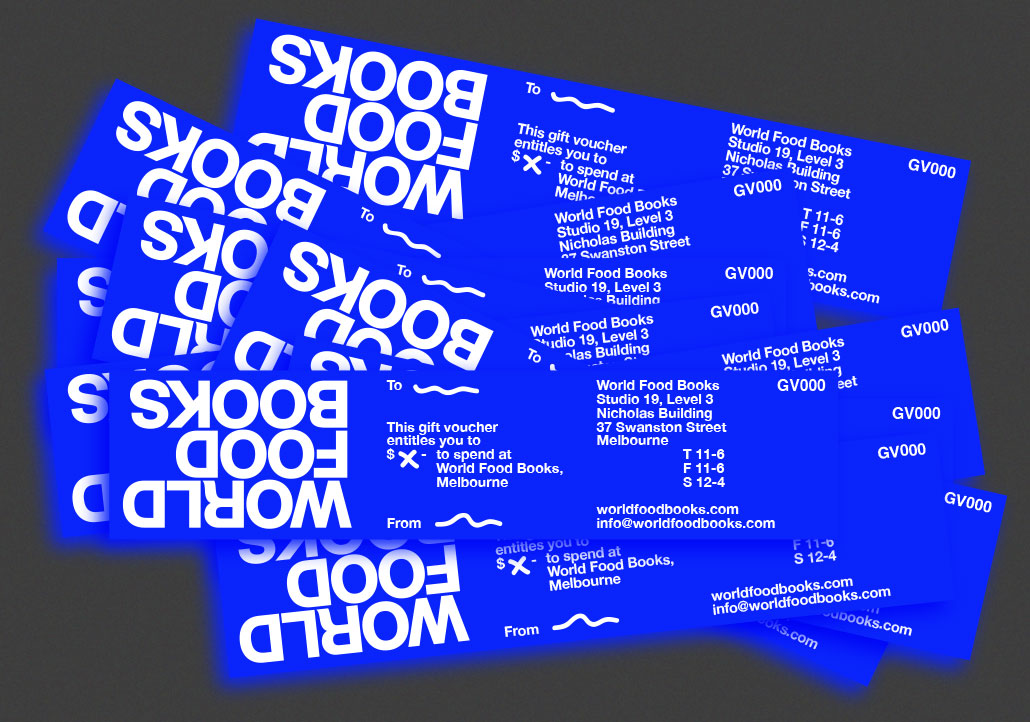
A World Food Books gift voucher is redeemable in our Melbourne bookshop or via our webshop (here). An e-voucher (printable pdf) will be sent to your purchase email address (please notify us if you wish to have the voucher sent to an alternate address and wish us to fill in the receiver's details on the card).
Gift vouchers can be purchased in increments of $20 (Australian Dollars) and the total amount can simply be added to by increasing the quantity in your shopping cart. eg. A quantity of 5 gift vouchers will result in an item total of $100 - a $100 gift voucher. Simply click "ADD TO CART" 5 times, or update your quantity in the shopping cart.
If you wish to purchase multiple, separate gift vouchers in one go, please just email us and we can personally prepare and email you a payment request.
Please note: Please select Pick-Up on gift voucher purchse to avoid any postage charges. Accidental postage charges will be refunded right away!
Thank you.
For any questions, please don't hesitate to email: [email protected]
2000, Japanese
Hardcover (w. dust jacket), 80 pages, 27 x 19.2 cm
1st Edition, Out of print title / used / very good
Published by
Kadokawa Shoten / Tokyo
$70.00 - In stock -
First 2000 hardcover edition of this lavish photo book, Derrière les paupières (Behind the Eyelids), collecting the delicate ball-jointed bisque doll works of renowned Japanese doll artist Koizukihime (b. 1955). Koizukihime's ethereal gothic dolls exude a quiet, timeless beauty, imbued with the softness of enternal youth. Shot intimately by Japanese photographer Sakichi Kataoka, her nymphish girl creations—whether coffined, stigmatic, in slumber, or in erotic undress—are set in macabre, dreamlike scenarios of ritual, eros and death. Koizukihime began creating ball-jointed dolls in 1980 – the entire body is divided into parts, each connected by a sphere at the joints, allowing the joints to move freely. An artistic method radicalised by Hans Bellmer. By 1996, Koizukihime was creating all-bisque ball-jointed dolls, introducing high-end antique doll methods of late 19th century France, making all of the doll's parts out of fired porcelain and joining them with strong elastic bands.
VG copy in VG dust jacket.
2014, English
Softcover, 112 pages, 28 x 21.59 cm
Published by
Creation Books / London
$48.00 - In stock -
The modern era of underground doll-making in Japan began in the late 1960s, with the experiments of Simon Yotsuya and Nori Doi. Directly inspired by the Surrealist Doll constructed by Hans Bellmer in 1932, Simon Yotsuya created a series of ball-jointed, life-sized dolls which featured in his ground-breaking "Eve In The Past And The Future" exhibition in Tokyo, in 1973.
Simon Yotsuya's work inspired a new wave of avant-garde Japanese doll-making, headed by artists such as Ryo Yoshida and Katan Amano, which has continued to flourish to the present day. SECRET DOLL UNDERGROUND, presented by Yuichi Konno, features dolls by fifteen artists, from Simon Yotsuya onwards, with over 80 full-sized colour photographs never before published outside Japan. It also includes Konno's introductory history of the underground doll in Japan.
Yuichi Konno is the editor of Yaso, an independent arts and culture publication founded in 1979.
1994, Japanese / English
Hardcover (w. corflute envelope slipcase), 196 pages, 32.5 x 23.5 cm
1st Edition, Out of print title / used / very good
Published by
Sequoia / Tokyo
$200.00 - In stock -
"I dedicate this book to all lives"
Very rare, first volume of the highly collectible cult classic two-volume death photo book series, SCENE, published in 1994 in Japan only. A lavish hardcover production filled with high-quality monochrome reproductions of anonymous, uncredited corpse photography, seemingly sociopolitical photo-journalism of human massacre stripped of text/language as a confronting stream of vivid and graphic images in conceptual photo book form. SCENE presents an unwavering, unapologetic exploration of a world usually hidden from view — the dead and death. Not for the faint of heart. Compiled by Kunio Shimizu and Yoichi Shibata for publisher Hirofumi Nagashima, SCENE is housed in an elaborate black button-and-tie-bound corflute envelope. Select plates have been featured in the pages of Kotaro Kobayshi’s underground publications TOO NEGATIVE and ULTRA NEGATIVE from the same period.
Fine copy with only standard storage wear from button-bind pressure to envelopes/wear to button metal.
2024, English
Hardcover (w. dust jacket), 316 pages, 21 x 15 cm
Published by
Infinity Land Press / London
$80.00 - In stock -
Necrophilia has shadowed humanity throughout its existence, from ancient Egypt, to the Moche culture of Peru, the exploits of the renowned Vampire of Montparnasse, the sexual murders of the Weimar Republic, through to serial killers such as Ted Bundy and Jeffrey Dahmer. This new edition of Grave Desire – with artworks by Karolina Urbaniak – delves unflinchingly into the myths, art and practices surrounding this taboo subject. Finding Juliet’s catatonic body and believing she had poisoned herself, it could have crossed Romeo’s mind to act out the unthinkable. Maybe Juliet, seeing Romeo’s corpse, considered a little sexual frottage before she stabbed herself with the phallic dagger. Repulsive yet real, disgusting and disturbing, this is an erotic book of the dead.
“If sex and death are two pivotal obsessions of the human species, Steve Finbow nails both of them simultaneously in his brilliantly incisive cultural and corporeal history of necrophilia. Pathologically and outlandishly good.”—Stephen Barber
“If you only read one book before you die make sure it’s Grave Desire.”—Stewart Home
Illustrated by Karolina Urbaniak
Interview conducted by Martin Bladh
Afterword by Richard Marshall
2026, English
Hardcover, 256 pages, 26 x 18 cm
Published by
Princeton University Press / New York
$69.00 - In stock -
From the author of Gothic, a marvelously illustrated cultural history of graves and graveyards, from the earliest known burial sites to today’s green burials.
Why, how, and where do we inter our dead? How have people throughout history responded to the problem of laying their dead to rest? Roger Luckhurst sets out in search of answers in this arresting book. Taking readers on an unforgettable tour of the rich and unusual visual culture of the grave, he visits locales such as the pyramids of Giza, the catacombs and columbaria of Rome, and the cenotaphs erected to the world’s war dead. Along the way, he examines the diverse role of graveyards in literature, art, film, and television.
In engaging chapters that look at all aspects of the treatment of the dead, Luckhurst covers topics ranging from early burials and the emergence of necropolises and catacombs to grave robbing, garden cemeteries, the perilous overcrowding of the urban dead, and the emergence of modern funerary culture. Exploring the cultural afterlives of burial and memorial sites in the popular imagination, he shows how graves have served as guides to the underworld, poignant dedications to those we have lost, as reminders of our own mortality, and settings in gothic horror.
Blending lively storytelling with a wealth of stunning illustrations, Graveyards is a lyrical, frequently unexpected account of the grave as a signpost to the afterlife, a site of remembrance and self-reflection, and an object of enduring fascination.
1984, Japanese / English
Slipcase, corrugated envelope, 64 looseleaf plates, 29.7 x 21 cm
Stamped and numbered,
1st Edition, Out of print title / used / very good
Published by
B-Sellers / Japan
$350.00 - In stock -
Very rare first stunning printing of Scene of Death, a rare 1984 death photo collection, published by B-Sellers in Japan only, compiled by Noriaki Nakagawa, Hitomi Komukai, and Yoichi Shihata. An elaborate and beautiful print production of the macabre. Housed in an illustrated slipcase within a stamped, button-and-tie-bound corrugated envelope, 64 looseleaf monochrome photographic plates reproduce images from "Atlas der Gerichtsmedizin", an absolutely fascinating collection by Weiman / Prokop, first published in 1963. Atlas der Gerichtsmedizin was originally a serious German scientific reference book for criminal investigators and those in the medical field — a photo scrapbook of thousands of images of graphic human death scenes — suffocation and strangulation, drowning and death by water, death by burning and electrocution, crimes of passion, abuse and neglect, and more. In turn, this visual opus became a bible of reference imagery to a wave of musicians, artists and authors during the industrial avant-garde, from Throbbing Gristle to Paul Buck to Atrax Morgue. This meticulous and unique Japanese offering further influenced many Japanese artists in the 1980s—1990's. Later re-printed in 1994.
Stamped and numbed first printing.
"We believe the scenes of death is, in one sense, the most erotic of human nature. It is at the time of death that man no longer can attempt to control his inner self and therefore the real self appears vividly. Here we have opened the doors to a topic that is usually not only hidden but also shut out of the minds of man. Please share our excitement and take a glance into the world of hidden eroticism"—Scene of Death blurb.
VG—NF copy in VG—NF slipcase, all plates still wrapped in seldom preserved internal obi strip. Some wear/rusting to envelope buttons.
2025, English
Softcover, 130 pages, 20.3 x 17.8 cm
Published by
The New York Review of Books / New York
$34.00 - In stock -
Ancient Mesopotamia, the Zodiac, and the land of the dead feature in this wildly surrealistic adventure story—Leonora Carrington's revolutionary second novel, long out of print.
The Stone Door is an omen, an incantation, and an adventure story rolled into one. Built in layers like a puzzle box, it is the tale of two people, of love and the Zodiac and the Kabbalah, of Transylvania and Mesopotamia converging at the Caucasus, of a mad Hungarian King named Böles Kilary and of a woman's discovery of an initiatory code that leads to a Cyclopean obstacle, to love, self and awareness, to the great stone door of Kescke and beyond.
Written at the end of World War II but not published until 1977 and long unavailable, The Stone Door is at once a celebration of the union of the surrealist painter Leonora Carrington and her husband, the Hungarian-born photographer Chiki Weisz, and an argument for the unification of the male and the female as a means of liberating the human race.
2024, English
Softcover, 320 pages, 20.2 x 12.7 cm
Published by
The New York Review of Books / New York
$39.00 - In stock -
Red Pyramid is a sort of "greatest hits" collection of short stories from across Vladimir Sorokin's career, beginning with juvenilia like "The Pink Tuber," composed with no expectation of either publication or readership; moving on to scatological conceptual texts like "An Obelisk"; then plunging into the more even-tempered, but still quite uncanny, delights of his post-Soviet work.
Stories like "A Month in Dachau" earn Sorokin his moniker as the "Russian De Sade," while others, like "Timka," are shockingly tender-despite their graphic depictions of mass shootings and anal sex.
This collection also contains the infamous "Nastya," a story about a family cannibalizing its daughter on the eve of the twentieth century, for which Sorokin was nearly put on trial; "Horse Soup," which was the first translation from the Russian to win an O'Henry Prize; as well as stories published in Anglophone magazines such as The New Yorker, n+1, Harper's, and The Baffler to great acclaim.
Translated by Max Lawton with equal attention to chewiness and pop flair, Red Pyramid is introduced brilliantly, brutally, and as always, unexpectedly by Will Self. Red Pyramid is perhaps the best place to begin a dive into Sorokin's arch detonation of Russian violence.
Extended comic turns like The Queue and relentless, mind-bending, genre-shredding extravaganzas like Ice Trilogy have established Vladimir Sorokin as a master of the contemporary novel. It is to Sorokin's short fiction, however, that readers must turn to encounter the wildest and most unsettling of his inventions and provocations. Sorokin is a virtuoso of parody and pastiche, as well as a poet of the black sites where the human soul stands exposed to its own incontinent desires, and Red Pyramid spans the whole of his career, from his emergence in the Soviet Union as a member of Moscow's artistic underground to his late preeminence as an observer and interpreter of the Putin era, with its squalid parade of gruesome folly and unhinged violence. Included here are queasy tour-de-forces, like the early "Obelisk," a story as scatological as it is conceptual; the notorious "A Month in Dachau," which earned Sorokin his sobriquet as the Russian Sade; and profoundly unsettling texts like "Tiny Tim," where tenderness is inseparable from horror.
Sorokin's stories have appeared in The New Yorker, n+1, Harper's Magazine, and The Baffler. This is the first time they have been collected in English.
2024, English
Softcover, 208 pages, 20.32 x 13.18 cm
Published by
The New York Review of Books / New York
$36.00 - In stock -
In this delightful, cinema-inspired daydream of a novel, an identity-shifting protagonist uses the everyday inspirations of his life to catapult himself into the realm of imagination, blurring the boundaries between reality and fantasy.
The Skin of Dreams is a novel of waking dreams. Even as he lives his life, Jacques L'Aum ne, its hero, daydreams a hundred other possible lives. A few lines on a page, a chance encounter, a remark overheard in passing, any of these are enough to kick things into gear and send him off outside of himself to become a boxer, a general, a bishop, or a lord. He lives alongside his life with diligence and steadfastness; and the passage from real to dream is so natural for him that he no longer knows precisely which him he is. Eventually he becomes an actor in Hollywood, and the basis of countless dreams for others. This Jacques L'Aum ne, like the characters who surround him, has the same sort of haunting and fluid consistency as someone that we might dream of in our beds at night. And reverie, here, is born through the tale's humor, which is as gentle as it is cruel, as well as by way of a writing technique that is itself drawn from one of Queneau's great loves, the cinema.
Raymond Queneau (1903—1976) was a French novelist, poet, critic, editor and co-founder and president of Oulipo, notable for his wit and cynical humour. Born in the French town of Le Havre and educated at the Sorbonne, he then performed his military service in Morocco. An early association with the Surrealists ended in 1929, and after completing a scholarly study of literary madmen of the nineteenth century for which he was unable to find a publisher, Queneau turned to fiction, writing his first novel, Le Chiendent (Witch Grass), in Greece in the summer of 1932. Influenced by James Joyce and Lewis Carroll, Queneau sought to reinvigorate French literature, grown feeble through formalism, with a strong dose of language as really spoken. He further encouraged innovation by founding, with the mathematician François Le Lionnais, the famous group OULIPO (Ouvroir de Littérature Potentielle), which investigated literary composition based on the application of strict formal or mathematical procedures (members of the group included Italo Calvino, Georges Perec, and Harry Mathews). Queneau’s many books, which typically blur the boundaries between fiction, poetry, and the essay, include Pierrot mon ami, The Sunday of Life, Zazie in the Metro (made into a movie by Louis Malle), and Exercises in Style; under the name of Sally Mara, he published We Always Treat Women Too Well, a brilliant comic spoof on the excesses of smutty popular novels. Queneau was the editor of the Encyclopédie de la Pléiade as well as a fine poet, whose lyric “Si tu t’imagines” was a hit for the celebrated postwar chanteuse Juliette Gréco.
2020, Japanese / English
Softcover (w. dust jacket and obi-strip), 366 pages, 15 x 21 cm
Published by
Treville / Tokyo
$90.00 - In stock -
Wonderful new memorial monograph dedicated to the exceptional work of Namio Harukawa (1947 – 2020), a pseudonymous Japanese fetish artist best known for his masterful pencil works depicting female domination ("femdom"), with erotic asphyxiation through facesitting appearing as a frequent subject of his art. Born 1947 in Osaka, Japan, Harukawa’s distinctive penname combines the name of film actress Harukawa Masumi with an anagram of Naomi, the sadistic heroine in Tanizaki Jun’ichiro’s novel "Chijin no ai / A Fool’s Love". While in high school, Harukawa began contributing work to the readers’ column of leading postwar Japanese SM pulp magazine "Kitan Club". Since then, Harukawa’s drawings of male masochism have lovingly portrayed noble, voluptuously beautiful women and the men who serve them as human furniture. Namio Harukawa passed away on April 2020, he was 72 years old. This book is a requiem dedicated to the memory of an extraordinary artist who remained committed to the regime of “absolute Ganmen Kijo Shugi (facesitting principle)” throughout his artistic life.
The profusely illustrated "Facesittings Are Forever" consists of a fine selection over 300 of Namio Harukawa’s works spanning his entire career, including many unpublished works, rough sketches, late works, and coloured works of his mid-career. It features an illustrated archive of his publications, including a rare Gekiga (hard-boiled style) work “Shokeijima no Oujo” and never before seen photographs of his workshop. There are also written contributions in Japanese from Shigeru Kashima, Jun Miura, Rockin Jelly Bean, and Hitomi Onuma.
2006, English / French
Softcover (french folds), 208 pages, 24 x 20 cm
1st Edition, Out of print title / used / very good
Published by
Halle Saint-Pierre / Paris
$180.00 - Out of stock
First edition of this wonderful Unica Zürn monograph, published by Publisher Éditions du Panama to accompany a major survey exhibition in Paris in 2006—2007 at the Halle Saint Pierre, curated by Martine Lusardy and Sepp Hiekisch-Picard. Lavishly illustrated, this important catalogue, now long out-of-print, includes a large number of illuminating texts by scholars in bi-lingual English/French, including: "Unica Zürn: designs so dense" by Roger Cardinal; “Du wirst dein Geheimnis sagen (“You will tell your secret”). The anagram in the work of Unica Zürn" by Victoria Appelbe; "The magical encounter between writing and image" by Barbara Safarova; "The work of Unica Zürn, genesis and reception" by Sepp Hiekisch-Picard; "Read Unica Zürn: the contagion of the void" by Jean-Louis Lanoux; "Unica Zürn (July 6, 1916 – October 19, 1970): biographical references" by Rike Felka and Erich Brinkmann. An important, heavily illustrated reference of Zürn's life and work.
The German artist and writer Unica Zürn (1916-1970) joined the ranks of Surrealism in the 1950s, after moving to Paris and taking up residence with fellow German-born Surrealist Hans Bellmer. Already an accomplished author, Zürn was drawn to the Surrealist movement's espousal of automatic drawing and writing, Zürn pursued Henri Michaux's declaration that "the hand dreams," making a vocation of these techniques with her dense, otherworldly drawings and paintings that are labyrinthine in detail, as one form sprouts out of another. Also with her experimental anagrams, natural extensions of her established interest in hidden meanings and coincidences. Zürn produced most of her oeuvre during this intensive period in the 1950s and 60s, though one marked by her deteriorating mental health. Many of her works were made during periods of hospitalisation. In 1970, Zürn leapt to her death from the balcony of the Paris apartment she had shared with Bellmer. Upon his death in 1975, Bellmer was buried, at his request, next to Zürn in Paris’s Père-Lachaise Cemetery. Their grave is marked with the words Bellmer wrote for Zürn’s funeral wreath nearly five years before: “My love will follow you into Eternity.”
Zürn has left us an account of the sensation of automatic drawing: "After an initial moment when the pen 'swims' hesitantly on the paper, she discovers the place assigned to the first eye. It is only when she is being watched from the depths of the paper that she begins to get her bearings and, effortlessly, one motif is added to another."
Very Good copy with light wear.
1980, French
Hardcover (w. dust jacket), 179 pages, 30.5 x 30.5 cm
1st Edition, Out of print title / used / fine
Published by
Clairefontaine / Lausanne
$150.00 - Out of stock
The most extensive monograph on the work of Argentine artist Leonor Fini (1918-1996), published in 1980 by Clairefontaine, Lausanne. With text by Constantin Jelenski, this over-sized hardcover volume is profusely illustrated throughout with Fini's incredible paintings, along with portraits, a list of exhibitions and bibliography.
Leonor Fini (1907–1996), an Argentine painter, designer, illustrator, and author, known for her depictions of powerful women, is considered one of the most important women artists of the twentieth century and also one of the most misunderstood.
Fini had no formal artistic training. Born in Buenos Aires, she travelled extensively from a young age, living in Milan and then moving to Paris in 1931-32 where she was considered part of a pre-war generation of Parisian artists, becoming acquainted with Carlo Carrà and Giorgio de Chirico, who inspired much of her work, and also Paul Éluard, Max Ernst, Georges Bataille, Henri Cartier-Bresson, Picasso, Salvador Dalí, and André Pieyre de Mandiargues. She had her first one person show in Paris when she was twenty-five at a gallery directed by Christian Dior. Her work caught on fast and was included in the pivotal and groundbreaking Fantastic Art, Dada and Surrealism exhibition at the MOMA in 1936 while at the same time she had her first New York exhibition at the avant-garde Julien Levy Galley. Surrealist artists in France came to know her as important in the movement. She is mentioned in most comprehensive works about surrealism, although she did not consider herself a surrealist, nor a part of any particular artistic movement. Fini preferred to stake her own claim on modernism with a vision that owes more to the farthest shores of her imagination than to any affiliation with art trends, schools or movements. The originality of her art as well as her intelligence, famous wit and charisma accorded her celebrity status in the Paris art world and beyond beginning in the late thirties. Her panache and glamour, once they found a place in the collective imagination of the time, turned her into a much-publicized fashion and feminist icon. Always controversial, with as many detractors as admirers, she lived and painted consummately on her own terms.
In Paris in 1939 she curated the inaugural exhibition of her friend Leo Castelli’s first gallery (of surrealist furniture) and shortly thereafter, just before the German occupation, she traveled with André and a new lover to Arcachon in the southwest of France to begin waiting out the war. She remained there for almost a year with Salvador and Gala Dali before moving to Monte Carlo where she met the young Italian diplomat, Stanislao Lepri who became one of the great and enduring loves of her life. As the war intensified she moved with Stanislao to Rome where she lived, worked and formed close friendships with Anna Magnani, Luchino Visconti and other leading figures of world of art and letters. After the Liberation of Paris in 1946 she returned there to live and work for the remainder of her life, exhibiting extensively around the world.
The predominant themes in Leonor Fini’s art are sexual tensions, mysteries and games. One of her favored subjects is the interplay between the dominant female and the passive male, and in many of her most powerful works the female takes the form of the sphinx to which she felt a strong identification. She was also a renowned portraitist, and among her subjects were such friends as writers André Pieyre de Mandiargues, Jean Genet, Klaus Mann (son of Thomas), such actresses as Anna Magnani and Suzanne Flon, ballerina Margot Fonteyn, film director Luchino Visconti and artists Meret Oppenheim and Leonora Carrington.
Her genius for stage and screen design is evident in her numerous ground breaking theater decors with their elaborate conception, costumes and phantasmagorical masks. She designed for the Paris Opera, George Balanchine’s ballet Palais de Crystal, and choreographer Roland Petit’s company Ballets de Paris, for Maria Callas at the La Scala theater in Milan, as well as over seventy productions at theaters in Paris between 1946 and 1969. She had a unique talent for film design and created costumes for Fellini's 8 ½ as well as for Renato Castellani's Romeo and Juliet and John Huston’s A Walk with Love and Death.
In the 1970s, she wrote three novels, Rogomelec, Moumour, Contes pour enfants velu and Oneiropompe. Her friends included Jean Cocteau, Giorgio de Chirico, and Alberto Moravia, Fabrizio Clerici and most of the other artists and writers inhabiting or visiting Paris. She illustrated many works by the great authors and poets, including Edgar Allan Poe, Charles Baudelaire and Shakespeare, as well as texts by new writers. She was very generous with her illustrations and donated many drawings to writers to help them get published. She is, perhaps, best known for her graphic illustrations for Histoire d'O.
The provocative and much-publicized life of Leonor Fini was pure theater. Her story is that of a hard-won struggle to forge her life as a woman artist in a man’s world and to invent herself on her own terms. It is the story of a woman possessing exceptional independence, a highly original vision and great personal magnetism who lived passionately through her art and friendships and in the process became a feminist role model.
Fine copy in Near Fine dust jacket.
1997, English
Softcover, 264 pages, 23.6 x 16 cm
1st Edition, Out of print title / used / very good
Published by
Verso / London
$20.00 - In stock -
The first publication of seminal early writing by Louis Althusser.
Throughout the 1960s and 1970s, Louis Althusser enjoyed virtually unrivalled status as the foremost living Marxist philosopher. Today, he is remembered as the scourge and severest critic of “humanist” or Hegelian Marxism, as the proponent of rigorously scientific socialism, and as the theorist who posited a sharp rupture—an epistemological break—between the early and the late Marx.
This collection of texts from the period 1945-1953 turns these interpretations of Althusser on their head: we discover that there was a “young Althusser” as well as the “mature Althusser” we are already familiar with. In his fascinating Master’s thesis, “On Content in the Thought of G.W.F. Hegel” (1947), Althusser developed a position which he was later to attack ferociously: namely, that the revolutionary potential of the Hegelian dialectic could be defended against Hegel’s own political conservatism. We see Althusser still wrestling with the spectres of Hegel and of Catholicism in another long text, his letter to Jean Lacroix, and, finally, we see his own “epistemological break” in the piece “On Marxism” from 1953. Other texts included are his critique of Alexander KojÅve (whose interpretation Francis Fukoyama has recently revived) and his attack on the French Church’s teachings on women, sex and the family. Widely recognized as an intellectual giant of the late twentieth century, Althusser has left a towering legacy. This collection not only gives a unique insight into the formation of such a personality, but will also restore the “unknown Althusser” to the centre of the history of Marxism and of philosophy since the Second World War.
VG copy, light wear/age, old price sticker to b.c.
1980, English
Hardcover (clothbound), 380 pages, 24 x 16 cm
1st Edition, Out of print title / used / very good
Published by
Northwestern University Press / Evanston
$30.00 - In stock -
1980 hardcover edition.
This collection contains original translations of essays, discussions, and papers including six previously unpublished works from the International Colloquium on Heidegger’s Conception of Language, held at The Pennsylvania State University in 1969. This volume endeavors to place Martin Heidegger’s ideas within a wide range of philosophical thought. It contains critical reflections on his conception of speech in Being and Time, linguistic meditations on Heidegger’s use of language, and analysis of his view on the relationship between thought and the language in which it is expressed. In this book, Heidegger scholars will find additional insights into his conception of language and his philosophy as a whole.
VG w/o dust jacket, small chip to bottom cover corner (back).
1993 / 1994, English
Hardcover (w. dust jacket), 584 pages, 25 x 17 cm
1st Edition, Out of print title / used / very good
Published by
Harvard University Press / Cambridge
The Belknap Press / Cambridge
$45.00 - In stock -
Scarce first 1993 hardcover edition. Second 1994 printing.
The young psychiatrist from Budapest had studied medicine in Vienna, he had read The Interpretation of Dreams, and now he was about to meet its author. Seventeen years Sigmund Freud's junior, Sándor Ferenczi (1873-1933) sent off a note anticipating the pleasure of the older man's acquaintance--thus beginning a correspondence that would flourish over the next twenty-five years, and that today provides a living record of some of the most important insights and developments of psychoanalysis, worked out through the course of a deep and profoundly complicated friendship.
This volume opens in January of 1908 and closes on the eve of World War I. Letter by letter, a "fellowship of life, thoughts, and interests" as Freud came to describe it, unfolds here as a passionate exchange of ideas and theories. Ferenczi's contribution to psychoanalysis was, Freud said, "pure gold," and many of the younger man's notions and concepts, proposed in these letters, later made their way into Freud's works on homosexuality, paranoia, trauma, transference, and other topics. To the two men's mutual scientific interests others were soon added, and their correspondence expanded in richness and complexity as Ferenczi attempted to work out his personal and professional conflicts under the direction of his devoted and sometimes critical elder colleague.
Here is Ferenczi's love for Elma, his analysand and the daughter of his mistress, his anguish over his matrimonial intentions, his soliciting of Freud's help in sorting out this emotional tangle--a situation that would eventually lead to Ferenczi's own analysis with Freud. Here is Freud's unraveling relationship with Jung, documented through a heated discussion of the events leading up to the final break. Amid these weighty matters of heart and mind, among the psychoanalytic theorizing and playful speculation, we also find the lighter stuff of life, the talk of travel plans and antiquities, gossip about friends and family. Unparalleled in their wealth of personal and scientific detail, these letters give us an intimate picture of psychoanalytic theory being made in the midst of an extraordinary friendship.
NF copy in VG dust jacket with some fading to spine edge.
1979, French
Hardcover (clothbound, gilt), 112 pages, 21.8 x 14 cm
1st Edition, Out of print title / used / very good
Published by
Obliques / Paris
$170.00 - In stock -
First edition of this beautiful clothbound album of arresting erotic photography by Pierre Molinier (1900—1976), a French painter, photographer and a forerunner of gender performance art and Body Art (Art corporel), published in 1979 by Obliques Images, Paris. Briefly associated with Breton's surrealist group, Molinier spent much of his artistic life working in isolation in Bordeaux, exiled from local and national art scenes. With an introductory essay by French man of letters, playwright, poet, writer, director, journalist, literary critic and photographer, Pierre Bourgeade entitled "La clé est chez le concierge" the rest of the book is made up of some of the most exquisite examples of Molinier's challenging monochrome erotic photography. Cent photographies erotique is the fourth of the collection "Images Obliques" produced by Roger Borderie and Michel Camus.
Pierre Molinier is an unknown of worldwide renown. Every book and every exhibition on the body, gender confusion or sexual excess seems to feature at least one work by this artist whose “genius” was acclaimed by André Breton in a memorable text published in 1956. But the bulk of his work has remained inaccessible. A number of pictures have never been shown and a corpus of only 160 prints has been published. The ensemble revealed by the artist's archives is much more extensive. It includes numerous proofs made to prepare his photomontages and working prints given to friends, but also notebooks and personal letters. Here, precise links emerge between his paintings, photographs and scandalous life. The myth carefully constructed by the artist begins to crumble before the reality of the work.
An inveterate seducer, thoroughgoing fetishist, unrepentant transvestite and inadvertent bisexual, to the very last Molinier remained haunted by two obsessions: pleasure, meaning immediate access to la petite mort, and “leaving a trace in the infinity of time.” This book charts the aesthetic incarnation of his passions. Its 819 photographs, most of them never published before, reveal the method, shed light on the procedures and give details of the origin and alchemy of his latent or composed images. Finally, an exhaustive chronology offers a new biography of Molinier, based on his letters: for it is in the intimacy of these writings that the shaman's heart beats closest to the truth.
In a career shared between the university (fifteen years) and publishing (twenty) Jean-Luc Mercié has written widely on painting and photography. This monograph is his fourth book about Pierre Molinier, the master from Bordeaux.
Born 1900 in Agen (France), Pierre Molinier, surrealistic painter and photographer, a precursor to body art, died in 1976 after having thought out radical and pornographic artwork.
VG copy with light foxing to block edges, initial blanks.
2010, English
Hardcover, 400 pages, 24 x 31 cm
Published by
Les Presses Du Reel / Paris
Mennour / Paris
$150.00 - In stock -
The Molinier bible! A mammoth, crucial 400 page book on the method and genesis of Pierre Molinier's provocative, gender-bending photos and artwork. Beautifully printed and prodigiously illustrated with over 800 pictures, mostly unpublished, numerous documents, manuscripts and letters, a complete (nearly 100-page) chronology, a critical biography, and a text by Jean-Luc Mercié.Molinier. Essential publication on Molinier, the most comprehensive to date, and a must for any fan.
Rare English edition translated from the French by Edward Penwarden.
Pierre Molinier is an unknown of worldwide renown. Every book and every exhibition on the body, gender confusion or sexual excess seems to feature at least one work by this artist whose “genius” was acclaimed by André Breton in a memorable text published in 1956. But the bulk of his work has remained inaccessible. A number of pictures have never been shown and a corpus of only 160 prints has been published. The ensemble revealed by the artist's archives is much more extensive. It includes numerous proofs made to prepare his photomontages and working prints given to friends, but also notebooks and personal letters. Here, precise links emerge between his paintings, photographs and scandalous life. The myth carefully constructed by the artist begins to crumble before the reality of the work.
An inveterate seducer, thoroughgoing fetishist, unrepentant transvestite and inadvertent bisexual, to the very last Molinier remained haunted by two obsessions: pleasure, meaning immediate access to la petite mort, and “leaving a trace in the infinity of time.” This book charts the aesthetic incarnation of his passions. Its 819 photographs, most of them never published before, reveal the method, shed light on the procedures and give details of the origin and alchemy of his latent or composed images. Finally, an exhaustive chronology offers a new biography of Molinier, based on his letters: for it is in the intimacy of these writings that the shaman's heart beats closest to the truth.
In a career shared between the university (fifteen years) and publishing (twenty) Jean-Luc Mercié has written widely on painting and photography. This monograph is his fourth book about Pierre Molinier, the master from Bordeaux.
Born 1900 in Agen (France), Pierre Molinier, surrealistic painter and photographer, a precursor to body art, died in 1976 after having thought out radical and pornographic artwork.
1975, English / German
Softcover, 96 pages, 28.1 x 26.9 cm
1st Edition, Out of print title / used / very good
Published by
Kunstraum München / Münich
$85.00 - In stock -
Catalogue for Italian artist Giorgio Griffa's 1975 exhibition at the Kunstraum München. Featuring works on cardboard, reproduced here at actual size, illustrated throughout in (mostly) two-colour printing. Accompanying text by Herrmann Kern in German and English.
“Giorgio Griffa is one of the least-known Turin-born artists of the Arte Povera generation. Another precious ‘secret’ that the city of Turin, discreet and haughty as ever, has managed to keep under wraps—in this case for almost half a century. From the immediate post-war period, a singular group of young artists in the city helped write the history of European art in the second half of the twentieth-century. Together with now universally acclaimed figures, such as Alighiero Boetti, Giuseppe Penone, Giulio Paolini, Giovanni Anselmo, Michelangelo Pistoletto, Gilberto Zorio, and Mario and Marisa Merz, there were also other leading artists in Turin, who have only recently begun to receive the international attention they deserve. Here I am thinking of the likes of Piero Gilardi, Gianni Piacentino, Carol Rama, Salvo, and Aldo Mondino, but also of the eccentric and eclectic Carlo Mollino. Griffa was one of the most discreet and isolated in this group of young people who revolved around Sperone’s gallery. He immediately showed an exclusive interest in painting, while his companions mainly moved out towards sculpture and installation from the mid-sixties.”—Andrea Bellini
Very Good copy, light wear only.
2015, English
Hardcover (cloth-bound), 248 pages, 18 x 25 cm
1st Edition, Out of print title / used / fine
Published by
Mousse Publishing / Milan
$400.00 - Out of stock
The great hardcover monographic book on the work of Giorgio Griffa, edited by Andrea Bellini, that very quickly disappeared from print and became understandibly collectible. This most comprehensive English-language book on the artist, published on the occasion of the cycle of exhibitions dedicated to the work of Giorgio Griffa (Turin, 1936) (Centre d’Art Contemporain, Geneva; Museu de Arte Contemporanea de Serralves, Porto; Bergen Kunsthall; and Fondazione Giuliani, Rome) aims—through a series of essays by Andrea Bellini, Luca Cerizza, Laura Cherubini, Martin Clark, Suzanne Cotter, and Chris Dercon, a conversation between Griffa and Hans Ulrich Obrist, and a selection of artist’s writings and a chronology compiled by Marianna Vecellio—to highlight the very diverse features and extraordinary richness of Griffa’s paintings. Profusely illustrated throughout.
“Giorgio Griffa is one of the least-known Turin-born artists of the Arte Povera generation. Another precious ‘secret’ that the city of Turin, discreet and haughty as ever, has managed to keep under wraps—in this case for almost half a century. From the immediate post-war period, a singular group of young artists in the city helped write the history of European art in the second half of the twentieth-century. Together with now universally acclaimed figures, such as Alighiero Boetti, Giuseppe Penone, Giulio Paolini, Giovanni Anselmo, Michelangelo Pistoletto, Gilberto Zorio, and Mario and Marisa Merz, there were also other leading artists in Turin, who have only recently begun to receive the international attention they deserve. Here I am thinking of the likes of Piero Gilardi, Gianni Piacentino, Carol Rama, Salvo, and Aldo Mondino, but also of the eccentric and eclectic Carlo Mollino. Griffa was one of the most discreet and isolated in this group of young people who revolved around Sperone’s gallery. He immediately showed an exclusive interest in painting, while his companions mainly moved out towards sculpture and installation from the mid-sixties.”—Andrea Bellini
Fine copy, almost As New.
2008, English
Hardcover (w. obi-strip), 220 pages, 23 x 16 cm
1st Edition, Out of print title / used / very good
Published by
Walther König / Köln
$180.00 - In stock -
First edition of this beautiful hardcover monograph on the work of Miroslav Tichý, published in 2008 by Walther König and quickly out of print. Profusely illustrated throughout with Tichý's works alongside informative background about the artist and his work by contributors Harald Szeemann, Carolyn Christov-Bakargiev, Clint Burnham, Roman Buxbaum.
After studying at the Academy of Arts in Prague, Miroslav Tichý, born in 1926 in the former Czechoslovakia, withdrew to a life of isolation in his hometown of Kyjov. In the late 1950s, he stopped painting and, during his daily walks, began to take photographs of women with cameras he made by hand. He mounted his prints on handmade frames and added finishing touches in pencil, shifting from photography to drawing. Disregarding the rules of photography, for four decades Tichý created a large oeuvre of poetic, dreamlike views of female beauty.
A former neighbor, Roman Buxbaum, discovered Tichý's hidden work in the 1980s and has been documenting and collecting it ever since. In 2004, the esteemed international curator Harald Szeemann mounted the first solo exhibition of the nearly 80-year-old artist. That same year, Tichý was given the Rencontres d'Arles Photographie Discovery Award and the Kunsthaus Zurich organized a large retrospective. Solo exhibitions at the Centre Pompidou in Paris and the Museum of Modern Art (MMK) Frankfurt followed in 2008. Tichý does not see his exhibitions, for he no longer leaves his house. This beautifully produced, thorough volume collects the work — perfectly.
Very Good copy with light wear. Interior Fine. With original illustrated publisher's obi-strip.
2023, Czech / English / German
Softcover, 256 pages, 24 x 33 cm
Published by
Edizioni Periferia / Lucerne
$175.00 - In stock -
Despite his art education, Czech painter and photographer Miroslav Tichý (1926–2011) was considered an outsider due to his unconventional approach to photography that revealed a voyeuristic fascination for the female body. His analogue photography shows traces and errors he deliberately sought out by building his own cameras and telephoto lenses. In the 1970s and ’80s, Tichý regularly took pictures of his television screen. Because he lived close to the Austrian border, he was able to circumvent the censorship of Eastern Bloc media and watch the more permissive films and late night shows from the West. Many of his seemingly surreptitious screenshots appear in this book.
2011, English / French
Hardcover (w. dust jacket), 248 pages, 24 x 30 cm
Published by
Kant / Prague
$160.00 - In stock -
Like the Prague exhibition that provided the opportunity to publish it, this stunning, over-sized hardcover book is the 'explosive' result of the meeting between two personalities with a heretical reputation: the great photographer Miroslav Tichý and the former situationist Gianfranco Sanguinetti. Both are better known internationally than they are in the Czech Republic. Their paths were destined to cross - simply for the originality and radical nature of their approach to life. Tichý's work inspired Sanguinetti to make critical and riveting insights into the art of our age. While his comments may fuel polemical debate, they cannot leave the reader indifferent. The photographs by Tichý that are being presented for the first time in this book and at the City Gallery Prague represent a strict selection that prioritises the eloquence of symbols that pervade Tichý's work and which are, according to Sanguinetti, the key to his art.
Lavishly illustrated in colour throughout with all texts in English and French.
Miroslav Tichy (1926-2011)
After studying at the Academy of Arts in Prague (1945-48), Miroslav Tichy withdrew to a life in isolation in his hometown of Kyjov, Moravia, Czech Republic. In the late 1950s he quit painting and became a distinctive Diogenes-like figure. From the end of the 1960s he began to take photographs mainly of local women, in part with cameras he made by hand. He later mounted them on hand-made frames, added finishing touches with pencil, and thus moved them from photography in the direction of drawing. The result are works of strikingly unusual formal qualities, which disregard the rules of conventional photography. They constitute a large oeuvre of poetic, dreamlike views of feminine beauty in a small town under the Czechoslovak Communist regime.