World Food Books' programme is largely produced on Kulin Nation land. We acknowledge the Wurundjeri people of the Kulin Nation as the first and continuing custodians of this land, and pay respect to their Elders past, present, and emerging.
World Food Books is an arts and special interests bookshop in Naarm / Melbourne. Founded in 2010, World Food Books is devoted to the presentation of a rotating, hand-selection of international art, design, literary and counterculture publications with an emphasis on the anti-traditional, the experimental, the avant-garde, the heretic, the marginal.
Presenting new titles alongside rare and out-of-print books, catalogues and journals spanning the fields of modern and contemporary art, design, photography, illustration, film, literature, poetry, cultural theory, philosophy, sexuality, popular and underground culture in its many radical forms, World Food Books wishes to encourage adventurous, thoughtful and open-minded reading, looking, writing, and exchange of publishing and ideas, both current and historical.
As well as our bookshop, located in Melbourne's historical Nicholas Building, all of our inventory is available internationally via our online mail-order service.
World Food Books semi-regularly co-ordinates "Occasions", a programme of exhibits and events at the bookshop and in partnership with other hosts (such as museums and art galleries) that develop out of the activities, relationships and content of the bookshop itself.
World Food Books
The Nicholas Building
37 Swanston Street
Room 5, Level 6
Melbourne 3000
Australia
SHOP HOURS:
Thu–Fri 12–6, Sat 12–5
WEB-SHOP OPEN 24/7
World Food Books
Postal Address:
PO Box 435
Flinders Lane
Victoria 8009
Australia
Art
Theory / Essay
Architecture / Interior
Graphic Design / Typography
Photography
Fashion
Eros
LGBTQ+
Fiction / Poetry
Weird / Speculative / Science Fiction / Horror
Transgressive / Visceral / Abject
Symbolism / Decadence / Fin de siècle
Film / Video
Painting
Sculpture / Installation
Performance / Dance / Theater
Drawing
Sound / Music
Curatorial
Group Shows / Collections
Periodicals
Out-of-print / Rare
Posters / Ephemera / Discs
Signed Books
World Food Books Gift Voucher
World Food Book Bag
Australian Art
Australian Fiction
Australian Science Fiction / Speculative Fiction
Australian Poetry
Australian Photography
Japanese Photography
Conceptual Art
Minimal Art
Dada
'Pataphysics / Oulipo
Fluxus
Concrete Poetry
Pop Art
Surrealism
Arte Povera
Arte Informale / Haute Pâte / Tachism
Nouveau Réalisme / Zero / Kinetic
Situationism / Lettrism
Collage / Mail Art / Xerox Art
Art Brut / Folk / Visionary / Fantastic
Illustration / Graphic Art / Bandes Dessinées
Furniture
Italian Radical Design / Postmodernism
Textiles
Ceramics / Glass
Counterculture
Protest / Revolt
Philosophy
Psychoanalysis
Anthropology
Anarchism
Socialism / Anarchism / Communism / Capitalism
Literary Theory / Semiotics / Language
Feminism / Women's Studies
Gender Studies / Sexuality
Anthropology
Fetishism / BDSM
Drugs / Psychedelia
Crime / Violence
Animal Rights / Veganism
Occult / Esoterica
Ecology / Earth / Alternative Living
Whole Earth / Crafts
All prices in AUD (Australian dollars)
Pick-Ups
Pick-up orders can be collected in our bookshop during opening hours after order date. Please collect any Pick-up orders within 2 weeks of ordering as we have limited storage space. Orders will be released back into stock if not collected within this time. No refunds can be made for pick-ups left un-collected. If you cannot make it in to the bookshop in this time-frame, please choose postage option.
Return Policy
All sales are final. We do accept returns (for refund or exchange) for items received in error. All our orders are packed with special care using heavy-duty padding and cardboard book-mailers or bubble mailers (for smaller books), using reinforcement where required. We cannot take responsibility for any lost, stolen or damaged parcels.
Insurance
Should you wish to insure your package, please email us directly after placing your order and we can organise this at a small extra expense. Although all standard/express tracked packages are very safe and dependable, we cannot take responsibility for any lost, stolen or damaged parcels. We recommend insurance on valuable orders.
Interested in selling your old books, catalogues, journals, magazines, comics, fanzines, ephemera? We are always looking for interesting, unusual and out-of-print books to buy. We only buy books in our fields of interest and specialty, and that we feel we can resell.
We base these prices on desirability, market value, in-print prices, condition and our current stock levels. We offer cash, store credit, and can take stock on consignment. All
about 25% of the price we expect to get when we sell them, or 30% in store credit. We base these prices on desirability, market value, in-print prices, condition and our current stock levels.
Sell your books any day of the week. You can drop them off and return later. If you have a lot of books, we can visit your Sydney home.
We buy books that we feel we can resell. We offer about 25 % of the price we expect to get when we sell them, or 30% in store credit. We base these prices on desirability, market value, in-print prices, condition and our current stock levels.
Philadelphia Wireman
03 August - 01 September, 2018
World Food Books is proud to announce our next Occasion, the first presentation of sculptures by Philadelphia Wireman in Australia.
The Philadelphia Wireman sculptures were found abandoned in an alley off Philadelphia’s South Street on trash night in 1982. Their discovery in a rapidly-changing neighbourhood undergoing extensive renovation, compounded with the failure of all attempts to locate the artist, suggests that the works may have been discarded after the maker’s death. Dubbed the "Philadelphia Wireman" during the first exhibition of this work, in 1985, the maker’s name, age, ethnicity, and even gender remain uncertain. The entire collection totals approximately 1200 pieces, all intricately bound together with tightly-wound heavy-gauge wire (along with a few small, abstract marker drawings, reminiscent both of Mark Tobey and J.B. Murry). The dense construction of the work, despite a modest range of scale and materials, is singularly obsessive and disciplined in design: a wire armature or exoskeleton firmly binds a bricolage of found objects including plastic, glass, food packaging, umbrella parts, tape, rubber, batteries, pens, leather, reflectors, nuts and bolts, nails, foil, coins, toys, watches, eyeglasses, tools, and jewellery.
Heavy with associations—anthropomorphic, zoomorphic, and socio-cultural responses to wrapped detritus—the totemic sculptures by Philadelphia Wireman have been discussed in the context of work created to fulfil the shamanistic needs of alternative religions in American culture. Curators, collectors, and critics have variously compared certain pieces to sculpture from Classical antiquity, Native American medicine bundles, African-American memory jugs, and African fetish objects. Reflecting the artist’s prolific and incredibly focused scavenging impulse, and despite—or perhaps enhanced by—their anonymity, these enigmatic objects function as urban artefacts and arbiters of power, though their origin and purpose is unknown. Philadelphia Wireman, whatever their identity, possessed an astonishing ability to isolate and communicate the concepts of power and energy through the selection and transformation of ordinary materials. Over the course of the past two decades, this collection has come to be regarded as an important discovery in the field of self-taught art and vernacular art.
Presented in collaboration with Fleisher-Ollman Gallery, Philadelphia, and Robert Heald, Wellington.
Susan Te Kahurangi King
02 February - 10 March, 2018
Susan Te Kahurangi King (24 February 1951 - ) has been a confident and prolific artist since she was a young child, drawing with readily available materials - pencils, ballpoint pens and felt-tip markers, on whatever paper is at hand. Between the ages of four and six Susan slowly ceased verbal communication. Her grandparents William and Myrtle Murphy had developed a special bond with Susan so they took on caring responsibilities for extended periods. Myrtle began informally archiving her work, carefully collecting and storing the drawings and compiling scrapbooks. No drawing was insignificant; every scrap of paper was kept. The King family are now the custodians of a vast collection containing over 7000 individual works, from tiny scraps of paper through to 5 meter long rolls.
The scrapbooks and diaries reveal Myrtle to be a woman of great patience and compassion, seeking to understand a child who was not always behaving as expected. She encouraged Susan to be observant, to explore her environment and absorb all the sights and sounds. Myrtle would show Susan’s drawings to friends and people in her community that she had dealings with, such as shopkeepers and postal workers, but this was not simply a case of a grandmother’s bias. She recognised that Susan had developed a sophisticated and unique visual language and sincerely believed that her art deserved serious attention.
This was an unorthodox attitude for the time. To provide some context, Jean Dubuffet coined the term Art Brut in 1945 to describe work created by self-taught artists – specifically residents of psychiatric institutions and those he considered to be visionaries or eccentrics. In 1972 Roger Cardinal extended this concept by adopting the term Outsider Art to describe work made by non-academically trained artists operating outside of mainstream art networks through choice or circumstance. Susan was born in Te Aroha, New Zealand in 1951, far from the artistic hubs of Paris and London that Dubuffet and Cardinal operated in. That Myrtle fêted Susan as a self-taught artist who deserved to be taken seriously shows how progressive her attitudes were.
Susan’s parents Doug and Dawn were also progressive. Over the years they had consulted numerous health practitioners about Susan’s condition, as the medical establishment could not provide an explanation as to why she had lapsed into silence. Dawn educated herself in the field of homeopathy and went on to treat all twelve of her children using these principles – basing prescriptions on her observations of their physical, mental and emotional state.
Doug was a linguist with an interest in philosophy who devoted what little spare time he had to studying Maori language and culture. To some extent their willingness to explore the fringes of the mainstream made them outsiders too but it was their commitment to living with integrity and their respect for individuality that ensured Susan’s creativity was always encouraged.
Even though Susan’s family supported her artistic pursuits, some staff in schools and hospitals saw it as an impediment to her assimilation into the community and discouraged it in a variety of ways. Her family was not always aware of this and therefore did not fully understand why Susan stopped drawing in the early 1990s. However, rather than dwell on the challenges that Susan faced in pursuit of her artistic practice, they prefer to highlight her achievements. In 2008 Susan began drawing again in earnest, after an almost 20 year interruption, and her work is now shown in galleries around the world.
Susan grew up without television and has been heavily influenced by the comics she read as a child. She is absolutely fearless in the appropriation of recognizable characters, such as Donald Duck and Mickey Mouse, in her work. She twists their limbs, contorts their faces, compresses them together, blends them into complex patterned backgrounds - always imbuing them with an incredible energy. Although Susan often used pop culture characters in her work they are not naive or childlike. These are drawings by a brilliant self-taught artist who has been creating exceptional work for decades without an audience in mind.
Mladen Stilinović
"Various Works 1986 - 1999"
02 February 16 - September 10, 2016
Various works 1986 - 1999, from two houses, from the collections of John Nixon, Sue Cramer, Kerrie Poliness, Peter Haffenden and Phoebe Haffenden.
Including: Geometry of Cakes (various shelves), 1993; Poor People’s Law (black and white plate), 1993; White Absence (glasses, ruler, set square, silver spoon, silver ladel with skin photograph and wooden cubes), 1990-1996; Exploitation of the Dead (grey and red star painting, wooden painting, black spoon with red table, red plate), 1984-1990; Money and Zeros (zero tie, paintings made for friends in Australia (Sue, John, Kerrie), numbers painting), 1991-1992; Words - Slogans (various t-shirts) - “they talk about the death of art...help! someone is trying to kill me”, “my sweet little lamb”, “work is a disease - Karl Marx”; Various artist books, catalogues, monographs, videos; Poster from exhibition Insulting Anarchy; "Circular" Croatian - Australian edition; Artist book by Vlado Martek (Dostoyevsky); more.
Thanks to Mladen Stilinović and Branka Stipančić.
Jonathan Walker
Always Will Need To Wear Winter Shirt Blue + Ochre Small Check Pattern
21 August - 21 September, 2015
Untitled
I am not a great reader of poetry but I always return to the work of Melbourne poet, Vincent Buckley (1925- 1988). Perhaps I find his most tantalising piece to be not a finished poem but a fragment left on a scrap of paper discovered on his desk after the poet’s death.
The poetry gathers like oil
In the word-core, and spreads
It has its music meet,
Its music is in movement.
This fragment is more the shell left behind from a volatile thought than a finished poem. I find the last two lines honest but awkward whereas the first two lines work like an arrow. Most likely he could not find a resolution so it was left. Still, in its present form, it remains an eloquent testimony to the ultimate failure of a medium to express mobile thought and sensation, in Buckley’s case, through verbal language. It’s an important matter because this is something all artists have to deal with regardless of the medium.
I have never written a poem, however, I am forever copying fragments from books on paper scraps in a vain effort to fix certain notions in my head. At first, they function as bookmarks that are sometimes returned to when I open the book. But before long, as they accumulate, they fall out littering the table interspersed with A4 photocopies, bills, books and medications.
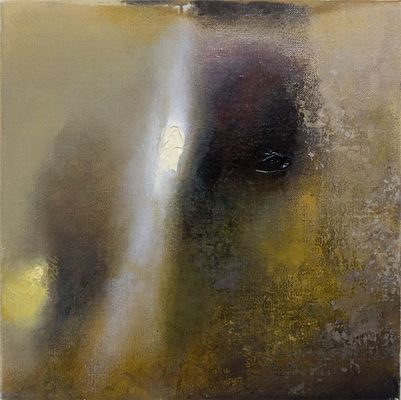
To return to Buckley’s fragment, the first two lines very much evoke how I paint nowadays. As you age, detail diminishes and patches of light become more luminous and float. I feel the most honest way of dealing with this is by smearing the oil paint on the canvas with the fingers and working close-up, blind. Only if the patches coalesce into an approaching image can the work gain a life.
-
Jonathan Walker was born in Melbourne, Australia and brought up on a dairy farm in Gippsland. In the 1970’s he studied painting at RMIT and won the Harold Wright Scholarship to the British Museum, London. During the 1980’s he exhibited at Pinacotheca Gallery, Richmond and had work shown at the NGV and Heidi City Art Gallery. Over the same period he designed the cover for the “Epigenesi” LP by Giancarlo Toniutti, Italy and conducted a mail exchange work with Achim Wollscheid, Germany. The work with artists through the post resulted in an article published in the bicentenary issue of Art and Australia 1988. He showed in artist run spaces such as WestSpace in the 90’s and 2000’s, and until 2012, taught painting at Victoria University, which is where we (Colleen Ahern and Lisa Radford) as organisers of the exhibition, among many others, had the privilege of being his student.
Walker’s knowledge was imparted to students through the careful selection of music, literature, and artists found in books that he himself had ordered for the library. Walker’s strategy was the generosity of sharing his vast knowledge with references specific to each student and their context.
Walker’s paintings share a similar focus and intimacy.
This exhibition presents a small selection of recent paintings alongside a publication that includes Walker’s writing. Observational and analytical, Walker’s work is a type of material notation — the time of day, colour and how it is blended, the both specific and fleeting location of a reflection on lino or the question of whether a chair leg should be included in a painting.
Please join us on Friday August 21 between 6-8pm to celebrate the opening of the exhibition.
Curated by Colleen Ahern and Lisa Radford.
B. Wurtz
Curated by Nic Tammens
March 26 - April 4, 2015
B.Wurtz works from a basement studio in his home on Manhattan’s Lower East Side.
This local fact is attested to by the plastic shopping bags and newsprint circulars that appear in his work. As formal objects, they don’t make loud claims about their origins but nonetheless transmit street addresses and places of business from the bottom of this long thin island. Like plenty of artists, Wurtz is affected by what is local and what is consumed. His work is underpinned by this ethic. It often speaks from a neighborhood or reads like the contents of a hamper:
“BLACK PLUMS $1.29 lb.”
“Food Bazaar”
“USDA Whole Pork Shoulder Picnic 99c lb.”
“RITE AID Pharmacy, with us it’s personal.”
“H. Brickman & Sons.”
“Sweet Yams 59c lb."
Most of the work in this exhibition was made while the artist was in residence at Dieu Donne, a workshop dedicated to paper craft in Midtown. Here Wurtz fabricated assemblages with paper and objects that are relatively lightweight, with the intention that they would be easily transportable to Australia. This consideration isn’t absolute in Wurtz’s work, but was prescriptive for making the current exhibition light and cheap. Packed in two boxes, these works were sent from a USPS post office on the Lower East Side and delivered to North Melbourne by Australia Post.
Wurtz appears courtesy of Metro Pictures, New York.
Thanks to Rob Halverson, Joshua Petherick, Sari de Mallory, Matt Hinkley, Helen Johnson, Fayen d'Evie, Ask Kilmartin, Lisa Radon, Ellena Savage, Yale Union, and "Elizabeth".
John Nixon
"Archive"
December 15 - January 20, 2014
The presentation of John Nixon's archive offered a rare showcase of this extensive collection of the artist's own publications, catalogues, posters, ephemera, editions and more, from the mid 1980s onwards, alongside a selection of his artworks.
Organized by John Nixon, Joshua Petherick and Matt Hinkley.
<a href=http://wfb.public-office.info/artist/john-nixon>All titles by John Nixon
"Habitat"
at Minerva, Sydney (organised by Joshua Petherick and Matt Hinkley)
November 15 - December 20, 2014
Lupo Borgonovo, Janet Burchill & Jennifer McCamley,
Lewis Fidock, HR Giger, Piero Gilardi, Veit Laurent Kurz,
Cinzia Ruggeri, Michael E. Smith, Lucie Stahl, Daniel Weil, Wols
Press Release:
“...It contained seven objects. The slender fluted bone, surely formed for flight, surely from the wing of some large bird. Three archaic circuitboards, faced with mazes of gold. A smooth white sphere of baked clay. An age-blackened fragment of lace. A fingerlength segment of what she assumed was bone from a human wrist, grayish white, inset smoothly with the silicon shaft of a small instrument that must once have ridden flush with the surface of the skin - but the thing’s face was seared and blackened.”
William Gibson, “Count Zero”, 1986
"Autumn Projects Archive"
Curated by Liza Vasiliou
March 6 - March 15, 2014
World Food Books, in conjunction with the Virgin Australia Melbourne Fashion Festival 2014, presented the Autumn Projects archive, consisting of a selection of early examples in Australian fashion with a particular interest in collecting designers and labels from the period beginning in the 1980’s, who significantly influenced the discourse of Australian Fashion.
Curated by Liza Vasiliou, the exhibition provided a unique opportunity to view pieces by designers Anthea Crawford, Barbara Vandenberg, Geoff Liddell and labels CR Australia, Covers, Jag along with early experimental collage pieces by Prue Acton and Sally Browne’s ‘Fragments’ collection, suspended throughout the functioning World Food Books shop in Melbourne.
H.B. Peace
presented by CENTRE FOR STYLE
November 14, 2013
"Hey Blinky, you say chic, I say same"
Anon 2013
H.B. Peace is a clothing collaboration between great friends Blake Barns and Hugh Egan Westland. Their pieces explore the divergences between 'character’ and ‘personality’ in garments....etc
Special Thanks to Joshua Petherick and Matt Hinkley of WFB and Gillian Mears
and a Very Special Thank you to Audrey Thomas Hayes for her shoe collaboration.
Janet Burchill & Jennifer McCamley
"Aesthetic Suicide"
May 10 - June 8, 2013
The first of our occasional exhibitions in the World Food Books office/shop space in Melbourne, "Aesthetic Suicide" presented a body of new and older works together by artists Janet Burchill & Jennifer McCamley, including videos, prints, a wall work, and publications.
During shop open hours videos played every hour, on the hour.
1972, German
Softcover, 96 pages, 28 x 205 cm
1st Edition, Out of print title / used / good
Published by
Heyne Verlag / Münich
$35.00 - Out of stock
Wonderful 1972 German book of erotic art selected by Phyllis and Dr. Eberhard Kronhausen, rightly considered international experts in the field. "Their exhibition "Erotic Art," which has been shown in many countries around the world, formed the basis for this illustrated volume. Because this exhibition included loans from museums and galleries, as well as works from the Kronhausen couple's collection and other private collections, it was possible to present images that had previously been inaccessible to the public. In selecting works for this volume, care was taken, on the one hand, to depict these unknown works, and, on the other, to provide a reliable overview of the erotic work of the leading artists (painting, graphic art, and sculpture) of our century. Thus, this book is a fortunate exception; it is a precious document, but also a demonstration of the sexual and cultural revolution of our century."
Features the work of Franz von Bayros, Hans Bellmer, Marc Chagall, Lovis Corinth, Salvador Dali, Paul Delvaux, Otto Dix, J. Dubuffet, Max Ernst, Ernst Fuchs, Willi Geiger, George Grosz, Horst Janssen, Allen Jones, Gustav Klimt, Felix Labisse, Jan Lebenstein, Edward Munch, Claes Oldenburg, Pablo Picasso, Herbert Rauschenberg, George Segal, Max Walter Swanberg, Tomi Ungerer, Andy Warhol, Tom Wesselmann.
Good—VG copy with some laminate seperation to cover extremities and slight corner bump.
2025, English
Softcover, 640 pages, 24 x 16.99 cm
Published by
Intellect Ltd / US
$110.00 - In stock -
Industrial music has long been recognized for its sonic innovations, but the radical visual culture that accompanied this underground movement has remained largely unexplored. Shock Factory: The Visual Culture of Industrial Music presents the first comprehensive examination of how industrial artists created a coherent aesthetic language across multiple media—from xerox art and mail art to installation and performance—fundamentally challenging modernist utopias while prophetically anticipating contemporary discourse about media manipulation and technological control.
Emerging in mid-1970s Britain from the post-punk underground before expanding globally throughout the 1980s, artists like Throbbing Gristle, Cabaret Voltaire, SPK, Test Dept, Laibach, Einstürzende Neubauten, Nurse With Wound, Current 93, Coil, Psychic TV, Boyd Rice, Whitehouse, Merzbow, Hijokaidan, Hunting Lodge, Controlled Bleeding, Hafler Trio, Z'EV, Nocturnal Emissions, 23 Skidoo, Clock DVA, Master/Slave Relationship, and Monte Cazazza developed sophisticated visual strategies that matched their abrasive soundscapes with equally confrontational imagery.
At 640 pages, this award-winning monograph reveals how industrial artists systematically appropriated reprographic techniques—particularly xerox art and photocollage—to create disturbing visual narratives investigating mind control, criminality, occultism, pornography, psychiatry, and totalitarianism. Through détournement strategies borrowed from Situationist theory, they exposed the coercive mechanisms of mass media and technological society, creating a visual vocabulary that challenged viewers to confront uncomfortable truths about modern power structures. What emerges is a movement that perceptively anticipated contemporary concerns about surveillance, media manipulation, and collective psychological control. Industrial artists' exploration of these themes through deliberately provocative imagery served not as mere provocation but as sophisticated critique of the very media systems they inhabited. Their radical aesthetic choices—degraded reproduction quality, found imagery manipulation, shock tactics—created hybrid forms that defied traditional categorization while establishing independent networks that bypassed conventional art world structures.
Shock Factory positions industrial music's visual culture within broader art historical narratives, revealing connections to Dada, Surrealism, and conceptual art while demonstrating the movement's unique contributions to contemporary visual culture. The book arrives at a moment when questions about technology, media manipulation, and social control have never been more urgent, demonstrating how these artists' radical visual strategies continue to offer valuable insights for our digital age.
For scholars of contemporary art, music history, and media studies, this book provides essential documentation of an overlooked movement that significantly influenced subsequent artistic developments. For readers interested in underground culture and avant-garde aesthetics, Shock Factory reveals the sophisticated visual thinking that accompanied one of the most innovative musical movements of the past half-century.
"A history of industrial music needed to be written. Nicolas Ballet has accomplished this. Thoroughly. This is the book's greatest strength. It explores the significance of noise as a reflection of a world in decay and screaming as a need. And doing it so it reveals a significant connection between industrial music and contemporary art. This is also what makes it an essential book: its contribution to dismantling categories and rethinking history from mixed creative territories."—David G. Torres
Nicolas Ballet is an art historian and assistant curator at the Centre Pompidou in the New Media Department. He is the author of books and articles exploring the visual and sonic contributions of countercultures and experimental artistic practices.
2023, French
Softcover, 465 pages, 17 x 24 cm
Published by
Les Presses Du Reel / Paris
$80.00 $50.00 - In stock -
A vast study of the visual culture of industrial music during its development in Europe, the United States and Japan, from the 1970s to the 1990s, a global culture that goes beyond sound experimentation to cross different media (graphics, film, performance, video), in a close dialogue with the heritage of modernity and under the growing influence of technologies.
Industrial music appeared in the mid-1970s, and far from being a simple sound experimentation phenomenon, it quickly produced a global visual culture operating at the intersection of a multitude of media (collage, mail art, installation, film, performance, sound, video) in a close dialogue with the legacy of modernity and the growing influence of technology. Originally British, its development grew in Europe, the United States and Japan during the 1980s. The sound experiments deployed by industrial bands—designing synthesizers, manipulating and transforming recorded sounds from audio tapes recycled or conceived by the artists—were supplemented by a rich array of radical visual productions, deriving their sources from the modernist utopias of the first part of the 20th century. The saturated sounds were translated into abrasive images, altered by a détournement of reprographic techniques (Xerox art) that invested polemical themes: mental control, criminality, occultism, pornography, psychiatry and totalitarianism, among others. This book aims to introduce the visual and aesthetic elements of industrial culture to a general history of contemporary art by analyzing the different approaches taken and topics addressed by the primary protagonists of the movement, who anticipated current issues concerning the media and their coercive power.
Nicolas Ballet is an art historian and associate curator at the Centre Pompidou. He specialises in research into alternative visual cultures, experimental art, sound studies and the avant-garde. He received his PhD from the Université Paris 1 Panthéon-Sorbonne, where he teaches contemporary art history. He has written numerous texts exploring the visual and sonic contributions of counter-cultures and experimental artistic practices. He is the author of two books on Genesis P-Orridge, and has published in Les Cahiers du Musée national d'art moderne, Octopus Notes, Marges,OpticalSound, Volume !, Revue & Corrigée, Klima, in Cahiers du CAP and Histo.art (Éditions de la Sorbonne), as well as in books devoted to the work of Nigel Ayers and Zoe Dewitt. In 2023, he curated the exhibition "Who You Staring At? Visual culture of the no wave scene in the 1970s and 1980s" at the Centre Pompidou.
Foreword by Pascal Rousseau.
1975, German
Softcover, 164 pages, 25 x 19 cm
1st Edition, Out of print title / used / fine
Published by
Zweitausendeins / Frankfurt
$35.00 - Out of stock
1975 German edition of Max Ernst's first collage novel 'La femme 100 têtes' / 'The Hundred Headless Woman', published in its entirety with original instructions for the reader by André Breton. First published in French in 1929, the book features a loosely narrative sequence of uncanny Surrealist collages, made by cutting up and reassembling nineteenth-century illustrations, accompanied by Ernst’s equally strange captions. Ernst’s French title, La Femme 100 têtes, is a double entendre; when read aloud it can be understood as either “the hundred-headed woman” or “the headless woman.” Along with this enigmatic title character, the book marks the introduction of Ernst’s favourite alter ego, Loplop, “the Bird Superior.” Ernst was deeply engaged with illustrated books during the 1930s; in addition to collage novels, he created many etchings and lithographs to complement the poems and stories of Surrealist writers with whom he was closely associated.
Near Fine copy.
1976, English
Softcover, 208 pages, 28 x 21 cm
1st Edition, Out of print title / used / very good
Published by
Dover / New York
$45.00 - Out of stock
First 1976 Dover edition of this absolute classic of Surrealist collage by Max Ernst, first published in 1934.
This is the legendary collage masterpiece of Max Ernst (b. 1891), one of the leading figures of the surrealist movement and among the most original artists of the 20th century. From old catalogue and pulp novel illustrations, Ernst produced this series of 182 bizarre and darkly humorous collage scenes of classic dreams and erotic fantasies which seem mysteriously to lure the unconscious into view... Stern, proper-looking women sprout giant sets of wings, serpents appear in the drawing-room and bed chamber, a baron has the head of a lion, a parlor floor turns to water on which some people can apparently walk while others drown ...
UNE SEMAINE DE BONTÉ (A Week of Kindness) is divided into seven parts, one for each day of the week, with each section illustrating one of Ernst's "seven deadly elements." "Oedipus," "The Court of the Dragon," and "Three Visible Poems" are among the startling episodes of Ernst's week. The Dada and surrealist epigraphs which introduce each section appear in this edition in both French and English.
UNE SEMAINE first appeared in 1934 in a series of five pamphlets of fewer than 1000 copies each, and has never been reprinted before this present edition.
Previously available only to a few libraries and collectors, this is a major source and great treat for anyone interested in the surrealists and their work, in collage. visual illusion, dream visions and the interpretation of dreams.
Unabridged republication of original (1934) edition.
Very Good copy some edge wear, tanning, foxing to initials/endpapers.
1970, German
Softcover (printed cloth), 154 pages, 23 x 23.5 cm
1st Edition, Out of print title / used / fine
Published by
Württembergischer Kunstverein / Stuttgart
$65.00 - In stock -
First printing of this wonderful cloth-covered, 1970 monographic catalogue on the work of German artist Max Ernst, published to accompany his solo exhibition at Württembergischer Kunstverein, in Stuttgart in 1970.
Max Ernst "Gemälde, Plastiken, Collagen, Frottagen, Bücher" ("Paintings, Sculptures, Collages, Frottage, Books") is a handsomely designed and profusely illustrated book covering much of his astounding career of work in full-colour and black and white plates. Includes a chronology (1909-1968), bibliography, list of works, and texts by Werner Spies, Lothar Pretzell, Helmut R. Leppien, Uwe M. Schneede, and a series of texts by Max Ernst himself, covering topics of Dada, Nature, Collage, Surrealism, etc. All texts in German.
Max Ernst (1891–1976) was a German painter, sculptor, graphic artist, and poet. A prolific artist, Ernst was a primary pioneer of the Dada movement and Surrealism, and among the most original artists of the 20th century.
Very Good—Near Fine, well preserved and clean copy.
2018, English
Hardcover, 788 pages, 28.7 x 25.4 cm
Published by
Kant / Prague
$220.00 - In stock -
Art theorist and critic, graphic designer, artist, author and translator Karel Teige (1900–51) is today recognized not just as the creator of internationally acclaimed surrealist collages, but also as a leading figure of the European avant-garde. Teige spent his entire life commenting on and interpreting developments in the visual arts. His multifaceted theoretical writings helped shape the conceptual foundations of modern art, and his activities and intensive contacts with other members of the European avant-garde helped secure Czech art's place on the international art scene. His work anticipated, initiated and helped to develop the progressive artistic movements that fundamentally influenced art in the 20th century.
Karel Teige was one of the great European intellectuals of his time; his efforts were aimed at creating not just a system of aesthetics but also an all-encompassing life philosophy. He was intensively interested in architecture and found inspiration in Germany's Bauhaus (where he spent a year lecturing); architectural functionalism would have looked completely different without his input. Teige's preference for rational, minimalist designs with an emphasis on the social uses of modern architecture was the "most functionalist functionalism" of his time.
Teige's own work consisted primarily of a series of phenomenal collages that reveal the hidden and passionate aspects of his personality. His book designs set the tone for an entire generation, and his design principles remain valid today. Teige's complicated personality, full of contradictions, utopian dreams and a yearning for order and logic make him an indecipherable and deeply human individual, a perfect symbol for the 20th century.
This comprehensive, nearly 800-page monograph, by the art historian Rea Michalová, takes a wide-ranging look at the evolution of Teige's ideological, theoretical and political views, and recalls important moments in his life and their significance within the international context. The book includes a rich set of illustrations, photographs from his life, and examples of his unique collages and graphic designs.
"Just a few of the reasons why we can't get over this new Karel Teige monograph. Measuring more than 2.5 inches thick and just under 800 pages long—with 318 color reproductions and a whopping 635 pages of scholarly texts—Karel Teige: Captain of the Avant-Garde, the new Teige monograph from noted Czech art book publisher Kant, is truly extraordinary. "There is no need to explain who Karel Teige was," a Czech writer for Typografia magazine proclaimed in 1927. "I don't think that there was a single modern impulse in our country that he did not either directly inspire or at least support. Architecture, poetry, film, photography, painting, theater, typography—all these bear traces of his insightfulness and modernity."
2025, English
Hardcover, 304 pages, 29 x 22 cm
Published by
Hatje Cantz / Berlin
$105.00 - In stock -
A spectacular appraisal of one of the most innovative avant-garde artists of the Dada scene
Raoul Hausmann fought convention all his life. Radically resolved to be "unscrupulously honest" in both art and life, the Dadaist was a multimedia activist of the first hour and a sharp-tongued critic of society. Now his visionary output can be enjoyed in all its breadth. With more than 300 illustrations, this catalogue from the Berlinische Galerie traces his path: the early Expressionist works, gems of Dada from the Berlin years, Hausmann's photography, but also fashion, dance and literature, and the artist's lesser-known productivity in exile. Twelve essays by international experts in the history of art and literature, media studies, and psychoanalysis examine the multilayered oeuvre to offer a multifaceted panorama of Hausmann's astonishing significance—even today. Another appealing feature of the catalogue is its attractive, artistic design.
Raoul Hausmann (1886-1971) was an exceptionally innovative avant-garde artist. He co-invented collage, explored body, words, and space in early happenings, merged the visual with the haptic, and translated sound into images. In and beyond art, the provocative "Dadasoph" called out the establishment.
Edited by: Ralf Burmeister, Thomas Köhler
Graphic Design: Gregor Schreiter
Texts by: Hanne Bergius, Peter Bexte, Ralf Burmeister, Amélie Castellanet, Annina Guntli, Nadine Hartmann, Thomas Köhler, Annelie Lütgens, Agatha Mareuge, Nils Philippi, Bernd Stiegler, Hélène Thiérard, Timm Ulrichs, Michael White
2024, English
Softcover, 200 pages, 23 x 17 cm
Published by
Scheidegger und Spiess / Zürich
$90.00 - In stock -
A groundbreaking, richly illustrated book on Hannah Höch’s montages in the context of film and the visual culture of Modernism. Sheds light for the first time on Hannah Höch’s significance as a pioneering artist to confront the industrial age’s flood of images.
Hannah Höch (1889-1978) moved between differing worlds: as an editorial assistant with a major Berlin-based magazine publisher, and as the only woman who could hold her own in the German capital's vibrant Dada scene of the 1920s. Her works dissected a world marked by the catastrophe of the Great War and an intense consumer culture, and reassembled it in revolutionary, poetic, and often ironic ways. Scissors and glue were the weapons of her art of montage, of which she was a coinventor.
Cutting and montage also shaped film, still a new medium in the 1920s, which strongly influenced Höch's art: she understood her assembled pictures as static films. This richly illustrated and expertly annotated book explores comprehensively for the first time Höch's life-long fascination with film and the visual culture of the modern industrial age. Covering her entire career, It demonstrates how montage evolved in a field of tension between artistic experimentation, commercial exploitation, and political appropriation. A text on photomontage by Höch, written in 1948, and a text-collage on the history of montage, in which major protagonists of Modernism and Avant-garde have their say, round out this volume.
Contributors:
Martin Waldmeier is a curator at the Zentrum Paul Klee in Bern.
Nina Zimmer is director of the Kunstmuseum Bern and its affiliate Zentrum Paul Klee.
2010, English
Hardcover, 400 pages, 24 x 31 cm
Published by
Les Presses Du Reel / Paris
Mennour / Paris
$150.00 - In stock -
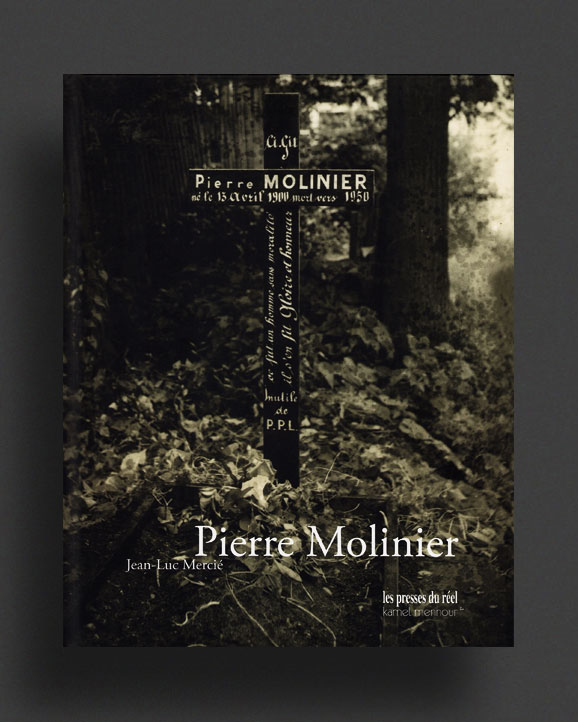
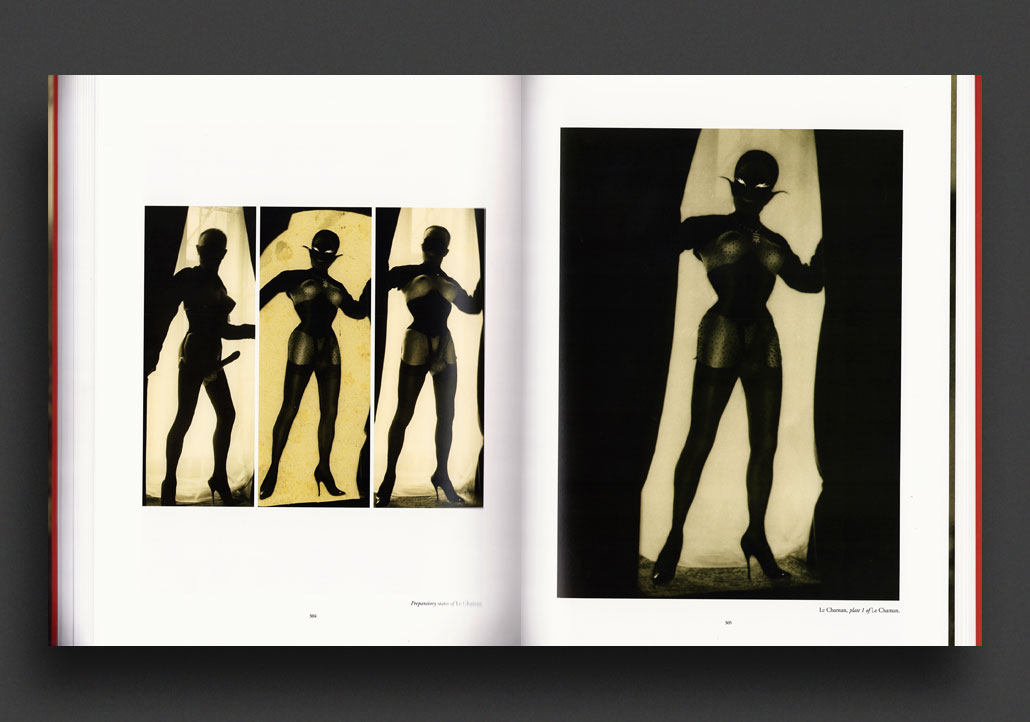
The Molinier bible! A mammoth, crucial 400 page book on the method and genesis of Pierre Molinier's provocative, gender-bending photos and artwork. Beautifully printed and prodigiously illustrated with over 800 pictures, mostly unpublished, numerous documents, manuscripts and letters, a complete (nearly 100-page) chronology, a critical biography, and a text by Jean-Luc Mercié.Molinier. Essential publication on Molinier, the most comprehensive to date, and a must for any fan.
Rare English edition translated from the French by Edward Penwarden.
Pierre Molinier is an unknown of worldwide renown. Every book and every exhibition on the body, gender confusion or sexual excess seems to feature at least one work by this artist whose “genius” was acclaimed by André Breton in a memorable text published in 1956. But the bulk of his work has remained inaccessible. A number of pictures have never been shown and a corpus of only 160 prints has been published. The ensemble revealed by the artist's archives is much more extensive. It includes numerous proofs made to prepare his photomontages and working prints given to friends, but also notebooks and personal letters. Here, precise links emerge between his paintings, photographs and scandalous life. The myth carefully constructed by the artist begins to crumble before the reality of the work.
An inveterate seducer, thoroughgoing fetishist, unrepentant transvestite and inadvertent bisexual, to the very last Molinier remained haunted by two obsessions: pleasure, meaning immediate access to la petite mort, and “leaving a trace in the infinity of time.” This book charts the aesthetic incarnation of his passions. Its 819 photographs, most of them never published before, reveal the method, shed light on the procedures and give details of the origin and alchemy of his latent or composed images. Finally, an exhaustive chronology offers a new biography of Molinier, based on his letters: for it is in the intimacy of these writings that the shaman's heart beats closest to the truth.
In a career shared between the university (fifteen years) and publishing (twenty) Jean-Luc Mercié has written widely on painting and photography. This monograph is his fourth book about Pierre Molinier, the master from Bordeaux.
Born 1900 in Agen (France), Pierre Molinier, surrealistic painter and photographer, a precursor to body art, died in 1976 after having thought out radical and pornographic artwork.
1997, English
Softcover (stapled), 32 pages, 26.5 x 19 cm
1st Edition, Out of print title / used / very good
Published by
Kohn Turner Gallery / Los Angeles
$65.00 - In stock -
Rare catalogue for Bruce Conner's 1997 exhibition "Fearful Symmetry" at Kohn Turner Gallery, Los Angeles. Heavily illustrated throughout, includes a lengthy interview with Conner by Michael Kohn.
Bruce Conner (1933–2008) was an influential American avant-garde artist known for his pioneering work in assemblage, experimental film, drawing, and photography. Emerging from the San Francisco art scene in the late 1950s, Conner gained early recognition for his haunting assemblage sculptures made from found objects—nylons, wax, furniture fragments, and discarded materials—that explored themes of violence, consumerism, and postwar anxiety. He became a central figure in underground cinema with his groundbreaking 1958 film A Movie, which re-edited found footage into a rapid, provocative montage that challenged traditional filmmaking. Throughout his career, Conner resisted categorization, often using repetition, appropriation, and even pseudonyms to question authorship and originality in art. His work bridged Beat culture, counterculture, and conceptual art, leaving a lasting impact on video art, music videos, and contemporary media practices.
VG copy.
2024, English
Softcover, 132 pages, 16 x 12 cm
Published by
Resampled / UK
$45.00 - In stock -
Selected cassette tape and vinyl artwork from experimental electronic music of the 1980s. Touching on industrial, noise, new wave, minimal, drone, sound art, ambient and more. A visual archive of the xerox scanned imagery, disorderly type and hand illustration used to present the decade's boundary-pushing music and abstract compositions.
2008, English
Softcover (spiral bound w. acetate protector), unpaginated, 28 x 22 cm
Ed. of 200 copies,
Out of print title / used / good
Published by
Printed Matter Inc. / New York
$260.00 - In stock -
The second, expanded edition of this now highly-collectible, limited edition compilation of materials by and about New York art rock band Sonic Youth.
Compiled by Thurston Moore and Lee Ranaldo to accompany the exhibition of the same name at Printed Matter in the summer of 2000, Sonic Matters, Sonic Kollaborations is a sort of Sonic Youth super ‘zine, with over 220 photocopied pages including essays, interviews, ephemera, memorabilia, photographs, writings, gig flyers, posters, letters, song lyrics, poetry, angry fan mail, art work, record covers and related material. Includes a rambling, poetic essay by Moore on the Youth’s roots in–and ongoing relationship with–the art community, as well as the original exhibition proposals by curator, Todd Alden.
“Sonic Youth’s music explores the sometimes liberating, sometimes repressive + always complexx tensions between subjectivity + mass culture, sexuality + mass media, abjection and the star sy$tem. It is these leitmotifs which also find graphic expression, appropriately enough, in the elegantly degraded poetics of the band’s printed matter and ephemera.” ––from the exhibition introduction by Todd Alden, edited and transcribed directly onto the walls of Printed Matter by Thurston Moore.
This expanded edition goes even further, featuring extra bonus materials.
Good copy but with some marking/creasing to transparent acetate cover and marking to black acetate back cover, interior Good—VG with some marking to block edge.
1983, English
Softcover, 122 pages, 24.5 x 17.5 cm
1st Edition, Out of print title / used / very good
Published by
Pluto Press / UK
$20.00 - In stock -
First 1983 edition.
"Committing Photography considers photography from the turn of the century to the present day; as social reform imposed from above, and as direct action and participation. Su Braden looks in particular at recent radical photography and poster-making in Britain. She argues for community access and collective involvement in the process of conceiving, taking and distributing photographs.
She examines the work of Bootle Art in Action, whose members have been directly involved in photographing themselves and their broken down environment with pride and with humour. She compares this approach with the consultative process developed by Loraine Leeson and Peter Dunn with the East London Health Group in the production of photomontage posters on health issues. She looks at the pedagogical ideas of Paulo Freire and their relevance to the work of projects aiming to raise technical and visual literacy in Britain.
Committing Photography reveals the controls that manufacturers have created over the practice of photography through their marketing policies for photographic equipment. Su Braden shows how the 'amateur' and 'professional' market has been divided: how simplified equipment of limited flexibility is marketed to encourage family snaps, and more complex cameras for professionals advertised as investigative and scientific tools.
Committing Photography looks at social and political constraints on photography and shows how these constraints have been overthrown —for example by the worker photography movement in the thirties."
Su Braden has been active in community media since the late sixties. She is the author of Artists and People (Routledge & Kegan Paul 1978) and is currently running a video project in Brighton, Barefoot Video.
VG copy, monor wear to extremities.
2026, English
Hardcover (w. dust jacket), 252 pages, 27.5 x 26 cm
Published by
Til Van Laere Gallery / Antwerp
Hannibal Books / Veurne
$120.00 - Out of stock
Unique collection of drawings by the celebrated Swedish artist Jockum Nordström, featuring never-before-seen work
Swedish artist Jockum Nordström (b. 1963) is one of Scandinavia’s most celebrated contemporary voices, renowned for the evocative, dreamlike worlds he brings to life through his art. This book spans more than three decades, from 1992 to 2025, tracing both early pieces and recent works, several of which have never been shown to the public before. Alongside captivating drawings, Nordström also creates sculptures, collages and maquettes – a testament to his versatility and to the richly imaginative universe he continues to shape.
With accompanying essays by Femke Vandenbosch and Carl Fredrik Hårleman. Graphic design by Kim Beirnaert.
Published on the occasion of the artist’s exhibition at Tim Van Laere Gallery from 9 October to 22 November 2025.
Jockum Nordström is a Swedish contemporary artist known for his distinct mixed-media works, which blend collage, drawing, and painting. Born in 1963 in Stockholm, Nordström’s style is often characterized by a whimsical yet surreal aesthetic, combining figures, landscapes, and architectural elements. Throughout his career, Nordström has exhibited internationally, earning recognition for his innovative approach to visual storytelling.
2025, English
Softcover, 224 pages, 29.7 x 21 cm
Published by
Galerie Eva Presenhuber / Zürich
Walther König / Köln
$70.00 - In stock -
This profusely illustrated catalogue focuses on early sculptures and objects by Austrian artist Franz West (1947—2012), created between 1975 and 1990. Many of the works are drawn from important private collections, including those belonging to West’s longtime mentor, former gallerist and curator Peter Pakesch, and to Galerie Eva Presenhuber.
2025, English / German
Softcover, 240 pages, 30 × 24.5 cm
Published by
Distanz / Berlin
Fondation Vincent van Gogh Arles / Arles
$98.00 - In stock -
Sigmar Polke (1941–2010) has been hailed as one of the world’s preeminent artists of the twentieth century. In his oeuvre, Polke worked through experiences of war, militarization and forced migration, and reflected on the image and the mass media in which it circulated. Taking an interest early on in the visual information contained in pictures and their agency, Polke set standards that younger generations of artists continue to emulate, and his work remains as relevant as ever—what might seem its historic dimension in fact turns out to speak directly to present-day concerns.
Beneath the Cobblestones, the Earth is the catalogue for the exhibition devoted to Sigmar Polke at the Fondation Vincent van Gogh Arles. Bice Curiger, curator of the exhibition and a specialist in Polke’s work, is editing the book. It gathers paintings, photographs, and films plus graphic art from 1960 to 2009 to illustrate the multifaceted quality of the artist’s output, which is informed by astute observations and powerful creative choices that reflect the artist’s sense of irony and love of experimentation. One focus of the selection of works is on the political dimension of Polke’s oeuvre; he was an exacting analyst of the world around him and commented critically on politics, art, and history.
The extensive essay section includes the main contribution by Bice Curiger, and texts by Ulf Erdmann Ziegler, Nina Pohl, Kathy Halbreich, Friedrich W. Heubach, Maria Stavrinaki, Petra Lange-Berndt and Dietmar Rübel. Poems by Thomas Kling and statements by artists Anne Imhof, Alvaro Barrington, Michael Krebber, Helen Marten, Trajal Harrell, and Laura Owens provide further insight into Polke’s work.
2011, Japanese
Softcover (staple-bound), 26 pages, 29.5 x 21 cm
1st Edition, Out of print title / used / fine
Published by
The Museum of Modern Art / Kamakura
$45.00 - In stock -
Scarce exhibition catalogue on the Japanese Surrealist painter Kikuji Yamashita (1919—1986), a postwar painter who confronted the problem of the common people's consciousness and characterised the chaos of social realism with spectacular surrealist methods, inventing reportage paintings, and turning real-life incidents into provocative picture-story shows. Published on the occasion of an exhibition focussing on his lesser-known and equally breath-taking collage works at The Museum of Modern Art, Kamakura Annex, January 8 - March 27, 2011, organized by The Museum of Modern Art, Kamakura & Hayama. Bi-lingual introduction in English and Japanese, the catalogue is filled with his collages based on the theme of The Sayama Case Trials, which were donated to the museum in 2009, followed by a chronology.
Kikuji Yamashita (b. 1919, Tokushima, Shikoku Island, d. 1986) was a Japanese Surrealist painter, printmaker, collagist, activist and bird lover associated with the postwar avant-garde art movement in Japan who studied under the Japanese Surrealist painter Ichiro Fukuzawa in Tokyo. In 1939 he was drafted into the Japanese Imperial military to fight in China, and although he survived the war, feelings of guilt and traumatic memories of his wartime experience, including participating in the torture and murder of a Chinese prisoner, pervaded his ferocious postwar artistic vision and output. His work became emblematic of the ‘Reportage’ style of painting, whereby artists expressed Socialist concerns in a style combining Social Realism and Surrealism. As a young man he travelled to Europe where he was introduced to the works of artists including Max Ernst, Salvador Dali and Hieronymus Bosch. Yamashita transposes the perverse and fantastical imagery of Bosch into an explicitly Surrealist register. In Yamashita’s paintings, the human figure is fragmented and morphed into erotically suggestive, comical or abject guises. The nude body, and its potential to contort into something uncanny or grotesque, is a continual subject of Yamashita Kikuji’s phantasmagorical paintings. Although he continued to paint hundreds of canvases, he deliberately avoided seeking out commercial success, perhaps out of a sense of guilt, and was only able to survive as a full-time artist thanks to his devoted wife's earnings as a beautician. "He didn’t talk about it much, but he would cry out from his nightmares at night. He sounded like he was in such pain that I used to wake him. He didn’t tell me directly, but in 1970 he published an article, “A Peephole onto Discrimination.” In it, he wrote about how he had executed a prisoner of war in a very brutal fashion." He deeply regretted the fact that he couldn’t give his own life by refusing that order. He wanted to take responsibility for what he had done. That became the driving force behind his paintings. Yamashita was a bird lover—evident in the recurring image of birds in his paintings—and shared his home and studio with many birds, including owls and hawks. It is said that he would sometimes appear at an exhibition, disheveled and cheerful, accompanied by a small bird in his pocket that he would feed premasticated (pre‐chewed) food directly from his mouth.
Very Good copy.
1967, English
Hardcover, 342 pages, 23.5 x 15.5 cm
1st Edition, Out of print title / used / very good
Published by
edition hansjörg meyer / Düsseldorf
$190.00 - Out of stock
Rare first 1967 European hardcover edition of An Anthology of Concrete Poetry, published by the legendary edition hansjörg meyer. The book's editor, Emmett Williams, "as one of the original practitioners of concrete poetry, has been in a unique position to observe the development of the movement since its beginnings, and the selection in this volume therefore reflects a view of this evolution from within the movement rather than from a distance." An Anthology of Concrete Poetry was the first anthology on the international movement of Concrete poetry, published subsequently by the legendary Something Else Press in 1967 in America. The movement itself began in the early 1950s, in Germany–through Eugen Gomringer, who borrowed the term “concrete” from the art of his mentor, Max Bill–and in Brazil, through the Noigandres group, which included the de Campos brothers and Decio Pignatari. Over the course of the 1960s it exploded across Europe, America and Japan, as other protagonists of the movement emerged, such as Dieter Roth, Öyvind Fahlström, Ernst Jandl, bpNichol, Mary Ellen Solt, Jackson Mac Low, Ian Hamilton Finlay, Bob Cobbing, Dom Sylvester Houédard, Pierre Garnier, Henri Chopin, Brion Gysin and Kitasono Katue. By the late 1960s, poet Jonathan Williams could proclaim: “If there is such a thing as a worldwide movement in the art of poetry, Concrete is it.” The work of the 77 writers collected in this anthology varies greatly in its aims and forms, but all can be said to emphasize the visual dimension of language, manipulating individual letters and minimal semantic units to produce poems that are for contemplating as much as for reading. Emmett Williams, the book’s editor, added explanatory commentary for the poems and biographies of their authors, making this volume–long out of print–the definitive anthology of this movement, which has so influenced artists and writers of subsequent generations.
Writers and artists included: Friedrich Achleitner, Alain Arias-Misson, H. C. Artmann, Ronaldo Azeredo, Stephen Bann, Carlo Belloli, Max Bense, Edgard Braga, Claus Bremer, Augusto de Campos, Haroldo de Campos, Henri Chopin, Carl Friedrich Claus, Bob Cobbing, Paul de Vree, Reinhard Döhl, Torsten Ekbom, Öyvind Fahlström, Carl Fernbach-Flarsheim, Ian Hamilton Finlay, Larry Freifeld, John Furnival, Heinz Gappmayr, Ilse and Pierre Garnier, Matthias Goeritz, Eugen Gomringer, Ludwig Gosewitz, Bohumila Grögerova and Josef Hiršal, José Lino Grünewald, Brion Gysin, Al Hansen, Václav Havel, Helmut Heissenbüttel, Åke Hodell, Dom Sylvester Houédard, Ernst Jandl, Bengt Emil Johnson, Ronald Johnson, Hiro Kamimura, Kitasono Katue, Jiri Kolar, Ferdinand Kriwet, Arrigo Lora-Totino, Jackson Mac Low, Hansjörg Mayer, Cavan McCarthy, Franz Mon, Edwin Morgan, Maurizio Nannucci, bp Nichol, Hans-Jørgen Nielsen, Seiichi Niikuni, Ladislav Novák, Yuksel Pazarkaya, Décio Pignatari, Vlademir Dias Pino, Luiz Angelo Pinto, Carl Fredrik Reuterswärd, Diter Rot, Gerhard Rühm, Aram Saroyan, John J. Sharkey, Edward Lucie Smith, Mary Ellen Solt, Adriano Spatola, Daniel Spoerri, Vagn Steen, Andre Thomkins, Enrique Uribe Valdivielso, Franz Van Der Linde, Franco Verdi, Emmett Williams, Jonathan Williams, Pedro Xisto and Fujitomi Yasuo.
"Emmett Williams, as one of the original practitioners of concrete poetry, has been in a unique position to observe the development of the movement since its beginnings, and the selection in this volume therefore reflects a view of this evolution from within the movement rather than from a distance. However it is far too soon to regard any anthology of Concrete Poetry as being definitive since the movement is extremely active and major new works have yet to appear in this most interesting of current poetry movements." -- from interior flap. Printed in black-and-white.
Very Good copy with some light edge wear to thick covers, general light age/tanning.
1998, English / Japanese
Softcover, 128 pages, 30.5 x 22.5 cm
1st Edition, Out of print title / used / very good
Published by
Little More / Tokyo
Richardson / New York
$250.00 - Out of stock
Controversial inaugural (December 1998) issue of Richardson magazine, the cult 1990's art/sex magazine published by Little More in Japan, edited by Andrew Richardson (of Richardson label, fashion stylist w. Supreme, CK, Valentino, etc.) and art direction by Laura Genninger of STUDIO 191 (designer of AnOther Magazine, etc.). Navigating the murky boundaries between art and obscenity, an honourable pursuit in Japan, this first issue features the double-cover (censored and non-censored) of adult film star Jenna Jameson shot by Glen Luchford, along with J.J. photo feature and interview, Richard Prince’s “Spiritual America” text and photography/artworks inc. the infamous 11-year-old Brooke Shields piece, "Be Broken" erotic artwork gallery by Harmony Korine, "Love Letter to Amerika" from Takashi Homma, Terry Richardson photography, "Cunt" fiction by Stewart Home, photos by French cinematographer (Gummo, Ulysse, Boy Meets Girl, etc.) Jean-Yves Escoffier, Japanese V-Cinema and pink star Nao Saejima, Stewart Home on Cosey Fanni Tutti, many works of photography and text by American photojournalist and writer Erika Langley, erotic photography by skater Ed Templeton of photographer and wife Deanna Templeton, vintage erotica collection by photographer Bela Borsodi, poetry and more! Riddled with bans and confiscations due to explicit un-censored imagery by Japanese censorship standards.
Texts in both English and Japanese.
Very Good copy.
2006, English
Softcover, 204 pages, 23 x 29 cm
1st Edition, Out of print title / used / very good
Published by
A Magazine / Antwerp
The Flanders Fashion Institute / Antwerp
$250.00 - Out of stock
“We make noise not clothes.”
Rare copy of the fourth instalment of Belgium's A Magazine, published in 2006 and now one of the most sought after of the series. This volume was guest-curated by Jun Takahashi of UNDERCOVER, and contains contributions on or by Rei Kawakubo + Comme Des Garcons, Maison Martin Margiela, Terry Jones, Simon Marsden, Olivier Saillard, Hermes, Paolo Roversi, Mark Borthwick, Jan Svankmajer, Terry Richardson, and many, many more. An incredible, visually-packed volume that presents UNDERCOVER behind the scenes, including clothing, scrapbooks, art projects, furniture, collages, sculptures, samples, interviews, texts...
Designed by Paul Boudens.
"A Magazine is a biannual publication, exploring the creative sphere of a selected designer in each issue. We invite a guest curator - an international fashion designer, group or house - to develop innovative, personalized content that expresses their aesthetic and cultural values. Each issue celebrates this designer's ethos: their people, their passion, their stories, emotions, fascinations, spontaneity and authenticity".
Very Good copy with moderate wear to edges/corners, front cover.
1991, English
Softcover, 118 pages, 21 x 14.5 cm
Out of print title / used / very good
Published by
AK Press / Edinburgh
$50.00 - Out of stock
First AK Press 1991 edition of Stewart Home's THE ASSAULT ON CULTURE: UTOPIAN CURRENTS FROM LETTRISM TO CLASS WAR, first published in 1988 by Aporia Press and Unpopular Books. Chapters: Cobra, The Lettriste Movement, The Lettriste International (1952-57), The College Of Pataphysics, Nuclear Art and the International Movement for an Imaginist Bauhaus, From the "First World Congress of Liberated Artists" to the foundation of the Situationist International, The Situationist International in its heroic phase (1957-62)., On the theoretical poverty of the Specto-Situationists and the legitimate status of the Second International, The decline and fall of the Specto-Situationist critique, The origins of Fluxus and the movement in its 'heroic' period, The rise of the depoliticized Fluxus aesthetic, Gustav Metzger and Auto-Destructive Art, Dutch Provos, Kommune 1, Motherfuckers, Yippies and White Panthers, Mail Art, Beyond Mail Art, Punk, Neoism, Class War, plus bibliography.
*A straightforward account of the vanguards that followed Surrealism: Lettrisme, Fluxus, Neoism and others even more obscure"—Village Voice
"Home's book is the first that I know of to chart this particular 'tradition' and to treat it seriously.
It is a healthy corrective to the overly aestheti-cised view of 20th century avant-garde art that now prevails."—City Limits
"Much of the information is taken from obscure sources and the book is essential reading for anyone interested in the subject. It demystifies the political and artistic practices of opponents to the dominant culture and serves as a basic reference for a field largely undocumented in English. It is also engagingly honest, unpreten-tious, questioning and immediate in its impact"—Artists Newsletter
"Reflecting the uncategorisable aspect of art that hurls itself into visionary politics, the book will engage political scientists, performance artists and activists"—Art and Text
"Apocalyptic in the literal sense of the word: an uncovering, revelation, a vision"—New Statesman
"A concise introduction to a whole mess of troublemakers through the ages... well written, incisive and colourful"—NME
"Informative and provocative"—Art Forum
Very Good copy.
2008, English
Softcover (w. poster dust jacket), 176 pages, 21 x 29.7 cm
1st Edition, Out of print title / used / fine
Published by
Migros Museum für Gegenwartskunst / Zürich
JRP Ringier / Zürich
$380.00 - In stock -
The "Mnemosyne" of sexual identity.
Rare, first (and only) edition of this wonderful book centred around one of Olesen's master works, published by JRP-Ringier and Migros Museum für Gegenwartskunst, Zürich, and awarded for the “Most Beautiful Swiss Books 2008”. Edited by Heike Munder, with texts by Heike Munder and Henrik Olesen.
Since the mid-1990s, Henrik Olesen (*1967 Denmark, lives and works in Berlin) has used media such as collage, sculpture, and minimalistic spatial intervention to investigate the social construction of identity andits historiography. Through the appropriation of source images and contextual shifts not dissimilar to the method invented by Aby Warburg for his "Mnemosyne Atlas," Olesen probes the associations between
homosexuality and its criminalization in the past, as well as in the present. His archival work sheds light on the enduring existence of spaces for Others, and inscribes homosexual subculture once more into the history of art and culture.
Near Fine copy complete with fold-out poster dust jacket, only light wear to edge folds.
2024, English
Hardcover, 192 pages, 30.5 x 22.9 cm
Published by
Fulgur Press / UK
$110.00 - In stock -
Sultry and gothic, Slinger’s legendary 1970s photomontage project returns to print with unpublished archival photos and text from the artist.
First published in 1977 and long out of print, Slinger's classic photobook, An Exorcism: A Photo Romance, explores the feminine psyche. Developed from a visit to Lilford Hall in 1970, Slinger provides us with a series of haunting images that chart a process of self-discovery and awakening. This new edition from Fulgur Press has been expanded with new images from the original series held in the artist’s archive and offers a previously unpublished narrative by Slinger.
Penny Slinger is a Los Angeles–based artist whose work investigates the feminine, the magical and the erotic. While studying at Chelsea College of Art in the late 1960s, Slinger encountered Max Ernst’s Une semaine de bonté (1934), initiating an enduring involvement with both the Surrealist movement and the medium of collage. She has published three books of provocative photo collage: 50% The Visible Woman, An Exorcism and Mountain Ecstasy. Her work is in many international museum collections, including Tate Britain.