World Food Books' programme is largely produced on Kulin Nation land. We acknowledge the Wurundjeri people of the Kulin Nation as the first and continuing custodians of this land, and pay respect to their Elders past, present, and emerging.
World Food Books is an arts and special interests bookshop in Naarm / Melbourne. Founded in 2010, World Food Books is devoted to the presentation of a rotating, hand-selection of international art, design, literary and counterculture publications with an emphasis on the anti-traditional, the experimental, the avant-garde, the heretic, the marginal.
Presenting new titles alongside rare and out-of-print books, catalogues and journals spanning the fields of modern and contemporary art, design, photography, illustration, film, literature, poetry, cultural theory, philosophy, sexuality, popular and underground culture in its many radical forms, World Food Books wishes to encourage adventurous, thoughtful and open-minded reading, looking, writing, and exchange of publishing and ideas, both current and historical.
As well as our bookshop, located in Melbourne's historical Nicholas Building, all of our inventory is available internationally via our online mail-order service.
World Food Books semi-regularly co-ordinates "Occasions", a programme of exhibits and events at the bookshop and in partnership with other hosts (such as museums and art galleries) that develop out of the activities, relationships and content of the bookshop itself.
World Food Books
The Nicholas Building
37 Swanston Street
Room 5, Level 6
Melbourne 3000
Australia
SHOP HOURS:
Thu–Fri 12–6, Sat 12–5
WEB-SHOP OPEN 24/7
World Food Books
Postal Address:
PO Box 435
Flinders Lane
Victoria 8009
Australia
Art
Theory / Essay
Architecture / Interior
Graphic Design / Typography
Photography
Fashion
Eros
LGBTQ+
Fiction / Poetry
Weird / Speculative / Science Fiction / Horror
Transgressive / Visceral / Abject
Symbolism / Decadence / Fin de siècle
Film / Video
Painting
Sculpture / Installation
Performance / Dance / Theater
Drawing
Sound / Music
Curatorial
Group Shows / Collections
Periodicals
Out-of-print / Rare
Posters / Ephemera / Discs
Signed Books
World Food Books Gift Voucher
World Food Book Bag
Australian Art
Australian Fiction
Australian Science Fiction / Speculative Fiction
Australian Poetry
Australian Photography
Japanese Photography
Conceptual Art
Minimal Art
Dada
'Pataphysics / Oulipo
Fluxus
Concrete Poetry
Pop Art
Surrealism
Arte Povera
Arte Informale / Haute Pâte / Tachism
Nouveau Réalisme / Zero / Kinetic
Situationism / Lettrism
Collage / Mail Art / Xerox Art
Art Brut / Folk / Visionary / Fantastic
Illustration / Graphic Art / Bandes Dessinées
Furniture
Italian Radical Design / Postmodernism
Textiles
Ceramics / Glass
Counterculture
Protest / Revolt
Philosophy
Psychoanalysis
Anthropology
Anarchism
Socialism / Anarchism / Communism / Capitalism
Literary Theory / Semiotics / Language
Feminism / Women's Studies
Gender Studies / Sexuality
Anthropology
Fetishism / BDSM
Drugs / Psychedelia
Crime / Violence
Animal Rights / Veganism
Occult / Esoterica
Ecology / Earth / Alternative Living
Whole Earth / Crafts
All prices in AUD (Australian dollars)
Pick-Ups
Pick-up orders can be collected in our bookshop during opening hours after order date. Please collect any Pick-up orders within 2 weeks of ordering as we have limited storage space. Orders will be released back into stock if not collected within this time. No refunds can be made for pick-ups left un-collected. If you cannot make it in to the bookshop in this time-frame, please choose postage option.
Return Policy
All sales are final. We do accept returns (for refund or exchange) for items received in error. All our orders are packed with special care using heavy-duty padding and cardboard book-mailers or bubble mailers (for smaller books), using reinforcement where required. We cannot take responsibility for any lost, stolen or damaged parcels.
Insurance
Should you wish to insure your package, please email us directly after placing your order and we can organise this at a small extra expense. Although all standard/express tracked packages are very safe and dependable, we cannot take responsibility for any lost, stolen or damaged parcels. We recommend insurance on valuable orders.
Interested in selling your old books, catalogues, journals, magazines, comics, fanzines, ephemera? We are always looking for interesting, unusual and out-of-print books to buy. We only buy books in our fields of interest and specialty, and that we feel we can resell.
We base these prices on desirability, market value, in-print prices, condition and our current stock levels. We offer cash, store credit, and can take stock on consignment. All
about 25% of the price we expect to get when we sell them, or 30% in store credit. We base these prices on desirability, market value, in-print prices, condition and our current stock levels.
Sell your books any day of the week. You can drop them off and return later. If you have a lot of books, we can visit your Sydney home.
We buy books that we feel we can resell. We offer about 25 % of the price we expect to get when we sell them, or 30% in store credit. We base these prices on desirability, market value, in-print prices, condition and our current stock levels.
Philadelphia Wireman
03 August - 01 September, 2018
World Food Books is proud to announce our next Occasion, the first presentation of sculptures by Philadelphia Wireman in Australia.
The Philadelphia Wireman sculptures were found abandoned in an alley off Philadelphia’s South Street on trash night in 1982. Their discovery in a rapidly-changing neighbourhood undergoing extensive renovation, compounded with the failure of all attempts to locate the artist, suggests that the works may have been discarded after the maker’s death. Dubbed the "Philadelphia Wireman" during the first exhibition of this work, in 1985, the maker’s name, age, ethnicity, and even gender remain uncertain. The entire collection totals approximately 1200 pieces, all intricately bound together with tightly-wound heavy-gauge wire (along with a few small, abstract marker drawings, reminiscent both of Mark Tobey and J.B. Murry). The dense construction of the work, despite a modest range of scale and materials, is singularly obsessive and disciplined in design: a wire armature or exoskeleton firmly binds a bricolage of found objects including plastic, glass, food packaging, umbrella parts, tape, rubber, batteries, pens, leather, reflectors, nuts and bolts, nails, foil, coins, toys, watches, eyeglasses, tools, and jewellery.
Heavy with associations—anthropomorphic, zoomorphic, and socio-cultural responses to wrapped detritus—the totemic sculptures by Philadelphia Wireman have been discussed in the context of work created to fulfil the shamanistic needs of alternative religions in American culture. Curators, collectors, and critics have variously compared certain pieces to sculpture from Classical antiquity, Native American medicine bundles, African-American memory jugs, and African fetish objects. Reflecting the artist’s prolific and incredibly focused scavenging impulse, and despite—or perhaps enhanced by—their anonymity, these enigmatic objects function as urban artefacts and arbiters of power, though their origin and purpose is unknown. Philadelphia Wireman, whatever their identity, possessed an astonishing ability to isolate and communicate the concepts of power and energy through the selection and transformation of ordinary materials. Over the course of the past two decades, this collection has come to be regarded as an important discovery in the field of self-taught art and vernacular art.
Presented in collaboration with Fleisher-Ollman Gallery, Philadelphia, and Robert Heald, Wellington.
Susan Te Kahurangi King
02 February - 10 March, 2018
Susan Te Kahurangi King (24 February 1951 - ) has been a confident and prolific artist since she was a young child, drawing with readily available materials - pencils, ballpoint pens and felt-tip markers, on whatever paper is at hand. Between the ages of four and six Susan slowly ceased verbal communication. Her grandparents William and Myrtle Murphy had developed a special bond with Susan so they took on caring responsibilities for extended periods. Myrtle began informally archiving her work, carefully collecting and storing the drawings and compiling scrapbooks. No drawing was insignificant; every scrap of paper was kept. The King family are now the custodians of a vast collection containing over 7000 individual works, from tiny scraps of paper through to 5 meter long rolls.
The scrapbooks and diaries reveal Myrtle to be a woman of great patience and compassion, seeking to understand a child who was not always behaving as expected. She encouraged Susan to be observant, to explore her environment and absorb all the sights and sounds. Myrtle would show Susan’s drawings to friends and people in her community that she had dealings with, such as shopkeepers and postal workers, but this was not simply a case of a grandmother’s bias. She recognised that Susan had developed a sophisticated and unique visual language and sincerely believed that her art deserved serious attention.
This was an unorthodox attitude for the time. To provide some context, Jean Dubuffet coined the term Art Brut in 1945 to describe work created by self-taught artists – specifically residents of psychiatric institutions and those he considered to be visionaries or eccentrics. In 1972 Roger Cardinal extended this concept by adopting the term Outsider Art to describe work made by non-academically trained artists operating outside of mainstream art networks through choice or circumstance. Susan was born in Te Aroha, New Zealand in 1951, far from the artistic hubs of Paris and London that Dubuffet and Cardinal operated in. That Myrtle fêted Susan as a self-taught artist who deserved to be taken seriously shows how progressive her attitudes were.
Susan’s parents Doug and Dawn were also progressive. Over the years they had consulted numerous health practitioners about Susan’s condition, as the medical establishment could not provide an explanation as to why she had lapsed into silence. Dawn educated herself in the field of homeopathy and went on to treat all twelve of her children using these principles – basing prescriptions on her observations of their physical, mental and emotional state.
Doug was a linguist with an interest in philosophy who devoted what little spare time he had to studying Maori language and culture. To some extent their willingness to explore the fringes of the mainstream made them outsiders too but it was their commitment to living with integrity and their respect for individuality that ensured Susan’s creativity was always encouraged.
Even though Susan’s family supported her artistic pursuits, some staff in schools and hospitals saw it as an impediment to her assimilation into the community and discouraged it in a variety of ways. Her family was not always aware of this and therefore did not fully understand why Susan stopped drawing in the early 1990s. However, rather than dwell on the challenges that Susan faced in pursuit of her artistic practice, they prefer to highlight her achievements. In 2008 Susan began drawing again in earnest, after an almost 20 year interruption, and her work is now shown in galleries around the world.
Susan grew up without television and has been heavily influenced by the comics she read as a child. She is absolutely fearless in the appropriation of recognizable characters, such as Donald Duck and Mickey Mouse, in her work. She twists their limbs, contorts their faces, compresses them together, blends them into complex patterned backgrounds - always imbuing them with an incredible energy. Although Susan often used pop culture characters in her work they are not naive or childlike. These are drawings by a brilliant self-taught artist who has been creating exceptional work for decades without an audience in mind.
Mladen Stilinović
"Various Works 1986 - 1999"
02 February 16 - September 10, 2016
Various works 1986 - 1999, from two houses, from the collections of John Nixon, Sue Cramer, Kerrie Poliness, Peter Haffenden and Phoebe Haffenden.
Including: Geometry of Cakes (various shelves), 1993; Poor People’s Law (black and white plate), 1993; White Absence (glasses, ruler, set square, silver spoon, silver ladel with skin photograph and wooden cubes), 1990-1996; Exploitation of the Dead (grey and red star painting, wooden painting, black spoon with red table, red plate), 1984-1990; Money and Zeros (zero tie, paintings made for friends in Australia (Sue, John, Kerrie), numbers painting), 1991-1992; Words - Slogans (various t-shirts) - “they talk about the death of art...help! someone is trying to kill me”, “my sweet little lamb”, “work is a disease - Karl Marx”; Various artist books, catalogues, monographs, videos; Poster from exhibition Insulting Anarchy; "Circular" Croatian - Australian edition; Artist book by Vlado Martek (Dostoyevsky); more.
Thanks to Mladen Stilinović and Branka Stipančić.
Jonathan Walker
Always Will Need To Wear Winter Shirt Blue + Ochre Small Check Pattern
21 August - 21 September, 2015
Untitled
I am not a great reader of poetry but I always return to the work of Melbourne poet, Vincent Buckley (1925- 1988). Perhaps I find his most tantalising piece to be not a finished poem but a fragment left on a scrap of paper discovered on his desk after the poet’s death.
The poetry gathers like oil
In the word-core, and spreads
It has its music meet,
Its music is in movement.
This fragment is more the shell left behind from a volatile thought than a finished poem. I find the last two lines honest but awkward whereas the first two lines work like an arrow. Most likely he could not find a resolution so it was left. Still, in its present form, it remains an eloquent testimony to the ultimate failure of a medium to express mobile thought and sensation, in Buckley’s case, through verbal language. It’s an important matter because this is something all artists have to deal with regardless of the medium.
I have never written a poem, however, I am forever copying fragments from books on paper scraps in a vain effort to fix certain notions in my head. At first, they function as bookmarks that are sometimes returned to when I open the book. But before long, as they accumulate, they fall out littering the table interspersed with A4 photocopies, bills, books and medications.
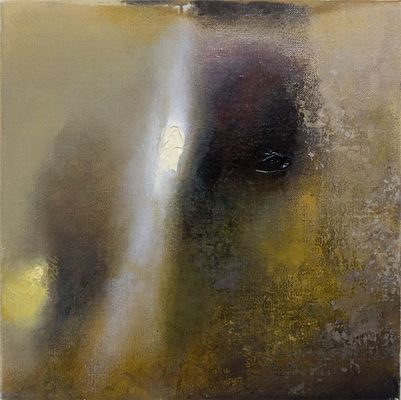
To return to Buckley’s fragment, the first two lines very much evoke how I paint nowadays. As you age, detail diminishes and patches of light become more luminous and float. I feel the most honest way of dealing with this is by smearing the oil paint on the canvas with the fingers and working close-up, blind. Only if the patches coalesce into an approaching image can the work gain a life.
-
Jonathan Walker was born in Melbourne, Australia and brought up on a dairy farm in Gippsland. In the 1970’s he studied painting at RMIT and won the Harold Wright Scholarship to the British Museum, London. During the 1980’s he exhibited at Pinacotheca Gallery, Richmond and had work shown at the NGV and Heidi City Art Gallery. Over the same period he designed the cover for the “Epigenesi” LP by Giancarlo Toniutti, Italy and conducted a mail exchange work with Achim Wollscheid, Germany. The work with artists through the post resulted in an article published in the bicentenary issue of Art and Australia 1988. He showed in artist run spaces such as WestSpace in the 90’s and 2000’s, and until 2012, taught painting at Victoria University, which is where we (Colleen Ahern and Lisa Radford) as organisers of the exhibition, among many others, had the privilege of being his student.
Walker’s knowledge was imparted to students through the careful selection of music, literature, and artists found in books that he himself had ordered for the library. Walker’s strategy was the generosity of sharing his vast knowledge with references specific to each student and their context.
Walker’s paintings share a similar focus and intimacy.
This exhibition presents a small selection of recent paintings alongside a publication that includes Walker’s writing. Observational and analytical, Walker’s work is a type of material notation — the time of day, colour and how it is blended, the both specific and fleeting location of a reflection on lino or the question of whether a chair leg should be included in a painting.
Please join us on Friday August 21 between 6-8pm to celebrate the opening of the exhibition.
Curated by Colleen Ahern and Lisa Radford.
B. Wurtz
Curated by Nic Tammens
March 26 - April 4, 2015
B.Wurtz works from a basement studio in his home on Manhattan’s Lower East Side.
This local fact is attested to by the plastic shopping bags and newsprint circulars that appear in his work. As formal objects, they don’t make loud claims about their origins but nonetheless transmit street addresses and places of business from the bottom of this long thin island. Like plenty of artists, Wurtz is affected by what is local and what is consumed. His work is underpinned by this ethic. It often speaks from a neighborhood or reads like the contents of a hamper:
“BLACK PLUMS $1.29 lb.”
“Food Bazaar”
“USDA Whole Pork Shoulder Picnic 99c lb.”
“RITE AID Pharmacy, with us it’s personal.”
“H. Brickman & Sons.”
“Sweet Yams 59c lb."
Most of the work in this exhibition was made while the artist was in residence at Dieu Donne, a workshop dedicated to paper craft in Midtown. Here Wurtz fabricated assemblages with paper and objects that are relatively lightweight, with the intention that they would be easily transportable to Australia. This consideration isn’t absolute in Wurtz’s work, but was prescriptive for making the current exhibition light and cheap. Packed in two boxes, these works were sent from a USPS post office on the Lower East Side and delivered to North Melbourne by Australia Post.
Wurtz appears courtesy of Metro Pictures, New York.
Thanks to Rob Halverson, Joshua Petherick, Sari de Mallory, Matt Hinkley, Helen Johnson, Fayen d'Evie, Ask Kilmartin, Lisa Radon, Ellena Savage, Yale Union, and "Elizabeth".
John Nixon
"Archive"
December 15 - January 20, 2014
The presentation of John Nixon's archive offered a rare showcase of this extensive collection of the artist's own publications, catalogues, posters, ephemera, editions and more, from the mid 1980s onwards, alongside a selection of his artworks.
Organized by John Nixon, Joshua Petherick and Matt Hinkley.
<a href=http://wfb.public-office.info/artist/john-nixon>All titles by John Nixon
"Habitat"
at Minerva, Sydney (organised by Joshua Petherick and Matt Hinkley)
November 15 - December 20, 2014
Lupo Borgonovo, Janet Burchill & Jennifer McCamley,
Lewis Fidock, HR Giger, Piero Gilardi, Veit Laurent Kurz,
Cinzia Ruggeri, Michael E. Smith, Lucie Stahl, Daniel Weil, Wols
Press Release:
“...It contained seven objects. The slender fluted bone, surely formed for flight, surely from the wing of some large bird. Three archaic circuitboards, faced with mazes of gold. A smooth white sphere of baked clay. An age-blackened fragment of lace. A fingerlength segment of what she assumed was bone from a human wrist, grayish white, inset smoothly with the silicon shaft of a small instrument that must once have ridden flush with the surface of the skin - but the thing’s face was seared and blackened.”
William Gibson, “Count Zero”, 1986
"Autumn Projects Archive"
Curated by Liza Vasiliou
March 6 - March 15, 2014
World Food Books, in conjunction with the Virgin Australia Melbourne Fashion Festival 2014, presented the Autumn Projects archive, consisting of a selection of early examples in Australian fashion with a particular interest in collecting designers and labels from the period beginning in the 1980’s, who significantly influenced the discourse of Australian Fashion.
Curated by Liza Vasiliou, the exhibition provided a unique opportunity to view pieces by designers Anthea Crawford, Barbara Vandenberg, Geoff Liddell and labels CR Australia, Covers, Jag along with early experimental collage pieces by Prue Acton and Sally Browne’s ‘Fragments’ collection, suspended throughout the functioning World Food Books shop in Melbourne.
H.B. Peace
presented by CENTRE FOR STYLE
November 14, 2013
"Hey Blinky, you say chic, I say same"
Anon 2013
H.B. Peace is a clothing collaboration between great friends Blake Barns and Hugh Egan Westland. Their pieces explore the divergences between 'character’ and ‘personality’ in garments....etc
Special Thanks to Joshua Petherick and Matt Hinkley of WFB and Gillian Mears
and a Very Special Thank you to Audrey Thomas Hayes for her shoe collaboration.
Janet Burchill & Jennifer McCamley
"Aesthetic Suicide"
May 10 - June 8, 2013
The first of our occasional exhibitions in the World Food Books office/shop space in Melbourne, "Aesthetic Suicide" presented a body of new and older works together by artists Janet Burchill & Jennifer McCamley, including videos, prints, a wall work, and publications.
During shop open hours videos played every hour, on the hour.
1989 / 1990, English
Softcover, 480 pages, 23.5 x 18.4 cm
1st Edition, Out of print title / used / very good
Published by
Zone Books / New York
$45.00 - Out of stock
Part one of Fragments for a History of the Human Body, published in 1989 by Zone Books, a tremendous 3 volume publication, long out-of-print. The forty-eight essays and photographic dossiers in these three volumes examine the history of the human body as a field where life and thought intersect. They show how different cultures at different times have entwined physical capacities and mental mechanisms in order to construct a body adapted to moral ideas or social circumstances — the body of a charismatic citizen or a visionary monk, a mirror image of the world or a reflection of the spirit.
Each volume emphasizes a particular perspective. Part 1 explores the human body’s relationship to the divine, to the bestial, and to the machines that imitate or simulate it. Part 2 covers the junctures between the body’s “outside” and “inside” by studying the manifestations — or production — of the soul and the expression of the emotions and, on another level, by examining the speculations inspired by cenesthesia, pain, and death. Part 3 brings into play the classical opposition between organ and function by showing how organs or bodily substances can be used to justify or challenge the way human societies function and, conversely, how political and social functions tend to make the bodies of the persons filling them the organs of a larger body — the social body or the universe as a whole.
Among the contributors to Fragments for a History of the Human Body are Mark Elvin, Catherine Gallagher, Françoise Héritier-Augé, Julia Kristeva, William R. LaFleur, Thomas W. Laqueur, Jacques Le Goff, Nicole Loraux, Mario Perniola, Hillel Schwartz, Jean Starobinski, Jean-Pierre Vernant, and Caroline Walker Bynum.
“ZONE is unequivocally the most innovative, informative, and intellectually stimulating journal I have ever encountered…It belongs in all but the smallest personal, public, and academic collections.” —Library Journal
VG copy of 2nd 1990 print, tanning to spine with light creasing.
1989, English
Softcover, 552 pages, 23.5 x 18.4 cm
1st Edition, Out of print title / used / very good
Published by
Zone Books / New York
$45.00 - Out of stock
Part two of Fragments for a History of the Human Body, published in 1989 by Zone Books, a tremendous 3 volume publication, long out-of-print. The forty-eight essays and photographic dossiers in these three volumes examine the history of the human body as a field where life and thought intersect. They show how different cultures at different times have entwined physical capacities and mental mechanisms in order to construct a body adapted to moral ideas or social circumstances — the body of a charismatic citizen or a visionary monk, a mirror image of the world or a reflection of the spirit.
Each volume emphasizes a particular perspective. Part 1 explores the human body’s relationship to the divine, to the bestial, and to the machines that imitate or simulate it. Part 2 covers the junctures between the body’s “outside” and “inside” by studying the manifestations — or production — of the soul and the expression of the emotions and, on another level, by examining the speculations inspired by cenesthesia, pain, and death. Part 3 brings into play the classical opposition between organ and function by showing how organs or bodily substances can be used to justify or challenge the way human societies function and, conversely, how political and social functions tend to make the bodies of the persons filling them the organs of a larger body — the social body or the universe as a whole.
Among the contributors to Fragments for a History of the Human Body are Mark Elvin, Catherine Gallagher, Françoise Héritier-Augé, Julia Kristeva, William R. LaFleur, Thomas W. Laqueur, Jacques Le Goff, Nicole Loraux, Mario Perniola, Hillel Schwartz, Jean Starobinski, Jean-Pierre Vernant, and Caroline Walker Bynum.
“ZONE is unequivocally the most innovative, informative, and intellectually stimulating journal I have ever encountered…It belongs in all but the smallest personal, public, and academic collections.” —Library Journal
VG copy of 1st 1989 print, light spine creasing, light wear to board edges, small knock to bottom back cover, tanning to block edge.
2007, English
Softcover, 213 pages, 23 x 15 cm
Published by
Semiotext(e) / Los Angeles
$35.00 - Out of stock
A report on the administration of deviant desire in specialized clinics that documents the way our postmodern society exposes sexuality to the point of overexposure.
Do you ever get aroused by your patient's fantasies? Do you discover through them something about your own sexuality?
–About my sexuality?
You are exposed to a lot of fantasies.
–Oh yes. Quite frankly, I think it has a satiation effect on me. I've been a sex researcher for ten years, and sometimes I get fed up with it, you know. I talk to people about sex all day long, and it does get to be a drag.
–from Overexposed
The most perverse perversions are not always those one would expect. Originally conceived as an American update to Foucault's History of Sexuality, Overexposed is even more outrageous and thought-provoking today than it was twenty years ago when first published by a commercial publisher. By a strange reversal, rather than being punished, deviant desire now is administrated in specialized clinics under medical supervision. Sexual excess is being turned into a "boredom therapy" claiming to rid patients of their own desires by forcing them to indulge them past the point of satiety. But are perversions still perverse when they are vindicated unconditionally? At once clinical, bewildering, and deeply poignant, Overexposed shows how science can pervert itself by identifying too closely with its object. This insider's exposition of controversial cognitive behavioral methods (carried out with instruments straight out of A Clockwork Orange–penile transducer? pupillometer?) is a hallucinatory document on the manner in which our postmodern society exposes sexuality to the point of overexposure–in order to exterminate it.
"Overexposed is a most remarkable work... A brilliant piece of undercover reporting, from the strangest of strange lands."–J.G. Ballard
"Overexposed is a voyage through hell. A gleaming, air-conditioned, sanitary, and polite hell where a triumphant psychotechnology replaces the old-fashioned shackles of the Law and 'cures' the sex-offender by boring to death his desire. Sylvère Lotringer's account of this charnel house of behaviorisim is deft, witty, and precise."–Joel Kovel
"The sexualization of postwar American culture has produced results that would astonish Freud, Reich, or even Kinsey. Modern techniques of behavior modification now cast doubt on the sources of individual eroticism. Overexposed is an engrossing description of sexual conditioning condoned by the state. A fascinating book."–William Burroughs
2025, English
Softcover, 455 pages, 24 x 17 cm
Published by
Headpress / Oxford
$65.00 - In stock -
From filmmaker, former Fangoria editor-in-chief, and Corman/Poe author Chris Alexander comes ART! TRASH! TERROR! Adventures in Strange Cinema, a treasure trove of in-depth essays and edifying interviews that celebrate some of the most eccentric and unforgettable movies in cult cinema history. From recognized classics (George A. Romero's Dawn Of The Dead, David Lynch's The Elephant Man) to misunderstood masterpieces (Michael Mann's The Keep, Boris Sagal's The Omega Man) to unfairly maligned curios (Kostas Karagiannis' Land Of The Minotaur, Brett Leonard's Hideaway), the author takes an alternately serious and playful but always personal look at several strains of international horror, dark fantasy, and exploitation film -- motion pictures that transform, transgress, challenge, infuriate, shock, and entertain.
Connecting these passionate and critical essays are insightful interviews with revered talents, such as John Waters (writer/director, Cecil B. Demented), Michael Winner (director, The Sentinel), Nicolas Cage (actor, Vampire's Kiss), Gene Simmons (co-founder/bassist, KISS), William Crain (director, Blacula), William Lustig (director, Maniac), Werner Herzog (director, Nosferatu: Phantom Der Nacht) and many more, as well as witty, heartfelt memoirs charting the author's oddball experiences on the fringes of Hollywood and beyond.
Illustrated with more than 200 startling photographs!
2025, English
Softcover, 640 pages, 24 x 16.99 cm
Published by
Intellect Ltd / US
$110.00 - In stock -
Industrial music has long been recognized for its sonic innovations, but the radical visual culture that accompanied this underground movement has remained largely unexplored. Shock Factory: The Visual Culture of Industrial Music presents the first comprehensive examination of how industrial artists created a coherent aesthetic language across multiple media—from xerox art and mail art to installation and performance—fundamentally challenging modernist utopias while prophetically anticipating contemporary discourse about media manipulation and technological control.
Emerging in mid-1970s Britain from the post-punk underground before expanding globally throughout the 1980s, artists like Throbbing Gristle, Cabaret Voltaire, SPK, Test Dept, Laibach, Einstürzende Neubauten, Nurse With Wound, Current 93, Coil, Psychic TV, Boyd Rice, Whitehouse, Merzbow, Hijokaidan, Hunting Lodge, Controlled Bleeding, Hafler Trio, Z'EV, Nocturnal Emissions, 23 Skidoo, Clock DVA, Master/Slave Relationship, and Monte Cazazza developed sophisticated visual strategies that matched their abrasive soundscapes with equally confrontational imagery.
At 640 pages, this award-winning monograph reveals how industrial artists systematically appropriated reprographic techniques—particularly xerox art and photocollage—to create disturbing visual narratives investigating mind control, criminality, occultism, pornography, psychiatry, and totalitarianism. Through détournement strategies borrowed from Situationist theory, they exposed the coercive mechanisms of mass media and technological society, creating a visual vocabulary that challenged viewers to confront uncomfortable truths about modern power structures. What emerges is a movement that perceptively anticipated contemporary concerns about surveillance, media manipulation, and collective psychological control. Industrial artists' exploration of these themes through deliberately provocative imagery served not as mere provocation but as sophisticated critique of the very media systems they inhabited. Their radical aesthetic choices—degraded reproduction quality, found imagery manipulation, shock tactics—created hybrid forms that defied traditional categorization while establishing independent networks that bypassed conventional art world structures.
Shock Factory positions industrial music's visual culture within broader art historical narratives, revealing connections to Dada, Surrealism, and conceptual art while demonstrating the movement's unique contributions to contemporary visual culture. The book arrives at a moment when questions about technology, media manipulation, and social control have never been more urgent, demonstrating how these artists' radical visual strategies continue to offer valuable insights for our digital age.
For scholars of contemporary art, music history, and media studies, this book provides essential documentation of an overlooked movement that significantly influenced subsequent artistic developments. For readers interested in underground culture and avant-garde aesthetics, Shock Factory reveals the sophisticated visual thinking that accompanied one of the most innovative musical movements of the past half-century.
"A history of industrial music needed to be written. Nicolas Ballet has accomplished this. Thoroughly. This is the book's greatest strength. It explores the significance of noise as a reflection of a world in decay and screaming as a need. And doing it so it reveals a significant connection between industrial music and contemporary art. This is also what makes it an essential book: its contribution to dismantling categories and rethinking history from mixed creative territories."—David G. Torres
Nicolas Ballet is an art historian and assistant curator at the Centre Pompidou in the New Media Department. He is the author of books and articles exploring the visual and sonic contributions of countercultures and experimental artistic practices.
1979, English
Hardcover (w. dust jacket), 158 pages, 23.5 x 15.5 cm
1st Edition, Out of print title / used / fine
Published by
Cambridge University Press / Cambridge
$65.00 - In stock -
First 1979 hardcover English edition of this landmark book by French social theorist Pierre Bourdieu.
Algeria 1960: The Disenchantment of the World, The Sense of Honour, The Kabyle House or the World Reversed, first published in 1977 but translated into English by Richard Nice in 1979 via Cambridge University Press, compiles Bourdieu’s early ethnographic fieldwork conducted during the late 1950s and early 1960s amidst the Algerian War of Independence. This research laid the foundation for his groundbreaking concepts of habitus and practical sense.
"Pierre Bourdieu is one of the leading anthropologists who have worked in Algeria. This book centres on his classic essay, Algeria 1960: The Disenchantment of the World, previously unavailable in English, which is based on his research on economic behaviour and attitudes in Algeria around 1960.
This essay analyses the relationship between economic structures and the structures of the experience of time which underlie opposing patterns of economic behaviour - hoarding or saving, gift-exchange or credit, mutual aid or contractual co-operation. Professor Bourdieu discusses the nature of this relationship in both capitalist and pre-capitalist economies. He analyses the economic practices of agents in different economic situations, and so brings to light the economic conditions in which 'rational' economic behaviour is really possible. Implicitly challenging theorists such as Frantz Fanon, he shows that the economic basis of the difference between sub-proletarian millenial reveries and proletarian revolutionary designs lies in the capacity to plan the future, which is demanded and instilled by a capitalist economy.
The second part of the book contains two studies in Kabyle ethnography. The first analyses in terms of symbolic power a set of practices - gift and counter-gift, challenge and riposte - that are generally reduced to their communication and exchange functions. The second explores the meanings of the Kabyle house, in the context of the Kabyle mythico-ritual system.
The book will be of interest to anthropologists, particularly those specialising in economic anthropology, sociologists and specialists in African studies."
NF copy in NF dust jacket. Preserved in mylar wrap.
2026, English
Softcover (bound by elastic band), 128 pages, 21 x 14.8 cm
Published by
UTS Gallery / Sydney
$30.00 - In stock -
Published on the occasion of the exhibition “No Place for mannequins: Remaking the fashion archive" (UTS Gallery, 2026), An index of wearing and reading fashion archives gathers and presents a collection of artist responses on how to make or unmake an archive.
With introductory essays by curators Todd Robinson and Ricarda Bigolin, the volume collects material and written assemblages of creative and research-based processes, including photographs, sketches, references, and citations, along with garments and accessories from participating artist's personal wardrobes, into an index of living traces.
Contributors: Ricarda Bigolin, D and K, Femke de Vries, Tim Hardy, Alix Higgins, Hansol Kim, Library of Unruly Fashion Practices, Kyra Mancktelow, Marco Marino, Todd Robinson, XEROXED, and Justine Woods.
Copy Editors: Stella Rosa McDonald and Alice Rezende
Design: Zenobia Ahmed
2 colour risographed covers, bound by elastic band.
1987, English
Softcover, 188 pages, 21 x 14 cm
1st Edition, Out of print title / used / very good
Published by
International General / New York
$20.00 - In stock -
Published in 1987 by Seth Sieglaub’s International General/IMMRC publishing imprint, this collection of texts is the first English-language presentation of a selection of the work of the important West German Marxist philosopher Wolfgang Fritz Haug. It brings together 10 essential essays written between 1970 and 1983, and sets forth a multi-dimensional analysis of culture integrating three interrelated theories: a theory of commodity aesthetics or the phenomenon and function of the realization of the value of commodities; a theory of the cultural as an omni-present dimension of everyday life, especially “culture from below”; and a theory of the ideological, particularly concerned with ideological powers “from above”. It includes an extensive bibliography of the author's writings since 1958.
Published on Seth Sieglaub’s imprint International General/IMMRC.
Very Good copy, light cover wear.
1988, English
Softcover, 78 pages, 30.5 x 23 cm
1st Edition, Out of print title / used / very good
Published by
KLF Publications / UK
$500.00 - In stock -
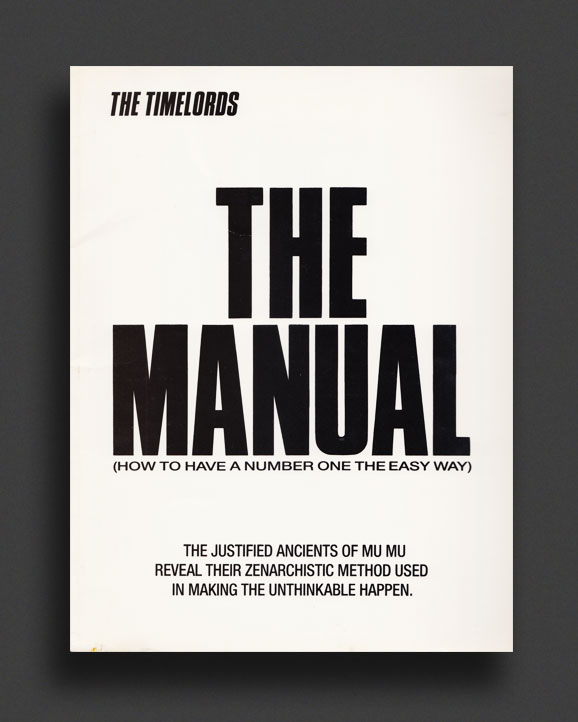
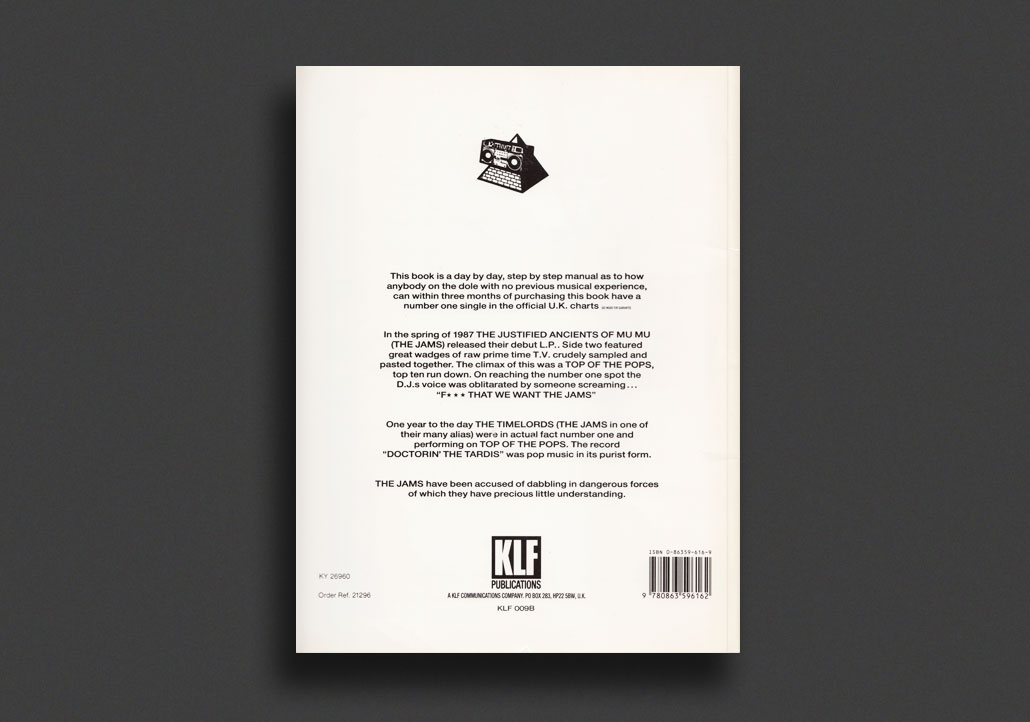
Extremely rare very first 1988 edition of The Manual (How to Have a Number One the Easy Way), the legendary publication by "The Timelords" ("Time Boy" and "Lord Rock", aliases of Bill Drummond and Jimmy Cauty, better known as The KLF). The Manual is a 'Zenarchistic' step-by-step guide to achieving a No.1 single with no money or musical skills, and a case study of the duo's UK novelty pop No. 1 "Doctorin' the Tardis". The Manual is an unparalleled expose of the reality behind the pop-music business and while names may have changed since its first issue, the mechanics of financing, producing and promoting a hit set out here remain absolutely relevant.
"Firstly, you must be skint and on the dole. Anybody with a proper job or tied up with full time education will not have the time to devote to see it through... Being on the dole gives you a clearer perspective on how much of society is run... having no money sharpens the wits. Forces you never to make the wrong decision. There is no safety net to catch you when you fall." "If you are already a musician stop playing your instrument. Even better, sell the junk."
Very collectible in this first, self-published large format edition (KLF009B). The following editions (also very hard to find) were much smaller in format with differing graphics and contents.
Very Good, clean copy, with only light wear to stiff covers and corners.
2015, English
Softcover, 48 pages, 21 x 14.8 cm
Ed. of 300,
1st Edition, Out of print title / used / fine
Published by
Der Konterfei / Vienna
$40.00 - In stock -
Rare first edition of 300 copies, later reprinted, all editions long out–of–print.
When it comes to pop music, conceptual art, audacious positioning, and fierce artistic independence, there is simply no way around Bill Drummond. The KLF, The Timelords, The Justified Ancients of Mu Mu (J.A.M.S.), The K Foundation, The 2K, K2 Plant Hire Ltd. – these were all projects that aimed to attack established pop practices by means of easily-acquired sampling technology.
Bill ceased being interested in the pop business a long time ago. Nonetheless, music is still at the centre of his current endeavours. The present book is a summary of his recorded lecture at Spoiler, MuseumsQuartier Vienna 2002, which for the past thirteen years has been available only as a single-copy library DVD.
Despite the fact that Bill is loath to look back at the past and always directs his focus to the here and now, or rather because of this, I deemed it necessary to highlight his vast artistic range, development, and process of the last thirty years by means of this contemporary document and to present it to a younger generation. For the concept of time plays a special role in Drummond’s work. Whether as The Timelords, or in songs like ‘What Time is Love?’ or ‘3 A.M. Eternal,’ or via metaphorical numbers like 23, 33⅓, or 45, or his current World Tour 2014-2025 Bill has always thought, planned, acted, and reacted in structural time periods.
Near Fine copy with only shelf rubbing to gloss boards.
1976, English
Softcover, 174 pages, 21.5 x 14 cm
1st Edition, Out of print title / used / good
Published by
Ernst Eulenburg Ltd / London
$55.00 - In stock -
Scarce copy of the first 1976 English edition of 'Debussy: Impressionism & Symbolism', a classic musicology book by Polish musicologist Stefan Jarociński, examining the composer's work against the broader aesthetic backdrop of the era, arguing that Debussy's music is much more deeply connected to the Symbolist movement than to visual Impressionism. Published by Ernst Eulenburg Ltd, London.
Translated from the French by Rollo Myers
Preface by Vladimir Jankelevitch
From the first, Debussy's music lent itself to all kinds of convenient critical labels, of which the most fashionable has always been 'impressionist'. In this book the doyen of Polish musicologists examines Debussy's output against the twin backgrounds of his upbringing and of contemporary movements in the other arts besides music. He concludes that the 'impressionist' analogy between music and painting has been too deceptively obvious, and that the movement with which Debussy's art is most deeply impregnated is Symbolism. This he shows by a review of the general aesthetic ferments of the age, by close analysis of Debussy's music, his early works in particular, and by well-directed quotation from Debussy's own many writings on the subject. In the course of his argument he leads the reader down many unexpected bypaths in aesthetics: his book is both an original contribution to musicology and a philosophical meditation on the whole of the art of this unusually fertile and adventurous period.
G–VG copy with some creaing to boards/spine, but overall very nice, lightly aged copy.
1972 / 1975, English
Softcover, 238 pages, 21.5 x 14 cm
1st Edition, Out of print title / used / very good
Published by
Rider and Company / London
$65.00 - In stock -
Scarce first 1972 edition, second 1975 printing, of 'Eliphas Lévi and the French Occult Revival', a seminal academic study by historian Christopher McIntosh, which explores the profound impact of the 19th-century French magician on modern Western esotericism, published by Rider & Company.
Eliphas Lévi is one of the key figures of Western occultism and the man of whom Aleister Crowley claimed to be the rein-carnation. This is the first full study in English of the life and writings of this colourful man and the occult revival of which he was part. This book not only brings out the sensational aspects of this era, but also analyses its importance in the history of occultism, giving much detailed information on some hitherto little-known magical orders. It also provides, for the first time, an objective and sympathetic assessment of Lévi's magical teaching.
•.. he was a fascinating character. McIntosh brings him to life in this fluent scholarly work.'–Psychic News
"This is a clearly-written and sympathetic account of the life and times of one of the most influential men in the history of occultism. Very few personal details have hitherto been published in English about Eliphas Lévi..."–Prediction
'The lively curiosity... is one which in my case Mr Mcintosh has satisfied and excited further with this serious, unsensational study of the arcane side of our pursuit and exercise of power.'–Country Life
VG copy. Light wear to boards.
1997, English
Softcover, 138 pages, 21.5 x 14 cm
1st Edition, Out of print title / used / very good
Published by
Praeger Publishers Inc. / New York
$50.00 - Out of stock
First 1997 edition.
"The Last Modernist's strength lies in its melange of critical thought. The seven essays and one interview present compelling judgments about Andropoulos's art, and the cultural, historical, and political processes that it involves.... essential reading."–Cineaste
"Theo Angelopoulos is widely regarded as one of the most distinctive of contemporary filmmakers and a highly idiosyncratic film stylist. His work, from the early 1970s to The Beekeeper, Landscape in the Mist, The Suspended Step of the Stork and the recent Cannes prize-winner, Ulysses' Gaze, demonstrates a unique sensibility, and a preoccupation with form (notably the long take, space and time) and with content, particularly Greek politics and history, and notions of the journey, border-crossing, exile and nostalgia.
This new collection of essays, including contributions from David Bordwell and Fredric Jameson, surveys Angelopoulos' entire cinematic output, and presents an intelligent and articulate discussion of his major films, themes and concerns. The authors argue that Angelopoulos' sustained œuvre has kept alive the tradition of postwar modernism - the cinema of Antonioni, Jancsó and Ozu - in the largely hostile climate of the 1980s and 1990s. In Bordwell's words, "at a moment when European cinema, both popular and elitist, seems to be breathing its last, Angelopoulos' work can endow our world of snack bars, video clips and ethnic wars with an astringent, contemplative beauty"."
Andrew Horton teaches in the English Department at Loyola University, and has written about Angelopoulos since 1975. Among his most recent books are Russian Critics On the Cinema of Glasnost (with Michael Brashinsky) and Writing the Character-Centered Screenplay (both 1994).
VG copy, light wear/age to boards.
1966, English
Softcover, 254 pages, 18.5 x 11 cm
1st Edition, Out of print title / used / very good
Published by
E P Dutton / New York
$25.00 - In stock -
First 1966 softcover edition of The New Art, the seminal anthology edited by Gregory Battcock, featuring contributing essays from prominent mid-century artists, critics, and art historians: Lucy R. Lippard, Marcel Duchamp, Alan Solomon, Ad Reinhardt, Allen Leepa, Clement Greenberg, Dore Ashton, E. C. Goossen, Gregory Battcock, Henry Geldzahler, John Cage, Kenneth King, Lawrence Alloway, Leo Steinberg, Martin Ries, Max Kozloff, Nicolas Calas, Sam Hunter, Samuel Adams Green, Susan Sontag, Thomas B. Hess. Illustrations of works by Henri Matisse, Jasper Johns, Frank Stella, Marcel Duchamp, Robert Morris, Paul Brach, Andy Warhol, Paul Thek.
"Today's critic is beginning to seem almost as essential to the development-indeed, the identification-of art as the artist him-self. The purpose of this volume is to bring together some of the best recent critical essays on the new art in the United States.
Most of these articles date from after 1960, and were originally published in periodicals and museum catalogues. But in keeping with the new role of the critic as interpreter, the pieces included in this anthology do more than simply describe, or even define their subject; their authors are actively and consciously engaged in the preparation of a new aesthetic. This is a unique collection that will be indispensable to all who wish to understand more about the new art in America."
VG copy with board/block tanning and some wear to board extremities.
1965 / 1972, English
Softcover, 278 pages, 20.2 x 13.5 cm
1st Edition, Out of print title / used / very good
Published by
Beacon Press / Boston
$40.00 - In stock -
First 1965 Beacon Press paperback edition (fifth 1972 print) of influential 20th-century American art critic Clement Greenberg's seminal 1961 book, Art and Culture: Critical Essays. This widely read collection cemented his legacy as a defining voice in American modern art theory establishing the theoretical framework for modernist art, championing the separation of "high art" from mass culture and advocating for Abstract Expressionism and the rise of the New York School, promoting artists like Jackson Pollock and Willem de Kooning as the true successors to the European modernist tradition.
"Clement Greenberg is, internationally, the best-known American art critic popularly considered to be the man who put American vanguard painting and sculpture on the world map. . . . An important book for everyone interested in modern painting and sculpture."—The New York Times
G—VG copy with some light wear to boards, tanning, previous owner's name to title page, erasereable light pencil underling to first few pages of first text.
2014, English
Softcover, 240 pages, 145 x 210 mm
1st Edition, Out of print title / used / very good
Published by
The MIT Press / Massachusetts
Whitechapel / London
$65.00 - In stock -
Out of print volume of Documents of Contemporary Art Series tracing the identification of art with sexual expression or repression, from the era of the rights movements to the present.
It has been argued, most notably in psychoanalytic and modernist art discourse, that the production of works of art is fundamentally driven by sexual desire. It has been further argued, particularly since the early 1970s, that sexual drives and desires also condition the distribution, display and reception of art.
This anthology traces how and why this identification of art with sexual expression or repression arose and how the terms have shifted in tandem with artistic and theoretical debates, from the era of the rights movements to the present. Among the subjects it discusses are abjection and the “informe,” or formless; pornography and the obscene; the performativity of gender and sexuality; and the role of sexuality in forging radical art or curatorial practices in response to such issues as state-sponsored repression and anti-feminism in the broader social realm.
Artists surveyed include:
Vito Acconci, Assume Vivid Astro Focus, Lynda Benglis, Louise Bourgeois, Gerard Byrne, George Chakravarthi, Judy Chicago, Vaginal Davis, Wim Delvoye, Elmgreen & Dragset, Valie Export, Félix González-Torres, Guillermo Gómez-Peña, Harmony Hammond, Claudette Johnson, Mary Kelly, Yayoi Kusama, Robert Legorreta, Paul McCarthy, Sarah Maple, Shirin Neshat, Lorraine O’Grady, Yoko Ono, Catherine Opie, Orlan, William Pope.L, Miriam Schapiro, Carolee Schneemann, Joan Semmel, Barbara Smith, Annie Sprinkle, Alina Szapocznikow, Del LaGrace Volcano, Hannah Wilke, David Wojnarowicz
Writers include:
Malek Alloula, Norman O. Brown, Judith Butler, Douglas Crimp, Angela Dimitrakaki, Michel Foucault, Daniel Guérin, Eleanor Heartney, Jonathan D. Katz, Rosalind Krauss, Julia Kristeva, Paweł Leszkowicz, Herbert Marcuse, Kobena Mercer, Laura Mulvey, Lawrence Rinder, Jacqueline Rose, Eve Kosofsky Sedgwick, Susan Sontag, Trinh T. Minh-ha, Stephen Whittle
About the Editor
Amelia Jones is Grierson Chair in Art History and Communication Studies at McGill University. Her books include Irrational Modernism: A Neurasthenic History of New York Dada (MIT Press), Self/Image: Technology, Representation and the Contemporary Subject, and Seeing Differently: A History and Theory of Identification and the Visual Arts.
VG copy.
1987, English
Softcover, 284 pages, 20.2 x 12.2 cm
1st Edition, Out of print title / used / very good
Published by
University of California / Berkeley
$80.00 - In stock -
Rare first 1987 edition of this wonderful book of urban ecology, documenting the ecosystems of (not so) vacant lots, weedy waysides and roadways.
Vacant lots aren't really vacant: a surprising number of plants and animals live in the left-over spaces in our cities. In this fascinating guide, authors Vessel and Wong provide a broad introduction to the unique ecosystems that can survive in the urban environment.—publisher
"An imaginative introduction to the tenacious plants and animals that battle people and pollution to survive. Anyone concerned with the natural environment will be delighted by Vessel and Wong's guided tour of this unexpected territory."–Tim Larimer, San Jose Mercury News
"Placed in the right hands, this book could help fuel another generation of environmentalists. ... In topical chapters and species accounts the authors introduce us to more than 300 denizens of ignored urban places. They do so in clear, straightforward prose, accompanied by good line drawings and photos. Their inclusions and exclusions are selected with care and intelligence."–Gary Mozel, Naturalist Review
"The book contains very good and useful descriptions of plants and animals regularly found in neglected lots throughout California... Part of the value of a little book like this is that it opens your eyes to things you would otherwise miss."–Lee Dembart, Los Angeles Times
Matthew F. Vessel is Professor Emeritus of Natural Science at San Jose State University. Herbert H. Wong was formerly Professor of Environmental Education at Western Washington State University and Lecturer at the University of California, Berkeley.
Very Good copy, tightly bound, light wear to board extremities.
2025, English
Softcover + flexi–disc, 184 pages, 26 x 19.5 cm
Limited Edition,
Published by
First To Knock / Michigan
$72.00 - In stock -
Limited-edition version with flexi-disc recording of Satie’s “Leit-motiv du Panthée” performed, as intended, as an accompaniment to a reading of Joséphin Péladan’s Le Panthée.
In 1892, Erik Satie was at a crossroads. Despite having already composed some of the finest works ever written for piano, the 26-year-old was still penniless and unappreciated. His artistic ethos—a paradoxical mix of reactionary Medievalism and avant-garde absurdism—could find no quarter in fin-de-siècle Paris. And so, with his musical aspirations dashed and nowhere left to turn, Satie would turn to himself.
His subsequent revolt was as shocking as it was incomprehensible to his contemporaries. Satie announced himself to be “the Parcener,” the head of a new religious order. It was, in fact, a church of his own founding—The Metropolitan Church of Art of Jesus the Conductor.
Transforming his dilapidated apartment into an “Abbatial Church,” Satie began issuing scathing letters to prominent cultural figures who had sought to render judgment upon his Art. Targets of the Parcener’s screeds ranged from the cape-clad mystagogue, Joséphin Péladan, to the pompous composer, Camille Saint-Saëns; from the novelist Octave Mirbeau, who had dared to lampoon the Parcener, to the theatre director Aurélien Lugné-Poe, whose unintentionally nude stage production had offended the Parcener’s moral sensibilities. The fiercest feud was reserved for music critic Henry Gauthier-Villars, whom the Parcener battled in the press for years, until the spat culminated in a physical altercation at a concert. Throughout the 1890s, luminaries, such as these, found themselves excommunicated from a church to which they had not even known they once belonged.
Inscrutable as the author himself, Satie’s writings from this brief period strike a tone that lies somewhere between fervent Catholicism, anarchistic satire, and the righteous rage of the true Artist—leaving readers befuddled as to the composer’s true intent. Yet, despite the impenetrability of his writings, the Parcener’s missives took the Parisian art scene by storm and, as Satie’s crusade grew in intensity, so too did his reputation, making this era as historically crucial as it is bewildering. Nevertheless, the Metropolitan Church was ultimately a solitary undertaking. Despite certain documents indicating that the Church expected to have more than a billion members, history would show that its congregation never grew beyond one: Erik Satie himself.
Know Me To Be Your Superior in Everything is the first book dedicated exclusively to the story of Erik Satie’s Metropolitan Church of Art of Jesus the Conductor. Drawing upon a multitude of firsthand sources—including documents held in the Erik Satie archives in Caen—the book includes new English translations of all known Church publications and correspondence by Satie as the Parcener. Facsimilic translations of Satie’s Church publications are reproduced herein as well, capturing, for the first time in English, the design and typography of the original productions.
Know Me To Be Your Superior in Everything was written by Sam Kunkel, a scholar of 19th century Symbolist literature. Previous to this book, Kunkel has also provided translations for Echoes of a Natural World—Tales of the Strange & Estranged (First To Knock, 2020); A Beam of Sunlight in the Deep Forest—Mystical Prose Works by Édouard Schuré (First To Knock, 2021); as well as The Solar Circus by Gustave Kahn (First To Knock, 2022). Kunkel has also written extensively in French, covering topics such as Joséphin Péladan and religion in fin-de-siècle Paris. His critical reedition of Péladan’s notorious novel, Istar, was published by Éditions du Lérot in 2024, and his book, L’Orphisme et le roman post-romantique, a comparative study of the mystical novel, was released by Éditions Otrante in 2023.
Design by Bryan Cipolla
1974, Japanese
Softcover (staple–bound), 90 pages, 21 x 15 cm
1st Edition, Out of print title / used / very good
Published by
Spin / Tokyo
$45.00 - Out of stock
Rare copy of Dabu–dabo No. 25, published in Tokyo in 1974, with original cover art painted by Aquirax Uno (Akira Uno). Dabu-dabo was wild countercultural lifestyle magazine ("A Lifestyle Catalog of Dawn Culture") that featured artwork, photography, manga and articles that proposed "new human life materials for the global village." This issue features an interview with author/model/actress/icon Izumi Suzuki, photography by Hajime Sawatari, jazz musician Sadao Watanabe, illustration galleries by avant–garde artist and author Genpei Akasegawa, Ayumi Ohashi and Teruya Harada, Hiro Tsunoda of the Sadistic Mika Band and psych legends Jacks, nude photography by Kenji Hiruma, poet and folk singer Shigeru Izumiya, a host of informative feature articles on "Commune Practices": developing commune practices, including the use of geodesic domes and inflatable housing, the farming practices of Japanese folk singer Masato Minami, DIY solar thermal devices, and much more. Like Goro meets CoEvolution Quarterly via Oz!
VG with light wear to extremities, rusted staples.
2025, English
Hardcover, 80 pages, 17.8 x 12.1 cm
Published by
Further Reading Library / New York
$55.00 - In stock -
Inventor, designer, artist and musician Thomas Wilfred (1889–1968) devoted his life to the creation of a new art form – “Lumia,” or the art of light. He invented his own version of a colour organ (a term he disliked) and dubbed it the Clavilux, from the Latin meaning “light played by key.” This title presents a stimulating collection of archival material culled from the Wilfred archive at Yale University and other sources, including Wilfred’s never-before-published sketches.
After a successful international tour in the 1920s, Wilfred reinvented these large-scale performances as self-enclosed light shows for domestic entertainment. While they enjoyed a short commercial life, Wilfred’s aesthetically elegant and interactive Clavilux and Lumia home models soon found their way into storied collections. His work was included in the Museum of Modern Art’s 1952 exhibition 15 Americans, where it was seen by many artists who would work with light as their medium in the 1960s and ’70s.
THE FURTHER READING LIBRARY is an ongoing series of books dedicated to forgotten ideas, overlooked accomplishments, and idiosyncratic world views. Each book explores — through a collection of original documents, photographs, and primary source material — a body of work, a specific topic, or an individual. Modeled on the size and range of topics of the King Penguin and Insel-Bücherei series, The Further Reading Library is edited by Christine Burgin and Andrew Lampert.
Christine Burgin is a publisher and former gallerist. Her publications include books by Hilma af Klint, Robert Walser, Emily Dickinson, and Susan Howe and projects with artists Rodney Graham, Matt Mullican, and Allen Ruppersberg.
christineburgin.com
Andrew Lampert is an artist, writer, and curator. His moving-image, photo, and performance works have been widely exhibited at international venues, and he has edited books on Tony Conrad, George Kuchar, and Harry Smith, among others. The former Curator of Collections at Anthology Film Archives, Lampert is co-author with Howie Chen of the advice columns Hard Truths and Hard Choices for Art in America.
2025, English
Hardcover, 88 pages, 17.8 x 12.1 cm
Published by
Further Reading Library / New York
$55.00 - In stock -
Science fiction writer Richard Sharpe Shaver believed that rocks were books imprinted with valuable information about such mythical ancient races as the Lemurians and Atlanteans. This title contains a generous selection of 'Rokfogos' accompanied by hand-typed texts in which Shaver explains – not always patiently – all that can be seen in these stones. Also included are facsimiles of his handmade books and publications, all of which he felt to be of incalculable importance to civilisation.
His controversial stories about an advanced prehistoric civilisation and a race of evil beings living at the center of the earth appeared in 'Amazing Stories' and other landmark sci-fi publications of the ’40s and ’50s.
A decade later, he was living in relative isolation and devoting himself to rock book research, a course of study that he shared with a devoted group of correspondents. Shaver believed that ancient leaders had left behind images embedded into rocks, which he then tried to interpret.
Richard Sharpe Shaver (1907–75) was an artist and author whose work frequently appeared in 1940s science fiction magazines such as Amazing Stories. He was the center of the Shaver Mystery, a controversy regarding his alleged discovery of a prehistoric civilization, which sparked mass interest and a devoted following that continues to this day.
THE FURTHER READING LIBRARY is an ongoing series of books dedicated to forgotten ideas, overlooked accomplishments, and idiosyncratic world views. Each book explores — through a collection of original documents, photographs, and primary source material — a body of work, a specific topic, or an individual. Modeled on the size and range of topics of the King Penguin and Insel-Bücherei series, The Further Reading Library is edited by Christine Burgin and Andrew Lampert.
Christine Burgin is a publisher and former gallerist. Her publications include books by Hilma af Klint, Robert Walser, Emily Dickinson, and Susan Howe and projects with artists Rodney Graham, Matt Mullican, and Allen Ruppersberg.
christineburgin.com
Andrew Lampert is an artist, writer, and curator. His moving-image, photo, and performance works have been widely exhibited at international venues, and he has edited books on Tony Conrad, George Kuchar, and Harry Smith, among others. The former Curator of Collections at Anthology Film Archives, Lampert is co-author with Howie Chen of the advice columns Hard Truths and Hard Choices for Art in America.
2025, English
Hardcover, 88 pages, 17.8 x 12.1 cm
Published by
Further Reading Library / New York
$50.00 - In stock -
Loïe Fuller’s (1862–1928) luminously radical dance performances at the turn of the century were unlike anything that had ever been staged or seen before. While her profound influence on writers and artists such as Mallarmé and Rodin is well documented, less well known is Fuller’s passion for technology and her involvement with the leading scientists of the time. This title spotlights Fuller’s scientific forays in her own words alongside an array of archival documents and photographs of the dancer in action.
In her 'Serpentine Dance', she wore a large, diaphanous gown she manipulated with her arms to form undulating waves, while coloured lights projected onto the fabric gave the illusion of birds, animals or flowers. The centrepiece of the book is her 1907 lecture on the invention of radium, her notes on meeting Marie and Pierre Curie and Thomas Alva Edison, and her literally explosive efforts to create a glow-in-the-dark dance performance.
Featuring an introduction by renowned cinema scholar Tom Gunning, this book presents Fuller’s eccentric passions and pioneering pursuits in a fresh light.
THE FURTHER READING LIBRARY is an ongoing series of books dedicated to forgotten ideas, overlooked accomplishments, and idiosyncratic world views. Each book explores — through a collection of original documents, photographs, and primary source material — a body of work, a specific topic, or an individual. Modeled on the size and range of topics of the King Penguin and Insel-Bücherei series, The Further Reading Library is edited by Christine Burgin and Andrew Lampert.
Christine Burgin is a publisher and former gallerist. Her publications include books by Hilma af Klint, Robert Walser, Emily Dickinson, and Susan Howe and projects with artists Rodney Graham, Matt Mullican, and Allen Ruppersberg.
christineburgin.com
Andrew Lampert is an artist, writer, and curator. His moving-image, photo, and performance works have been widely exhibited at international venues, and he has edited books on Tony Conrad, George Kuchar, and Harry Smith, among others. The former Curator of Collections at Anthology Film Archives, Lampert is co-author with Howie Chen of the advice columns Hard Truths and Hard Choices for Art in America.
2024, English
Softcover, 416 pages, 21.6 x 13.8 cm
Published by
SPBH Editions / UK
$89.00 $65.00 - In stock -
The cult periodical Little Joe, published as a limited-edition zine from 2010 to 2021, challenged the mainstream narrative of film history with a rebellious, queer perspective. Rather than reviewing new releases, it explored forgotten and overlooked films and celebrated a diverse spectrum of cinema – from obscure art films to porn to Hollywood classics – as worthy of critical debate. Stubbornly print-only, Little Joe was notoriously hard to find, privileging word-of-mouth distribution akin to the films it championed. This volume, compiled by editor-in-chief Sam Ashby, brings together the best of its previously elusive texts and proposes a new, alternative cinematic canon drawn from the fringes of taste and style, while paying homage to the original DIY Risograph aesthetic of the journal.
This volume features essays, in-depth conversations, short stories and archival discoveries from a host of queer and allied writers, artists, filmmakers, and academics, including John Waters, Sarah Schulman, Douglas Crimp, William E. Jones, Erika Balsom, Jeremy Atherton Lin, John Greyson, Elizabeth Purchell, Liz Rosenfeld, Peter Strickland, Ira Sachs, Terence Davies, Shu Lea Cheang, Kevin Killian, Wayne Koestenbaum, Abdellah Taïa, Marlene McCarty, John Cameron Mitchell, Rosa von Praunheim, Stuart Comer, Ed Halter, Jenni Olson, A.L. Steiner, A.K. Burns, Desiree Akhavan, and Andrew Haigh.
2007, English
Softcover, 458 pages, 10.7 x 17.5 cm
Published by
Urbanomic / Cornwall
$65.00 - In stock -
Philosophical Research and Development.
Edited by Robin Mackay
Associate Editor: Dustin McWherter
Collapse III contains explorations of the work of Gilles Deleuze by pioneering thinkers in the fields of philosophy, aesthetics, music and architecture. In addition, we publish in this volume two previously untranslated texts by Deleuze himself, along with a fascinating piece of vintage science fiction from one of his more obscure influences. Finally, as an annex to Collapse Volume II, we also include a full transcription of the conference on 'Speculative Realism' held in London in 2007.
The contributors to this volume aim to clarify, from a variety of perspectives, Deleuze's contribution to philosophy: in what does his philosophical originality lie; what does he appropriate from other philosophers and how does he transform it? And how can the apparently disparate threads of his work to be 'integrated' - what is the precise nature of the constellation of the aesthetic, the conceptual and the political proposed by Gilles Deleuze, and what are the overarching problems in which the numerous philosophical concepts 'signed Deleuze' converge?
Contents
ROBIN MACKAY - Editorial Introduction
THOMAS DUZER - In Memoriam: Gilles Deleuze 1925-1995
GILLES DELEUZE - Responses to a Series of Questions
ARNAUD VILLANI - "I Feel I Am A Pure Metaphysician": The Consequences of Deleuze's Remark
QUENTIN MEILLASSOUX - Subtraction and Contraction: Deleuze, Immanence and Matter and Memory
HASWELL & HECKER - Blackest Ever Black
GILLES DELEUZE - Mathesis, Science and Philosophy
INCOGNITUM - Malfatti's Decade
JOHN SELLARS - Chronos and Aion: Deleuze and the Stoic Theory of Time
ÉRIC ALLIEZ & JEAN-CLAUDE BONNE - Matisse-Thought and the Strict Ordering of Fauvism
MEHRDAD IRAVANIAN - Unknown Deleuze
J.-H. ROSNY THE ELDER - Another World
RAY BRASSIER, IAIN HAMILTON GRANT, GRAHAM HARMAN, QUENTIN MEILLASSOUX - Speculative Realism