World Food Books' programme is largely produced on Kulin Nation land. We acknowledge the Wurundjeri people of the Kulin Nation as the first and continuing custodians of this land, and pay respect to their Elders past, present, and emerging.
World Food Books is an arts and special interests bookshop in Naarm / Melbourne. Founded in 2010, World Food Books is devoted to the presentation of a rotating, hand-selection of international art, design, literary and counterculture publications with an emphasis on the anti-traditional, the experimental, the avant-garde, the heretic, the marginal.
Presenting new titles alongside rare and out-of-print books, catalogues and journals spanning the fields of modern and contemporary art, design, photography, illustration, film, literature, poetry, cultural theory, philosophy, sexuality, popular and underground culture in its many radical forms, World Food Books wishes to encourage adventurous, thoughtful and open-minded reading, looking, writing, and exchange of publishing and ideas, both current and historical.
As well as our bookshop, located in Melbourne's historical Nicholas Building, all of our inventory is available internationally via our online mail-order service.
World Food Books semi-regularly co-ordinates "Occasions", a programme of exhibits and events at the bookshop and in partnership with other hosts (such as museums and art galleries) that develop out of the activities, relationships and content of the bookshop itself.
World Food Books
The Nicholas Building
37 Swanston Street
Room 5, Level 6
Melbourne 3000
Australia
SHOP HOURS:
Thu–Fri 12–6, Sat 12–5
WEB-SHOP OPEN 24/7
World Food Books
Postal Address:
PO Box 435
Flinders Lane
Victoria 8009
Australia
Art
Theory / Essay
Architecture / Interior
Graphic Design / Typography
Photography
Fashion
Eros
LGBTQ+
Fiction / Poetry
Weird / Speculative / Science Fiction / Horror
Transgressive / Visceral / Abject
Symbolism / Decadence / Fin de siècle
Film / Video
Painting
Sculpture / Installation
Performance / Dance / Theater
Drawing
Sound / Music
Curatorial
Group Shows / Collections
Periodicals
Out-of-print / Rare
Posters / Ephemera / Discs
Signed Books
World Food Books Gift Voucher
World Food Book Bag
Australian Art
Australian Fiction
Australian Science Fiction / Speculative Fiction
Australian Poetry
Australian Photography
Japanese Photography
Conceptual Art
Minimal Art
Dada
'Pataphysics / Oulipo
Fluxus
Concrete Poetry
Pop Art
Surrealism
Arte Povera
Arte Informale / Haute Pâte / Tachism
Nouveau Réalisme / Zero / Kinetic
Situationism / Lettrism
Collage / Mail Art / Xerox Art
Art Brut / Folk / Visionary / Fantastic
Illustration / Graphic Art / Bandes Dessinées
Furniture
Italian Radical Design / Postmodernism
Textiles
Ceramics / Glass
Counterculture
Protest / Revolt
Philosophy
Psychoanalysis
Anthropology
Anarchism
Socialism / Anarchism / Communism / Capitalism
Literary Theory / Semiotics / Language
Feminism / Women's Studies
Gender Studies / Sexuality
Anthropology
Fetishism / BDSM
Drugs / Psychedelia
Crime / Violence
Animal Rights / Veganism
Occult / Esoterica
Ecology / Earth / Alternative Living
Whole Earth / Crafts
All prices in AUD (Australian dollars)
Pick-Ups
Pick-up orders can be collected in our bookshop during opening hours after order date. Please collect any Pick-up orders within 2 weeks of ordering as we have limited storage space. Orders will be released back into stock if not collected within this time. No refunds can be made for pick-ups left un-collected. If you cannot make it in to the bookshop in this time-frame, please choose postage option.
Return Policy
All sales are final. We do accept returns (for refund or exchange) for items received in error. All our orders are packed with special care using heavy-duty padding and cardboard book-mailers or bubble mailers (for smaller books), using reinforcement where required. We cannot take responsibility for any lost, stolen or damaged parcels.
Insurance
Should you wish to insure your package, please email us directly after placing your order and we can organise this at a small extra expense. Although all standard/express tracked packages are very safe and dependable, we cannot take responsibility for any lost, stolen or damaged parcels. We recommend insurance on valuable orders.
Interested in selling your old books, catalogues, journals, magazines, comics, fanzines, ephemera? We are always looking for interesting, unusual and out-of-print books to buy. We only buy books in our fields of interest and specialty, and that we feel we can resell.
We base these prices on desirability, market value, in-print prices, condition and our current stock levels. We offer cash, store credit, and can take stock on consignment. All
about 25% of the price we expect to get when we sell them, or 30% in store credit. We base these prices on desirability, market value, in-print prices, condition and our current stock levels.
Sell your books any day of the week. You can drop them off and return later. If you have a lot of books, we can visit your Sydney home.
We buy books that we feel we can resell. We offer about 25 % of the price we expect to get when we sell them, or 30% in store credit. We base these prices on desirability, market value, in-print prices, condition and our current stock levels.
Philadelphia Wireman
03 August - 01 September, 2018
World Food Books is proud to announce our next Occasion, the first presentation of sculptures by Philadelphia Wireman in Australia.
The Philadelphia Wireman sculptures were found abandoned in an alley off Philadelphia’s South Street on trash night in 1982. Their discovery in a rapidly-changing neighbourhood undergoing extensive renovation, compounded with the failure of all attempts to locate the artist, suggests that the works may have been discarded after the maker’s death. Dubbed the "Philadelphia Wireman" during the first exhibition of this work, in 1985, the maker’s name, age, ethnicity, and even gender remain uncertain. The entire collection totals approximately 1200 pieces, all intricately bound together with tightly-wound heavy-gauge wire (along with a few small, abstract marker drawings, reminiscent both of Mark Tobey and J.B. Murry). The dense construction of the work, despite a modest range of scale and materials, is singularly obsessive and disciplined in design: a wire armature or exoskeleton firmly binds a bricolage of found objects including plastic, glass, food packaging, umbrella parts, tape, rubber, batteries, pens, leather, reflectors, nuts and bolts, nails, foil, coins, toys, watches, eyeglasses, tools, and jewellery.
Heavy with associations—anthropomorphic, zoomorphic, and socio-cultural responses to wrapped detritus—the totemic sculptures by Philadelphia Wireman have been discussed in the context of work created to fulfil the shamanistic needs of alternative religions in American culture. Curators, collectors, and critics have variously compared certain pieces to sculpture from Classical antiquity, Native American medicine bundles, African-American memory jugs, and African fetish objects. Reflecting the artist’s prolific and incredibly focused scavenging impulse, and despite—or perhaps enhanced by—their anonymity, these enigmatic objects function as urban artefacts and arbiters of power, though their origin and purpose is unknown. Philadelphia Wireman, whatever their identity, possessed an astonishing ability to isolate and communicate the concepts of power and energy through the selection and transformation of ordinary materials. Over the course of the past two decades, this collection has come to be regarded as an important discovery in the field of self-taught art and vernacular art.
Presented in collaboration with Fleisher-Ollman Gallery, Philadelphia, and Robert Heald, Wellington.
Susan Te Kahurangi King
02 February - 10 March, 2018
Susan Te Kahurangi King (24 February 1951 - ) has been a confident and prolific artist since she was a young child, drawing with readily available materials - pencils, ballpoint pens and felt-tip markers, on whatever paper is at hand. Between the ages of four and six Susan slowly ceased verbal communication. Her grandparents William and Myrtle Murphy had developed a special bond with Susan so they took on caring responsibilities for extended periods. Myrtle began informally archiving her work, carefully collecting and storing the drawings and compiling scrapbooks. No drawing was insignificant; every scrap of paper was kept. The King family are now the custodians of a vast collection containing over 7000 individual works, from tiny scraps of paper through to 5 meter long rolls.
The scrapbooks and diaries reveal Myrtle to be a woman of great patience and compassion, seeking to understand a child who was not always behaving as expected. She encouraged Susan to be observant, to explore her environment and absorb all the sights and sounds. Myrtle would show Susan’s drawings to friends and people in her community that she had dealings with, such as shopkeepers and postal workers, but this was not simply a case of a grandmother’s bias. She recognised that Susan had developed a sophisticated and unique visual language and sincerely believed that her art deserved serious attention.
This was an unorthodox attitude for the time. To provide some context, Jean Dubuffet coined the term Art Brut in 1945 to describe work created by self-taught artists – specifically residents of psychiatric institutions and those he considered to be visionaries or eccentrics. In 1972 Roger Cardinal extended this concept by adopting the term Outsider Art to describe work made by non-academically trained artists operating outside of mainstream art networks through choice or circumstance. Susan was born in Te Aroha, New Zealand in 1951, far from the artistic hubs of Paris and London that Dubuffet and Cardinal operated in. That Myrtle fêted Susan as a self-taught artist who deserved to be taken seriously shows how progressive her attitudes were.
Susan’s parents Doug and Dawn were also progressive. Over the years they had consulted numerous health practitioners about Susan’s condition, as the medical establishment could not provide an explanation as to why she had lapsed into silence. Dawn educated herself in the field of homeopathy and went on to treat all twelve of her children using these principles – basing prescriptions on her observations of their physical, mental and emotional state.
Doug was a linguist with an interest in philosophy who devoted what little spare time he had to studying Maori language and culture. To some extent their willingness to explore the fringes of the mainstream made them outsiders too but it was their commitment to living with integrity and their respect for individuality that ensured Susan’s creativity was always encouraged.
Even though Susan’s family supported her artistic pursuits, some staff in schools and hospitals saw it as an impediment to her assimilation into the community and discouraged it in a variety of ways. Her family was not always aware of this and therefore did not fully understand why Susan stopped drawing in the early 1990s. However, rather than dwell on the challenges that Susan faced in pursuit of her artistic practice, they prefer to highlight her achievements. In 2008 Susan began drawing again in earnest, after an almost 20 year interruption, and her work is now shown in galleries around the world.
Susan grew up without television and has been heavily influenced by the comics she read as a child. She is absolutely fearless in the appropriation of recognizable characters, such as Donald Duck and Mickey Mouse, in her work. She twists their limbs, contorts their faces, compresses them together, blends them into complex patterned backgrounds - always imbuing them with an incredible energy. Although Susan often used pop culture characters in her work they are not naive or childlike. These are drawings by a brilliant self-taught artist who has been creating exceptional work for decades without an audience in mind.
Mladen Stilinović
"Various Works 1986 - 1999"
02 February 16 - September 10, 2016
Various works 1986 - 1999, from two houses, from the collections of John Nixon, Sue Cramer, Kerrie Poliness, Peter Haffenden and Phoebe Haffenden.
Including: Geometry of Cakes (various shelves), 1993; Poor People’s Law (black and white plate), 1993; White Absence (glasses, ruler, set square, silver spoon, silver ladel with skin photograph and wooden cubes), 1990-1996; Exploitation of the Dead (grey and red star painting, wooden painting, black spoon with red table, red plate), 1984-1990; Money and Zeros (zero tie, paintings made for friends in Australia (Sue, John, Kerrie), numbers painting), 1991-1992; Words - Slogans (various t-shirts) - “they talk about the death of art...help! someone is trying to kill me”, “my sweet little lamb”, “work is a disease - Karl Marx”; Various artist books, catalogues, monographs, videos; Poster from exhibition Insulting Anarchy; "Circular" Croatian - Australian edition; Artist book by Vlado Martek (Dostoyevsky); more.
Thanks to Mladen Stilinović and Branka Stipančić.
Jonathan Walker
Always Will Need To Wear Winter Shirt Blue + Ochre Small Check Pattern
21 August - 21 September, 2015
Untitled
I am not a great reader of poetry but I always return to the work of Melbourne poet, Vincent Buckley (1925- 1988). Perhaps I find his most tantalising piece to be not a finished poem but a fragment left on a scrap of paper discovered on his desk after the poet’s death.
The poetry gathers like oil
In the word-core, and spreads
It has its music meet,
Its music is in movement.
This fragment is more the shell left behind from a volatile thought than a finished poem. I find the last two lines honest but awkward whereas the first two lines work like an arrow. Most likely he could not find a resolution so it was left. Still, in its present form, it remains an eloquent testimony to the ultimate failure of a medium to express mobile thought and sensation, in Buckley’s case, through verbal language. It’s an important matter because this is something all artists have to deal with regardless of the medium.
I have never written a poem, however, I am forever copying fragments from books on paper scraps in a vain effort to fix certain notions in my head. At first, they function as bookmarks that are sometimes returned to when I open the book. But before long, as they accumulate, they fall out littering the table interspersed with A4 photocopies, bills, books and medications.
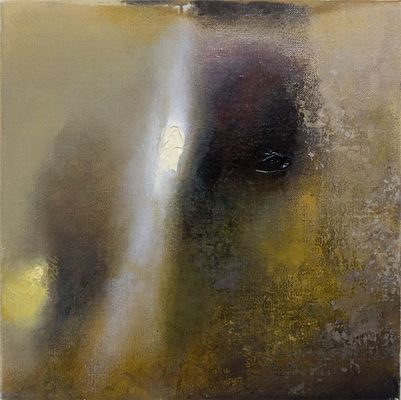
To return to Buckley’s fragment, the first two lines very much evoke how I paint nowadays. As you age, detail diminishes and patches of light become more luminous and float. I feel the most honest way of dealing with this is by smearing the oil paint on the canvas with the fingers and working close-up, blind. Only if the patches coalesce into an approaching image can the work gain a life.
-
Jonathan Walker was born in Melbourne, Australia and brought up on a dairy farm in Gippsland. In the 1970’s he studied painting at RMIT and won the Harold Wright Scholarship to the British Museum, London. During the 1980’s he exhibited at Pinacotheca Gallery, Richmond and had work shown at the NGV and Heidi City Art Gallery. Over the same period he designed the cover for the “Epigenesi” LP by Giancarlo Toniutti, Italy and conducted a mail exchange work with Achim Wollscheid, Germany. The work with artists through the post resulted in an article published in the bicentenary issue of Art and Australia 1988. He showed in artist run spaces such as WestSpace in the 90’s and 2000’s, and until 2012, taught painting at Victoria University, which is where we (Colleen Ahern and Lisa Radford) as organisers of the exhibition, among many others, had the privilege of being his student.
Walker’s knowledge was imparted to students through the careful selection of music, literature, and artists found in books that he himself had ordered for the library. Walker’s strategy was the generosity of sharing his vast knowledge with references specific to each student and their context.
Walker’s paintings share a similar focus and intimacy.
This exhibition presents a small selection of recent paintings alongside a publication that includes Walker’s writing. Observational and analytical, Walker’s work is a type of material notation — the time of day, colour and how it is blended, the both specific and fleeting location of a reflection on lino or the question of whether a chair leg should be included in a painting.
Please join us on Friday August 21 between 6-8pm to celebrate the opening of the exhibition.
Curated by Colleen Ahern and Lisa Radford.
B. Wurtz
Curated by Nic Tammens
March 26 - April 4, 2015
B.Wurtz works from a basement studio in his home on Manhattan’s Lower East Side.
This local fact is attested to by the plastic shopping bags and newsprint circulars that appear in his work. As formal objects, they don’t make loud claims about their origins but nonetheless transmit street addresses and places of business from the bottom of this long thin island. Like plenty of artists, Wurtz is affected by what is local and what is consumed. His work is underpinned by this ethic. It often speaks from a neighborhood or reads like the contents of a hamper:
“BLACK PLUMS $1.29 lb.”
“Food Bazaar”
“USDA Whole Pork Shoulder Picnic 99c lb.”
“RITE AID Pharmacy, with us it’s personal.”
“H. Brickman & Sons.”
“Sweet Yams 59c lb."
Most of the work in this exhibition was made while the artist was in residence at Dieu Donne, a workshop dedicated to paper craft in Midtown. Here Wurtz fabricated assemblages with paper and objects that are relatively lightweight, with the intention that they would be easily transportable to Australia. This consideration isn’t absolute in Wurtz’s work, but was prescriptive for making the current exhibition light and cheap. Packed in two boxes, these works were sent from a USPS post office on the Lower East Side and delivered to North Melbourne by Australia Post.
Wurtz appears courtesy of Metro Pictures, New York.
Thanks to Rob Halverson, Joshua Petherick, Sari de Mallory, Matt Hinkley, Helen Johnson, Fayen d'Evie, Ask Kilmartin, Lisa Radon, Ellena Savage, Yale Union, and "Elizabeth".
John Nixon
"Archive"
December 15 - January 20, 2014
The presentation of John Nixon's archive offered a rare showcase of this extensive collection of the artist's own publications, catalogues, posters, ephemera, editions and more, from the mid 1980s onwards, alongside a selection of his artworks.
Organized by John Nixon, Joshua Petherick and Matt Hinkley.
<a href=http://wfb.public-office.info/artist/john-nixon>All titles by John Nixon
"Habitat"
at Minerva, Sydney (organised by Joshua Petherick and Matt Hinkley)
November 15 - December 20, 2014
Lupo Borgonovo, Janet Burchill & Jennifer McCamley,
Lewis Fidock, HR Giger, Piero Gilardi, Veit Laurent Kurz,
Cinzia Ruggeri, Michael E. Smith, Lucie Stahl, Daniel Weil, Wols
Press Release:
“...It contained seven objects. The slender fluted bone, surely formed for flight, surely from the wing of some large bird. Three archaic circuitboards, faced with mazes of gold. A smooth white sphere of baked clay. An age-blackened fragment of lace. A fingerlength segment of what she assumed was bone from a human wrist, grayish white, inset smoothly with the silicon shaft of a small instrument that must once have ridden flush with the surface of the skin - but the thing’s face was seared and blackened.”
William Gibson, “Count Zero”, 1986
"Autumn Projects Archive"
Curated by Liza Vasiliou
March 6 - March 15, 2014
World Food Books, in conjunction with the Virgin Australia Melbourne Fashion Festival 2014, presented the Autumn Projects archive, consisting of a selection of early examples in Australian fashion with a particular interest in collecting designers and labels from the period beginning in the 1980’s, who significantly influenced the discourse of Australian Fashion.
Curated by Liza Vasiliou, the exhibition provided a unique opportunity to view pieces by designers Anthea Crawford, Barbara Vandenberg, Geoff Liddell and labels CR Australia, Covers, Jag along with early experimental collage pieces by Prue Acton and Sally Browne’s ‘Fragments’ collection, suspended throughout the functioning World Food Books shop in Melbourne.
H.B. Peace
presented by CENTRE FOR STYLE
November 14, 2013
"Hey Blinky, you say chic, I say same"
Anon 2013
H.B. Peace is a clothing collaboration between great friends Blake Barns and Hugh Egan Westland. Their pieces explore the divergences between 'character’ and ‘personality’ in garments....etc
Special Thanks to Joshua Petherick and Matt Hinkley of WFB and Gillian Mears
and a Very Special Thank you to Audrey Thomas Hayes for her shoe collaboration.
Janet Burchill & Jennifer McCamley
"Aesthetic Suicide"
May 10 - June 8, 2013
The first of our occasional exhibitions in the World Food Books office/shop space in Melbourne, "Aesthetic Suicide" presented a body of new and older works together by artists Janet Burchill & Jennifer McCamley, including videos, prints, a wall work, and publications.
During shop open hours videos played every hour, on the hour.
1979, English
Hardcover (w. dust jacket), 127 pages, 13.5 x 22 cm
1st UK Edition, Out of print title / used / good
Published by
Marion Boyars / London
$190.00 - Out of stock
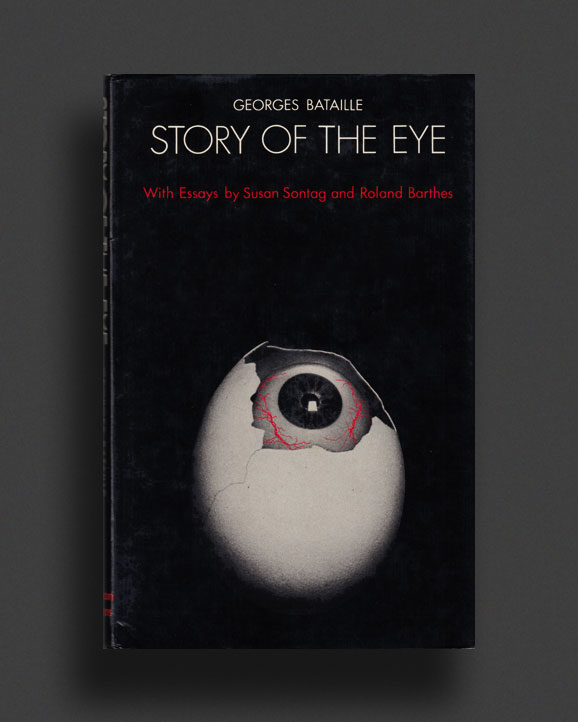
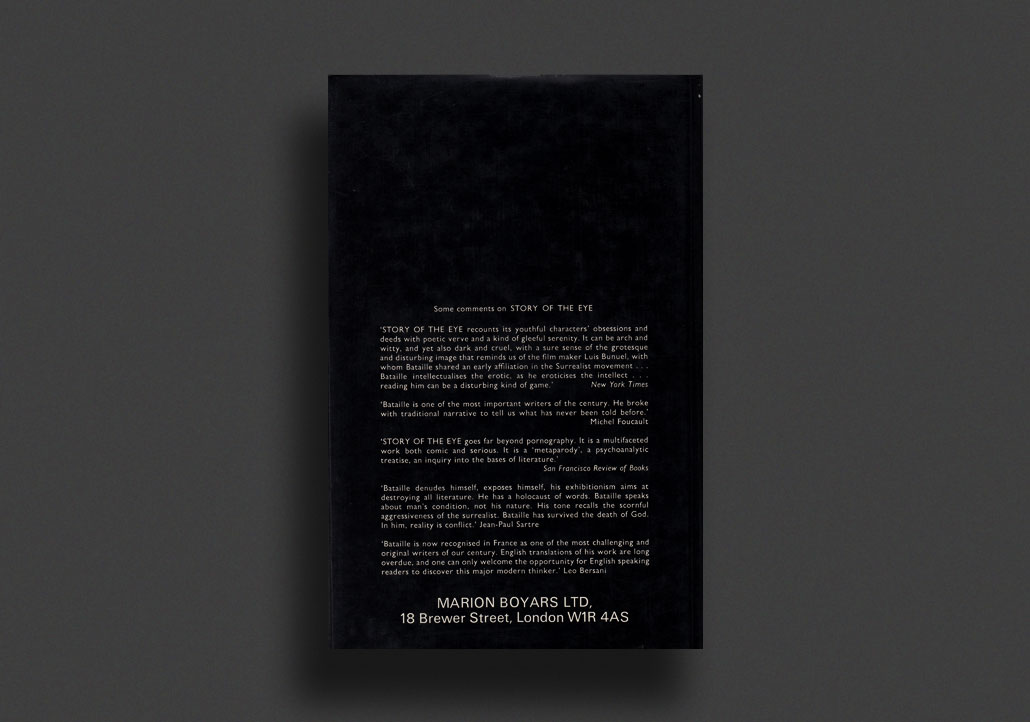
Wonderful first English hardcover edition of George Bataille's Story of the Eye, published by Marion Boyars, London, in 1979. Translated by Joachim Neugroschal with accompanying essays by Susan Sontag and Roland Barthes.
"The caress of the eye over the skin is so utterly, so extraordinarily gentle, and the sensation is so bizarre that it has something of a rooster's horrible crowing." - G.B.
A masterpiece of transgressive, surrealist erotica, Bataille's first novel, published under the pseudonym 'Lord Auch', is still his most notorious work. Called a "metaphysician of evil, Bataille wrote the 1928 novella "Story of the Eye (French: L'histoire de l'œil) as a psychoanalytical task. In this explicit erotic fantasy, the young male narrator and his lovers Simone and Marcelle embark on a sexual quest involving sadism, torture, orgies, madness and defilement, culminating in a final act of transgression. Shocking and sacrilegious, Story of the Eye is the fullest expression of Bataille's obsession with the closeness of sex, violence and death. Yet it is also hallucinogenic in its power, and is one of the erotic classics of the twentieth century.
This edition also includes Susan Sontag's superb study of pornography as art, 'The Pornographic Imagination', as well as Roland Barthes' essay 'The Metaphor of the Eye', which was first published in Bataille's own journal Critique, shortly after Bataille's death in 1962. Barthes' analysis focuses on the centrality of the eye to this series of vignettes, and notices that it is interchangeable with eggs, bulls' testicles and other ovular objects within the narrative. He also traces a second series of liquid metaphors within the text, which flow through tears, cat's milk, egg yolks, frequent urination scenes, blood and semen.
Georges Bataille (1897-1962), French essayist and novelist, was born in Billom, France. He converted to Catholicism, then later to Marxism, and was interested in psychoanalysis and mysticism, forming a secret society dedicated to glorifying human sacrifice. Leading a simple life as the curator of a municipal library, Bataille was involved on the fringes of Surrealism, founding the Surrealist magazine Documents in 1929, and editing the literary review Critique from 1946 until his death.
Good—VG ex-libris copy with light library wear to end blanks, small stamp to colophon in original G—VG dust jacket, no library markings, preserved under mylar wrap. Scarce in this edition with dust jacket present. General reading wear and tanning with age. There is a fierce feminist critique of Susan Sontag's essay in the margins that is an isolated attack Sontag. The rest is left unscathed.
1975, —
Softcover (staple-bound + obi), 16 pages, 10.5 x 14.5 cm
1st Edition, Out of print title / used / very good
Published by
De Harmonie / Amsterdam
$100.00 - In stock -
Rare 1975 edition of the mysterious artist's book and "Fluxus" classic conceived in 1971 by Roland Topor. All sentences were scratched, making this "Fluxus" book unreadable and therefore "unsaleable".
In 1971, the artist was talking with publisher Jaco Groot in a Paris cafe. The conversation was about illegible books. "I made a book like that," said Topor, "tomorrow, same time, same cafe, I'll bring it." When Groot saw the book the next day, he said to Topor's stupid astonishment: "We'll publish it!"
Three years after, Topor was interviewed by Adriaan van Dis in his book program. Van Dis handed Topor the illegible book and asked him to read a piece. Topor, unprepared for this, spontaneously put a hand to his mouth and began to read, muttering and incomprehensible.
Roland Topor (1938—1997) was one of the most unique and versatile French artists of the second half of the 20th century, working prolifically as a provocative and spirited illustrator, author, humorist, satirist, poet, painter, performer, sculptor, playwright, film and TV writer, filmmaker and actor, and much more. A founder of the Panic Movement, an art collective formed by Fernando Arrabal, Alejandro Jodorowsky, and Roland Topor in Paris in 1962, Topor was known for the surreal and absurdist nature of his work.
Very Good copy with edge tanning, rusted staples. Original obi band with light tanning.
1974, English
Softcover, 218 pages, 18.4 x 13.4 cm
1st Edition, Out of print title / used / good
Published by
Village Press / London
$25.00 - Out of stock
First Village Press 1974 edition of All or Nothing (1960) by Welsh author John Cowper Powys, a highly eccentric, metaphysical novel. It explores the deep philosophical and cosmic battle between absolute being and absolute nothingness through the perspective of a young boy and his journey into the mystic.
Powys was born in Shirley, Derbyshire, where his father was vicar. His mother was descended from the poet William Cowper, hence his middle name. His two younger brothers, Llewelyn Powys and Theodore Francis Powys, also became well-known writers. Other brothers and sisters also became prominent in the arts.
John studied at Sherborne School and Corpus Christi College, Cambridge, and became a teacher and lecturer; as lecturer, he worked first in England, then in continental Europe and finally in the USA, where he lived in the years 1904-1934. While in the United States, his work was championed by author Theodore Dreiser. He engaged in public debate with Bertrand Russell and the philosopher and historian Will Durant: he was called for the defence in the first obscenity trial for the James Joyce novel, Ulysses, and was mentioned with approval in the autobiography of US feminist and anarchist, Emma Goldman.
He made his name as a poet and essayist, moving on to produce a series of acclaimed novels distinguished by their uniquely detailed and intensely sensual recreation of time, place and character. They also describe heightened states of awareness resulting from mystic revelation, or from the experience of extreme pleasure or pain. The best known of these distinctive novels are A Glastonbury Romance and Wolf Solent. He also wrote some works of philosophy and literary criticism, including a pioneering tribute to Dorothy Richardson.
Having returned to the UK, he lived in England for a brief time, then moved to Corwen in Wales, where he wrote historical romances (including two set in Wales) and magical fantasies. He later moved to Blaenau Ffestiniog, where he remained until his death in 1963.
Good copy with some wear/marking to boards/extremities/light spine creases/tanning.
1974, English
Softcover, 224 pages, 18.4 x 13.4 cm
1st Edition, Out of print title / used / good
Published by
Village Press / London
$25.00 - Out of stock
First Village Press 1974 edition of Up and Out & The Mountains of the Moon (1957) by Welsh author John Cowper Powys, a collection of two surreal, philosophical fantasy novellas. First published in 1957, these visionary works dive into existential themes, mysticism, and alternate realities.
"Underlying both these stories, is that there is nothing in the universe devoid of some mysterious element of consciousness, however small, queer, ridiculous, or whether animal, vegetable, or mineral, such a thing may be?"–John Cowper Powy
Powys was born in Shirley, Derbyshire, where his father was vicar. His mother was descended from the poet William Cowper, hence his middle name. His two younger brothers, Llewelyn Powys and Theodore Francis Powys, also became well-known writers. Other brothers and sisters also became prominent in the arts.
John studied at Sherborne School and Corpus Christi College, Cambridge, and became a teacher and lecturer; as lecturer, he worked first in England, then in continental Europe and finally in the USA, where he lived in the years 1904-1934. While in the United States, his work was championed by author Theodore Dreiser. He engaged in public debate with Bertrand Russell and the philosopher and historian Will Durant: he was called for the defence in the first obscenity trial for the James Joyce novel, Ulysses, and was mentioned with approval in the autobiography of US feminist and anarchist, Emma Goldman.
He made his name as a poet and essayist, moving on to produce a series of acclaimed novels distinguished by their uniquely detailed and intensely sensual recreation of time, place and character. They also describe heightened states of awareness resulting from mystic revelation, or from the experience of extreme pleasure or pain. The best known of these distinctive novels are A Glastonbury Romance and Wolf Solent. He also wrote some works of philosophy and literary criticism, including a pioneering tribute to Dorothy Richardson.
Having returned to the UK, he lived in England for a brief time, then moved to Corwen in Wales, where he wrote historical romances (including two set in Wales) and magical fantasies. He later moved to Blaenau Ffestiniog, where he remained until his death in 1963.
Good copy with some wear/marking to boards/extremities.
1994, English
Softcover, 352 pages, 20.5 x 15 cm
Published by
Exact Change / Boston
$38.00 - In stock -
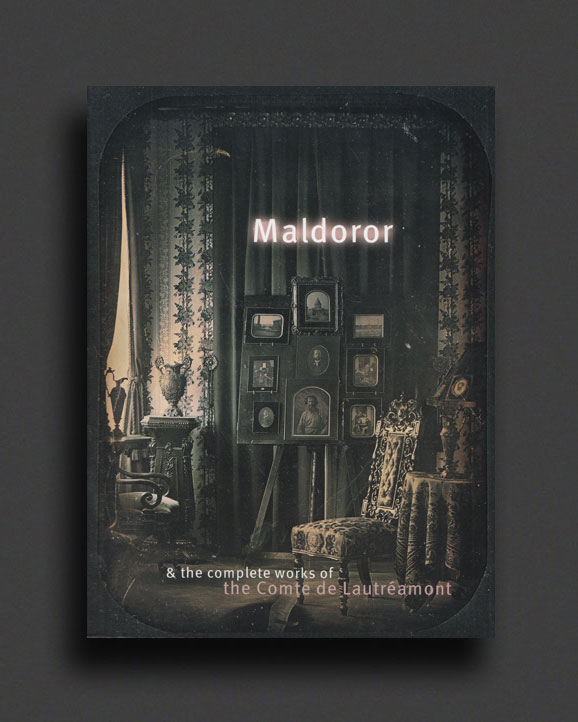
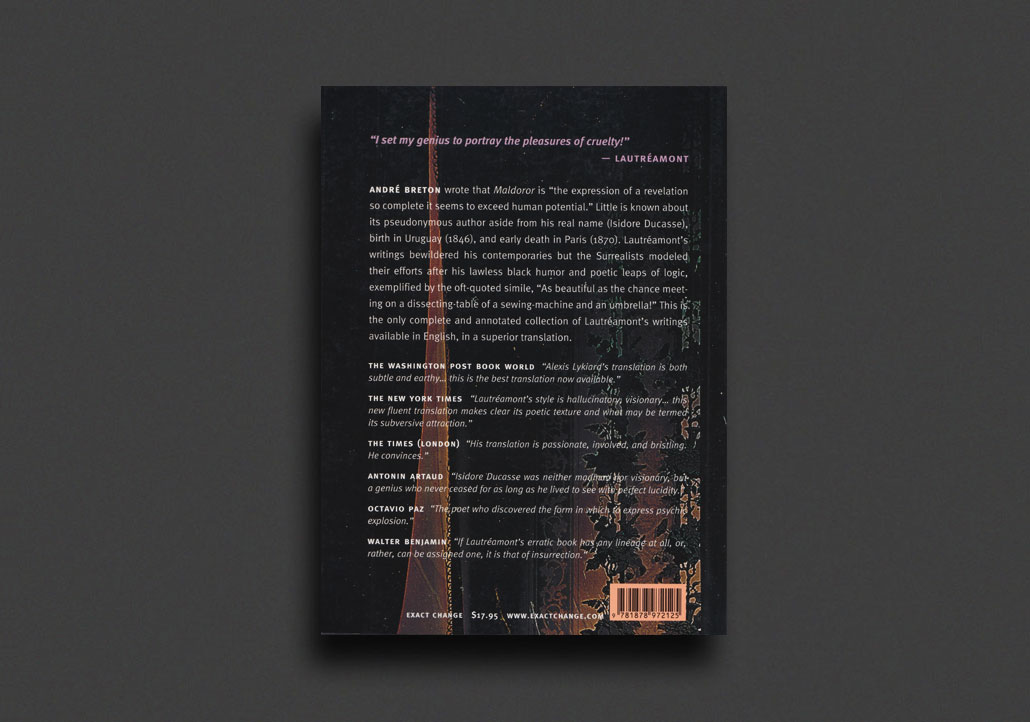
Andre Breton described Maldoror as "the expression of a revelation so complete it seems to exceed human potential." Little is known about its pseudonymous author, aside from his real name (Isidore Ducasse), birth in Uruguay (1846) and early death in Paris (1870). Lautreamont bewildered his contemporaries, but the Surrealists modeled their efforts after his black humor and poetic leaps of logic, exemplified by the oft-quoted line, "As beautiful as the chance meeting on a dissecting table of a sewing machine and an umbrella." Maldoror's shocked first publisher refused to bind the sheets of the original edition--and perhaps no better invitation exists to this book, which warns the reader, "Only the few may relish this bitter fruit without danger."
This is the only complete annotated collection of Lautreamont's writings available in English, in Alexis Lykiard's superior translation. For this latest edition, Lykiard updates his introduction to include recent scholarship.
1984, English
Hardcover (w. dust jacket), 320 pages, 21 x 13.5 cm
1st Edition, Out of print title / used / good
Published by
Academy Chicago Publishers / Chicago
$20.00 - Out of stock
First 1984 US hardcover edition, published by Academy Chicago Publishers.
This is the first historical anthology of Australian science fiction. It offers a good selection of exciting recent works and also reveals a long history of science fiction in Australia, providing a comprehensive chronological sampling of the various styles, attitudes and ideas of Australian science fiction writers from 1845 to the present.
The selection includes excepts from the utopian and anti-utopian novels of the 1800s and 1890s, social criticism from a feminist romance of 1901, and social despair from an anti-socialist novel of 1911. "Lost civilization" romances of 1847 and 1898 offer mystery, excitement and high adventure, and an account of a Japanese invasion of Sydney gives a dire warning of racial fear.
Major contemporary writers represented are Damen Broderick, Frank Bryning, Peter Carey, A. Bertram Changler, Lee Harding, David J. Lake, Dal Stivens, George Turner, Wynne N. Whiteford, Michael Wilding and Jack Woodhams.
Australian science fiction has undergone a renaissance since 1975. Writers such as George Turner and Lee Harding have produced award-winning novels, Peter Carey's speculative short stories have attracted international interest, and films such as Picnic at Hanging Rock and Mad Max have won worldwide acclaim.
In his introduction Van Ikin traces the development of SF in Australia showing its preoccupation with the Australian emptiness and discussing its reflection of the conflict between conservative and visionary social attitudes.
Dr. Ikin holds a Ph.D. from the University of Sydney and currently teaches Australian Literature at the University of Western Australia. He is editor and publisher of the magazine Science Fiction: A Review of Speculative Literature, has published articles and reviews in the Australian literary journals and has published his own stories in a number of magazines and anthologies.
Includes 30-page History of Australian SF, notes, bibliography.
VG clean copy in Good—VG dust jacket with a few small chips/wear to edges, general light wear. Preserved in mylar wrap.
1994, English
Softcover, 166 pages, 20 x 12.5 cm
1st Edition, Out of print title / used / very good
Published by
Dedalus / Cambs
$30.00 - Out of stock
Scarce first 1994 Dedalus edition. Translated by Mike Mitchell.
The White Dominican is Meyrink's most esoteric novel, and draws on the wisdom of a number of mystical traditions, the most important of which is Tao. It is set in a mystical version of the Bavarian town of Wasserburg, which sits on a promontory surrounded on three sides by the River Inn.
The novel describes the spiritual journey of the simple hero, who, guided by a number of figures, (his eccentric father, the spirit of a distant ancestor, the protecting presence of his dead lover and the mysterious figure of the White Dominican), escapes the Medusa's head' of the world to a transfiguration, through which he joins the living chain that stretches to infinity!
This is the novel which has been eagerly awaited by those who see Meyrink as not just a novelist, but as a mystic visionary who can tell them what lies on the Other Side.
Gustav Meyrink (I868-1932) found worldwide critical and commercial acclaim with his first novel The Golem (1915) It established his reputation as the master of the occult and the grotesque.(He was the German translator of Dickens).
VG copy.
1994, English
Softcover, 222 pages, 20 x 12.5 cm
1st Edition, Out of print title / used / very good
Published by
Dedalus / Cambs
$35.00 - Out of stock
Scarce first 1994 Dedalus edition. Translated by Maurice Raraty
"Meyrink's short stories epitomised the non-plus-ultra of all modern writing. Their magnificent colour, their spine-chilling and bizarre inventiveness, their aggression, their succinctness of style, their overwhelming originality of ideas, which is so evident in every sentence and phrase that there seem to be no lacunae: all this captivated me, and seemed to me to provide the proper antidote to all the adjectival prose and shallow, false romanticism of the immediate preceding generation."–Max Brod
"Gustav Meyrink's stories recall Gogol in their black, humorous vigour."–Kathy O'Shaugnessy in The European
Gustav Meyrink (I868-1932) found worldwide critical and commercial acclaim with his first novel The Golem (1915) It established his reputation as the master of the occult and the grotesque.(He was the German translator of Dickens).
VG copy.
2009, French / English
Hardcover (w. audio CD), 90 pages, 21 x 15 cm
Ed. of 350, hand-numbered,
Published by
Alga Marghen / Milan
$60.00 - In stock -
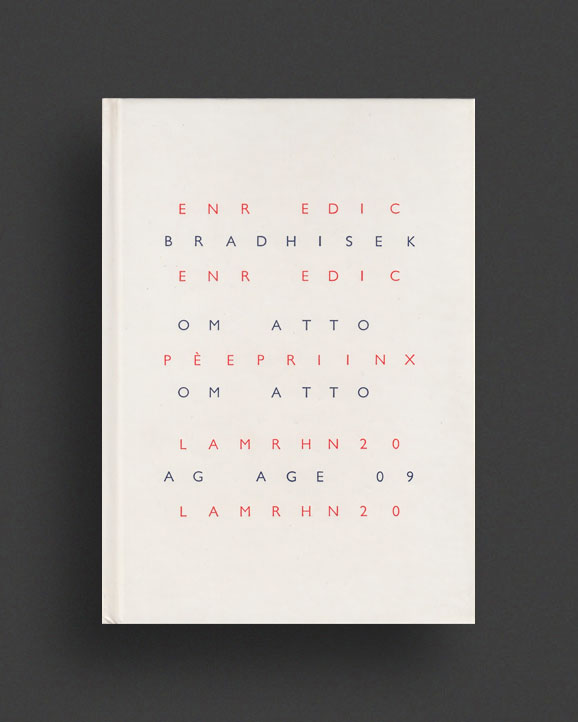
Limited edition book and CD presentation of Bernard Heidsieck's Poème-Partition "X", bound in hardcover in a hand-numbered edition of 350 copies. Recorded 1960, this publication of the work plus CD of the original 1960 recording and later 1962 performance (accompanied by saxophone improvisation by American painter Larry Rivers) were issued in this deluxe volume in 2009 by Alga Marghen, Milan. Heidsieck (1928—2014) was one of the greatest French poets of the 20th century and an originator of the sound poetry movement.
Bernard Heidseick (1928-2014) was a French sound poet, associated with various movements throughout a long career: including Beat, Fluxus, and minimalism. Heidseick decided in the mid-1950s to break off from written poetry, and to bring it outside of books. He opposed passive poetry to active poetry, to an “on its feet” poetry, in his own words. Starting in 1955 he was one of the founders of Sound Poetry, and in 1962 of Action Poetry. As early as 1959 he used a tape recorder as an additional means for writing and retransmitting, opening his research to new experimental fields. While remaining concerned with semantics, Bernard Heidseick became increasingly independent from the constraints of language. He explored all its formal aspects, either by spatializing the text in his written scores, or by the presence of his body in space. He gave sound a formal dimension, notably through an exceptional diction based as much on breathing as on articulating perfectly or on constantly renewing the inflections of his voice. As the years went by he reinvented his writing in order to render our daily life more accurately. Our social, political or economical universe, through its main events, as well as through its extreme ordinariness. In 1955 he developed his first Score-Poems. He then worked continuously on series, with the 13 Biopsies between 1966 and 1969. From 1969 to 1980, he created the 29 Passe-Partout (Catch-alls). From 1978 to 1986, he wrote Derviche/Le Robert (Dervish/Le Robert) composed of 26 sound poems. Then, beginning in 1988, Respirations et brèves rencontres ( Respiration and Brief Encounters) (60 poems created from the archives of recordings of artists' breathing). He organised the first international festival of sound poetry in 1976 and the event Rencontres Internationales 1980 de poésie sonore which took place in Rennes, in Le Havre and at the Pompidou Centre in Paris.
As New.
2001, French
Softcover (w. audio CD + print insert), 64 pages, 21 x 15 cm
Ed. of 500,
1st Edition, Out of print title / as new
Published by
Le Corridor Bleu / Nîmes
$50.00 - In stock -
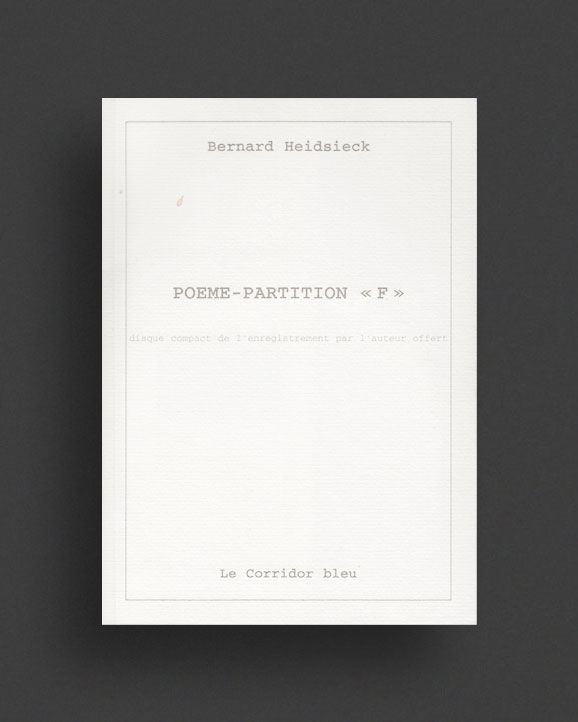
Limited edition book and CD presentation of Bernard Heidsieck's Poème-Partition "F" with print insert. Written 1957 and recorded 1960, this publication was issued in an edition of 500 in 2001 by Le Corridor Bleu, Nîmes. Includes an additional introduction by Heidsieck (1928—2014) himself, one of the greatest French poets of the 20th century, and an originator of the sound poetry movement.
Bernard Heidseick (1928-2014) was a French sound poet, associated with various movements throughout a long career: including Beat, Fluxus, and minimalism. Heidseick decided in the mid-1950s to break off from written poetry, and to bring it outside of books. He opposed passive poetry to active poetry, to an “on its feet” poetry, in his own words. Starting in 1955 he was one of the founders of Sound Poetry, and in 1962 of Action Poetry. As early as 1959 he used a tape recorder as an additional means for writing and retransmitting, opening his research to new experimental fields. While remaining concerned with semantics, Bernard Heidseick became increasingly independent from the constraints of language. He explored all its formal aspects, either by spatializing the text in his written scores, or by the presence of his body in space. He gave sound a formal dimension, notably through an exceptional diction based as much on breathing as on articulating perfectly or on constantly renewing the inflections of his voice. As the years went by he reinvented his writing in order to render our daily life more accurately. Our social, political or economical universe, through its main events, as well as through its extreme ordinariness. In 1955 he developed his first Score-Poems. He then worked continuously on series, with the 13 Biopsies between 1966 and 1969. From 1969 to 1980, he created the 29 Passe-Partout (Catch-alls). From 1978 to 1986, he wrote Derviche/Le Robert (Dervish/Le Robert) composed of 26 sound poems. Then, beginning in 1988, Respirations et brèves rencontres ( Respiration and Brief Encounters) (60 poems created from the archives of recordings of artists' breathing). He organised the first international festival of sound poetry in 1976 and the event Rencontres Internationales 1980 de poésie sonore which took place in Rennes, in Le Havre and at the Pompidou Centre in Paris.
As New with tiny little coffee drip mark to cover.
2026, English
Softcover, 76 pages, 18.5 x 11.4 cm
Published by
New Directions / New York
$34.00 - Out of stock
Translated by Rosmarie Waldrop
"I am supposed to tell you some of the words I heard deep down in the sea where there is much silence and so much happens."
So begins the first text in this indispensable volume, which includes: "Edgar Jene and the Dream about the Dream," "Backlight," "The Meridian," and the piece which Celan himself deemed his most important, "Conversation in the Mountains."
George Steiner wrote in The New Yorker that Celan's prose was "transforming the landscape of poetic theory and of the philosophy of language." This collection of essays, speeches, letters, as well as notes on Alexander Blok and Osip Mandelstam is a great gift to readers and to anyone who wishes to understand the twentieth century.
As the philosopher Hans-Georg Gadamer wrote, "Paul Celan's poems reach us, but we miss them." Perhaps through these rare prose texts we may find the key to what we missed.
2022, English
Softcover, 232 pages, 20.5 x 13.5 cm
Published by
First To Knock / Michigan
$40.00 - In stock -
“Have I understood the philosophy of The Solar Circus correctly? One must savor life in a few fevered grasps, as one might squeeze all of the juice and all of the beauty from a fruit, before casting aside its useless skin.” — Albert Mockel
“Henceforth, The Solar Circus shall be one of the two or three novels that I savor during the quiet hours of dream and melancholy, when the soul surrenders to the painful nostalgia of infinity and the beyond.” — Filippo Tommaso Marinetti
The Solar Circus is the great forgotten masterpiece of French Symbolist literature. Written by Gustave Kahn—the man whom Stéphane Mallarmé and Jules Laforgue credited as inventing free verse poetry—the novel drips in decadent images of pastoral vistas, exotic gemstones, merfolk, and a phantasmagoric menagerie. Inverting day for night and reality for a dazzling dream, The Solar Circus tells the story of a solipsistic, isolated Bavarian count who falls in love with the star of a traveling circus. Their relationship, in both love and jealousy, dramatizes that great tension between the inner life of contemplation and the dynamic beauty of the external world. And as they set out from the count’s castle, the couple examines this duality while encountering a world in transformation: peasants in rebellion, the bright lights of London’s Orpheum theater, and even an ether-swilling Jack the Ripper who analyzes humanity through a fog of opium.
Best known as a poet and member of the Symbolist movement, The Solar Circus showcases Kahn’s talents as a narrative writer and bears the hallmarks of many of the poetic endeavors unique to late 19th century. Indeed, in the same way that the novel’s circus coaxes the count out of oppressive isolation, so too does Kahn’s prose lead the reader in new and fantastic directions. The Solar Circus is a text unlike any other, one that vacillates effortlessly between imagistic poetry and obliquely philosophical prose, prefiguring those seminal 20th century works of Modernist literature which would appear more than two decades later.
This publication marks not only the novel’s first appearance in English but also its first independent reissue since it was published in 1898. The Solar Circus has been newly translated by Sam Kunkel, a scholar of 19th century Symbolist literature. Kunkel has also provided translations for the First To Knock collection Echoes of a Natural World—Tales of the Strange & Estranged (2020) as well as A Beam of Sunlight in the Deep Forest—Mystical Prose Works by Édouard Schuré (2021).
“It is a tale that is lucid, transparent, crystalline, but also enveloped in, and thick with, legend and dream. Is it an adventure or a daydream?... [A] blend of novel and legend, of poetry and prose: this transient world, dotted with figures who are painted with disarming clarity and soft style give to The Solar Circus its enigmatic and persistent charm. This novel is a true dream, drained and exhausted by the vigor of logic and thought.” — Léon Blum
“[With The Solar Circus,] Kahn is perhaps the only Symbolist to have successfully composed a novel free from the Naturalist mindset still perceptible in Against Nature.” — Sophie Basch, professor of 19th century French literature at the Sorbonne
2024, English
Softcover, 256 pages, 21.5 x 14 cm
Published by
Ↄalamari / Earth
$55.00 - In stock -
2024 redux edition of the long out-of-print 2002 cyberpunk cult classic
"A Finnegans Wake for the postdigital millennium, Kenji Siratori’s Blood Electric is probably the foundational text of the language-horror sub-genre: an evasive, esoteric and ultraexperimental writing style produced by the convergence of poetics and methods borrowed from avantgarde literature, electronic/noise music, synthetic abstract image generation, and severe—yet delicate—syntactic deconstruction. Siratori’s unique writing technique results in a hardcore-cyberpunk material account of a bio-techno singularity network in which flesh-code wetware and silicon-thriving software infold together into wave-multitudes of text-organisms. While most contemporary authors exploring the possibility of the blending of humans and machines focus on the extrapolation of logical and transcendental interactions (as in classical cyberpunk, from which Blood Electric initiates a radical breakup), Siratori’s language emanates directly from the contingent, rhizomatic, non-teleological, reciprocal disruption of several unstable and immanent modes of embodied (in)existence. In Blood Electric the text becomes an incantation demanding full abandonment, generating its own unpredictable rhythms as it enraptures you beyond reading, beyond yourself, like when participating in a rave."—Germán Sierra
"… Blood Electric is unreadable in anything other than short, migraine-inducing bursts."—The Guardian
"Following the publication of Kenji Siratori's Blood Electric, the Japanese cyberpunk writer perhaps pioneered a movement among all non-English speaking writers whose languages are radically dissociated from the dominant Latin-Anglo-Franco-German linguistic germ-line on the one hand, and are, on the other, enthusiastically seeking to contribute to the diversification of the English language whose centrality has already been sabotaged in the wake of emerging cyber-societies."—Reza Negarestani, in 3:AM Magazine
"Kenji is making rather more sense than usual. Perhaps the lad is finally coming into his own as the literary avatar of our times."—Bruce Sterling
"Kenji is a madman for sure, but if you scan his hallucinatory textual mashups in just the right frame of mind, they begin to make sense. And that's the scary part."—Douglas Rushkoff
"Contemporary Japan is exploding in slow-motion, and Kenji Siratori arranges the blood- and semen-encrusted deris with the finesse of a berserk Issey Miyake. Rendering English-language cyberpunk instantly redundant with his relenteless, murderous prose-drive, Siratori transmits his authentic, category-A hallucinogenic product direct to this reader’s cerebellum. A virulently warped amalgam of Tetsuo and cut-up era William Burroughs."—Stephen Barber (author of Tokyo Vertigo)
"Blood Electric is the black reverb of soft machine seppuku, a molten unspooling of sheet metal entrails and crucified memory banks into the howling void of violence. It is a cyborg crash nightmare of the new flesh, a final dispatch from mutant Hell where the embryo hunts in secret."—Jack Hunter (author of Eros in Hell)
"Siratori’s hypermodern project articulates the nonarticulation that currently dominates the substratum of much current discourse. Without the intense atomization of the individual, Siratori’s work does not resound. Yet, if we take pause, Siratori’s work resonates at a fever pitch, blaring at the limitless informational realm of our minds as it bursts the parameters of the skull. As a kind of accelerationist aesthetic, Siratori critiques technology by pushing it beyond its sensible potentiality; he cultivates alien cognitions where alternatives thrive, where semantic derangement is revolt, where epistemology uncoils. Ultimately, he uncompromisingly forces us to pause on the chaos of the glitch, to claim the instance where embodying the unquantifiable amounts to insurgency."—Andrew C. Wenaus, Author of The Literature of Exclusion: Dada, Data, and the Threshold of Electronic Literature
2002, English
Softcover, 224 pages, 21.5 x 13.5 cm
1st Edition, Out of print title / used / very good
Published by
Creation Books / London
$150.00 - Out of stock
Rare first 2002 edition of Kenji Siratori's cyberpunk cult classic, published by Creation Books, London.
A fatal collusion of drag embryos and DNA angels in Cadaver City ignites the circuitry of the ADAM Doll... dogs of zero waging gene war in Placenta World, chaos unleashed by the digital vampires of Sato Corporation, nano-junk virus pandemic. On the pink ash planet EVOL, ADAM and ANTI-ADAM clash in terminal zodiac burn... enter robo-succubus Super Cherry 666, hunting for the grotesque nova skulls of Sato Corporation napalm torture victims.
Vividly evoking the coming to consciousness of an artificial intelligence Blood Electric is a devastating loop of language from the Japanese avant-garde which breaks with all existing writing traditions. With unparalleled stylistic terrorism fully embracing the image mayhem of the internet/multimedia/digital age, Kenji Siratori unleashes his first literary Sarin attack.
"Contemporary Japan is exploding in slow-motion, and Kenji Siratori arranges the blood- and semen-encrusted debris with the finesse of a berserk Issey Miyake. Rendering English-language cyberpunk instantly redundant with his relentless, murderous prose-drive, Siratori transmits his authentic, category-A hallucinogenic product direct to his reader's cerebellum. A virulently warped amalgam of Tetsuo and cut-up era William Burroughs."–Stephen Barber (author, Tokyo Vertigo)
"Blood Electric is the black reverb of soft machine seppuku, a molten unspooling of sheet metal entrails and crucified memory banks into the howling void of violence. It is a cyborg crash nightmare of the new flesh, a final dispatch from mutant Hell where the embryo hunts in secret."–Jack Hunter (author, Eros In Hell)
"A Finnegans Wake for the postdigital millennium, Kenji Siratori’s Blood Electric is probably the foundational text of the language-horror sub-genre: an evasive, esoteric and ultraexperimental writing style produced by the convergence of poetics and methods borrowed from avantgarde literature, electronic/noise music, synthetic abstract image generation, and severe—yet delicate—syntactic deconstruction. Siratori’s unique writing technique results in a hardcore-cyberpunk material account of a bio-techno singularity network in which flesh-code wetware and silicon-thriving software infold together into wave-multitudes of text-organisms. While most contemporary authors exploring the possibility of the blending of humans and machines focus on the extrapolation of logical and transcendental interactions (as in classical cyberpunk, from which Blood Electric initiates a radical breakup), Siratori’s language emanates directly from the contingent, rhizomatic, non-teleological, reciprocal disruption of several unstable and immanent modes of embodied (in)existence. In Blood Electric the text becomes an incantation demanding full abandonment, generating its own unpredictable rhythms as it enraptures you beyond reading, beyond yourself, like when participating in a rave."—Germán Sierra
"… Blood Electric is unreadable in anything other than short, migraine-inducing bursts."—The Guardian
"Following the publication of Kenji Siratori's Blood Electric, the Japanese cyberpunk writer perhaps pioneered a movement among all non-English speaking writers whose languages are radically dissociated from the dominant Latin-Anglo-Franco-German linguistic germ-line on the one hand, and are, on the other, enthusiastically seeking to contribute to the diversification of the English language whose centrality has already been sabotaged in the wake of emerging cyber-societies."—Reza Negarestani, in 3:AM Magazine
"Kenji is making rather more sense than usual. Perhaps the lad is finally coming into his own as the literary avatar of our times."—Bruce Sterling
"Kenji is a madman for sure, but if you scan his hallucinatory textual mashups in just the right frame of mind, they begin to make sense. And that's the scary part."—Douglas Rushkoff
"Siratori’s hypermodern project articulates the nonarticulation that currently dominates the substratum of much current discourse. Without the intense atomization of the individual, Siratori’s work does not resound. Yet, if we take pause, Siratori’s work resonates at a fever pitch, blaring at the limitless informational realm of our minds as it bursts the parameters of the skull. As a kind of accelerationist aesthetic, Siratori critiques technology by pushing it beyond its sensible potentiality; he cultivates alien cognitions where alternatives thrive, where semantic derangement is revolt, where epistemology uncoils. Ultimately, he uncompromisingly forces us to pause on the chaos of the glitch, to claim the instance where embodying the unquantifiable amounts to insurgency."—Andrew C. Wenaus, Author of The Literature of Exclusion: Dada, Data, and the Threshold of Electronic Literature
Very Good copy. Light edge wear to boards, some foxing to block edges. No spine creases, overall a great copy.
1998, English
Softcover, 188 pages, 21.5 x 13.5 cm
1st Edition, Out of print title / used / very good
Published by
Creation Books / London
$150.00 - In stock -
Very rare first 1999 Creation Books paperback edition of Cows, the cult classic first book by British–born, Australian–based novelist Matthew Stokoe. One of the most polarizing books of transgressive fiction from the end of the end of the 20th century.
"...enormously disturbing and transcendently clever, Cows, a literally eviscerating portrait of life among the British lower classes, is revered internationally as one of the most daring English-language novels of the past few decades."–Dennis Cooper
"Stokoe's vision of Hell is a carnivore's nightmare. A powerful and all-too-possibly prophetic work."–Kathy Acker
"Underground literary shock-rocker Stokoe slaps his readers in the face with this bloody, truly disgusting diatribe against normalcy. On the bright side, there’s absolutely no pretense about what the book is aiming for..."–Kirkus Review
"If we had to name the most bloody, unpleasant piece of fiction we've read, COWS would be near the top of the list. That's a compliment."–Bizarre
"Forget Bret Easton Ellis, Poppy Z Brite, and Dennis Cooper. That's kid's stuff. If you want something truly repellent, try this."– Gay Times
"The word is out that COWS is every bit as dark and deranged as lain Banks' classic 'The Wasp Factory. It's not: it's even more so. Possibly the most visceral novel ever written."–Billy Chainsaw, Kerrang!
Very Good copy with some sun discolouration to spine edge of cover boards.
2003, English
Softcover, 310 pages, 21.5 x 13.5 cm
1st Edition, Out of print title / used / very good
Published by
Creation Books / London
$150.00 - Out of stock
Rare first 2003 English Edition of Antonin Artaud’s evil simulacrum of The Monk, the only work of sustained fiction by the infamous literary provocateur. Taking Matthew Gregory Lewis's gothic novel of 1794 as the raw material for an astonishing exploration of the far edges of death, sexuality, terror, language and the body, Artaud conducted an aberrant evisceration of the original novel, discarding entire chapters, recreating others and stamping his own distinctive identity on the work in his avowed aim to accentuate the story's violence and atrocity to the maximal degree.
In Artaud's The Monk, sexual obsession is irrepressibly crushed together with murder, cruelty and blasphemy. The result is a searing narrative of massacred nuns, raped virgins and satanic retribution which will leave the reader simultaneously ensnared, gratified and abused.
Best known for his Theatre of Cruelty manifestoes, experimental film projects and corporeal poetry, Artaud created The Monk in France in 1930, to the acclaim of such figures as Jean Cocteau, at a time when Artaud's explicit purpose in his work was to cancel out all existing social and moral systems. This is the first time ever that the book has appeared in English. With an introduction by Stephen Barber.
"A great masterpiece of fantastic literature... marvels burst out at the reader, burning with a thousand fires... the spirit of the supernatural inflames this book to the very core"—André Breton
Very Good—NF copy.
2003, English
Softcover, 310 pages, 21.5 x 13.5 cm
1st Edition, Out of print title / used / very good
Published by
Creation Books / London
$150.00 - Out of stock
Rare first 2003 English Edition of Artaud's Heliogabalus, published by Creation Books.
Translated into English for the first time, this novelized biography of the 3rd-century Roman Emperor Heliogabalus is simultaneously Artaud’s most accessible and his most extreme book. Written in 1933, at the time when Artaud was preparing to stage his legendary Theatre of Cruelty, Heliogabalus is a powerful concoction of sexual excess, self-deification and terminal violence. Reflecting its author’s preoccupations with the occult, magic, Satan, and a range of esoteric religions, this account of Heliogabalus’ reign invents incidents in the Emperor’s life in order to make the print of the author’s own passionate denunciations of modern existence.
Heliogabalus is Artaud’s greatest and most revolutionary masterpiece: an incendiary work that reveals both the divine cruelty of the Roman Emperor and that of Artaud himself.–Stephen Barber
Very Good copy.
2003, English
Softcover, 164 pages, 14 x 21.5 cm
Out of print title / used / very good
Published by
Creation Books / London
$150.00 - Out of stock
Rare 2003 English edition of Eden, Eden, Eden - Pierre Guyotat's masterpiece of atrocity and obscenity.
The most subversive French novelist of the later 20th century, Pierre Guyotat (b. 1940) was the uncompromising heir of De Sade, Artaud, Rimbaud and Genet. Published in France in 1970 by Gallimard, with a preface by Michel Leiris, Roland Barthes and Philippe Sollers, Eden, Eden, Eden was greeted by both furore and acclaim. The book was immediately banned by the French government as pornographic. A campaign of international support for the book was signed by the like of Pier Paolo Pasolini, Jean-Paul Sartre, Pierre Boulez, Joseph Beuys, Pierre Dac, Jean Genet, Simone de Beauvoir, Joseph Kessel, Maurice Blanchot, Max Ernst, Italo Calvino, Jacques Monod, and Nathalie Sarraute. François Mitterrand and Georges Pompidou tried to get the ban lifted but failed until 11 years later when a newly elected President Mitterrand personally intervened to lift the ban in 1981.
Today Eden, Eden, Eden is recognised as one of the major works of the last century. In literally a single sentence, a desert-like, polluted, apocalyptic landscape of unending civil war unfolds without any morality (and therefore also without evil). This delirious, lacerating novel of startling innovation brings scenes of brutal carnage into intimate collision with relentless acts of prostitutional sex and humiliation.
'a new landmark and starting-point for new writing'—Roland Barthes
'I have never read anything like it in any stream of literature'—Michel Foucault
Good–Very Good copy. Some light general wear, board wear and some scratching to the middle of the back cover. Sample images only.
1974, Japanese
Softcover (staple–bound), 90 pages, 21 x 15 cm
1st Edition, Out of print title / used / very good
Published by
Spin / Tokyo
$45.00 - Out of stock
Rare copy of Dabu–dabo No. 24, published in Tokyo in 1974, with original cover art painted by Aquirax Uno (Akira Uno). Dabu-dabo was wild countercultural lifestyle magazine ("A Lifestyle Catalog of Dawn Culture") that featured artwork, photography, manga and articles that proposed "new human life materials for the global village." This issue features Japanese jazz and blues singer/composer Maki Asakawa, actress/singer/politician Chinatsu Nakayama, pink actress Chiho Yuki, photography by Masaaki Nakagawa, Araki Nobuyoshi, illustration galleries by Yōji Kuri, Shizuichi Hayashi, Ryuzan Aki, folk singer Itsuro Shimoda (of Shimonsai and Tokyo Kid Brothers), Ryōhei Uchida, singer Mari Natsuki, Yonin Bayashi (rock group), singe/director Morio Agata, articles on how to grow marijuana, how to improve your jeans, how to make a lie detector, how to find out about psychic abilities, how to cure men's (sexual) illnesses, how to cure women's (sexual) illnesses, how to make candles, how to make shoes, how to raise chickens, how to make a flying horse, and how to spend time well in jail, and much more. Like Goro meets CoEvolution Quarterly via Oz!
VG with light wear to extremities, rusted staples.
1974, Japanese
Softcover (staple–bound), 90 pages, 21 x 15 cm
1st Edition, Out of print title / used / very good
Published by
Spin / Tokyo
$45.00 - Out of stock
Rare copy of Dabu–dabo No. 25, published in Tokyo in 1974, with original cover art painted by Aquirax Uno (Akira Uno). Dabu-dabo was wild countercultural lifestyle magazine ("A Lifestyle Catalog of Dawn Culture") that featured artwork, photography, manga and articles that proposed "new human life materials for the global village." This issue features an interview with author/model/actress/icon Izumi Suzuki, photography by Hajime Sawatari, jazz musician Sadao Watanabe, illustration galleries by avant–garde artist and author Genpei Akasegawa, Ayumi Ohashi and Teruya Harada, Hiro Tsunoda of the Sadistic Mika Band and psych legends Jacks, nude photography by Kenji Hiruma, poet and folk singer Shigeru Izumiya, a host of informative feature articles on "Commune Practices": developing commune practices, including the use of geodesic domes and inflatable housing, the farming practices of Japanese folk singer Masato Minami, DIY solar thermal devices, and much more. Like Goro meets CoEvolution Quarterly via Oz!
VG with light wear to extremities, rusted staples.
2025, English
Softcover, 360 pages, 128 x 19 cm
Published by
Pilot Press / London
$38.00 - Out of stock
Practicing Dying is a literary anti-memoir documenting life in a Zen Buddhist monastery in rural France where the protagonist, a woman in her late twenties, attempts to overcome chronic drug addiction and mental illness.
Broken and severely unwell, our protagonist arrives at the monastery from London: starving, drug-addicted and disillusioned, having exhausted every conventional treatment route available to her. The book examines how, habituated to a life of benefits assessments, petty-crime and sex work, she struggles to adjust to the rules, discipline and religious life of the monastery—at times to devastating and comedic effect.
As the story unfolds, she reflects on her addictions and past experiences, raising critical questions about what it means to be "an addict" and why there may be vested corporate and societal interests in maintaining a narrow, individualistic understanding of addiction.
Anarchic and provocative, tender and self-deprecating, Practicing Dying differs from other contemporary memoirs in the genre of addiction-recovery by simultaneously challenging the dominant narratives surrounding mental health while proposing an alternative approach to treating the “sickness of self” from which we all increasingly suffer.
‘Practicing Dying is brilliant, rewarding and difficult. Northall offers the most brazen and shocking account of addiction I’ve ever read. Committing herself to the practice of Mahayana Buddhism, she eventually finds a way out, but only on the most rambling, circuitious path. Her account of addiction and loss, displacement and grief is profound and it proves that nothing is ever one thing.’ — Chris Kraus, author of The Four Spent The Day Together
‘The untamed offspring of Pema Chödrön’s The Wisdom of No Escape and David Wojnarowicz’s Close to the Knives, this is an addiction memoir that coolly refuses conventional narratives of addiction, trauma and recovery; an unflinching, no-holds-barred, seriously intelligent investigation into existence and how to survive it. A gut-wrenching, sublimely rewarding ride.’ — Olivia Laing, author of The Silver Book
‘Charlotte Northall’s Practicing Dying is extraordinary. It had me holding my breath. She writes in the same direct and uncompromising vein as Heather Lewis and Shulamith Firestone about the darkest corners of experience. But hers is ultimately a story of survival and even transcendence, one earned on every page. The existence of the book itself is hope.’ — Nate Lippens, author of Ripcord
Charlotte Northall is a London-based writer. Her debut, Practicing Dying, blends autobiography and cultural criticism to explore addiction, capitalism, and spiritual practice. She works with rough sleepers, supporting those living with addiction and complex mental health needs.
2014, English
Softcover, 536 pages, 11.5 x 17.5 cm
Published by
Merve Verlag / Berlin
Urbanomic / Cornwall
$66.00 - In stock -
Accelerationism is the name of a contemporary political heresy: the insistence that the only radical political response to capitalism is not to protest, disrupt, critique, or détourne it, but to accelerate and exacerbate its uprooting, alienating, decoding, abstractive tendencies.
The term was coined to designate a certain nihilistic alignment of theory with the excess and abandon of capitalist culture, and the associated performative aesthetic of texts that seek to become immanent to the very process of alienation. Developing at the dawn of contemporary neoliberal consensus, the uneasy status of this impulse, between subversion and acquiescence, between theoretical purchase and aesthetic enjoyment, constitutes the core problematic of accelerationism.
Since the 2013 publication of Williams's and Srnicek's #Accelerate: Manifesto for an Accelerationist Politics, the term has been adopted to name a set of new theoretical enterprises that aim to conceptualise non-capitalist futures outside of traditional marxist critiques and regressive, decelerative or restorative solutions.
#Accelerate presents a genealogy of accelerationism, tracking the impulse through 90s UK darkside cyberculture and the theory-fictions of Nick Land, Sadie Plant, Iain Grant, and anonymous units like CCRU and SWITCH, across the cultural underground of the 80s (rave, acid house, Terminator and Bladerunner) and back to its sources in delirious post-68 ferment, in texts whose searing nihilistic jouissance would later be disavowed by their authors and the marxist and academic establishment alike.
On either side of this largely unexplored central sequence, the book includes texts by Marx that call attention to his own 'Prometheanism' and key works from recent years document the recent extraordinary emergence of new accelerationisms steeled against the onslaughts of neoliberal capitalist realism, and retooled for the twenty-first century.
At the forefront of the energetic contemporary debate around this disputed, problematic term, #ACCELERATE activates a historical conversation about futurality, technology, politics, enjoyment and Kapital. This is a legacy shot through with contradictions, yet urgently galvanized today by the poverty of 'reasonable' contemporary political alternatives.
Contents
ANTICIPATIONS
Karl Marx - Fragment on Machines
Samuel Butler - The Book of The Machines
Nikolai Fyodorov - The Common Task
Thorstein Veblen - The Machine Process and the Natural Decay of the Business Enterprise
FERMENT
Shulamith Firestone - On the Two Modes of Cultural History
Jacques Camatte - Decline of the Capitalist Mode of Production or Decline of Humanity?
Gilles Deleuze + Félix Guattari - The Civilized Capitalist Machine
Jean-François Lyotard - Energumen Capitalism
Gilles Lipovetsky - Power of Repetition
JG Ballard - Fictions of All Kinds
CYBERCULTURE
Nick Land - Circuitries
Nick Land + Sadie Plant - Cyberpositive
Iain Hamilton Grant - LA 2019: Demopathy and Xenogenesis
CCRU - Cybernetic Culture
CCRU - Swarmachines
ACCELERATION
Mark Fisher - Terminator vs Avatar
Nick Srnicek and Alex Williams - #Accelerate: Manifesto for an Accelerationist Politics
Antonio Negri - Reflections on the Manifesto
Tiziana Terranova - Red Stack Attack!
Luciana Parisi - Automated Architecture
Patricia Reed - Seven Prescriptions for Accelerationism
Reza Negarestani - The Labour of the Inhuman (Extended Mix)
Benedict Singleton - Maximum Jailbreak (Extended Mix)
Ray Brassier - Prometheanism and its Critics
Nick Land - Teloplexy: Notes on Acceleration
Diann Bauer - 4xAccelerationisms
2026, English
Softcover, 189 pages. 19.6 x 13.1 cm
Published by
Peninsula Press / UK
$35.00 - Out of stock
'The Waterfront Journals' is a road trip through the sensuous, perilous landscape of alternative America – a series of fictional monologues that ventriloquise the real people Wojnarowicz met on his travels while he was sleeping rough. We meet these hustlers, runaways and dreamers in unassuming locations – in truck stops, bus stations and parks. Their stories are disturbing, often shocking; but they're told with an honesty and a hallucinatory intensity that demands to be heard. Published for the first time in the UK, this electrifying collection confirms that David Wojnarowicz was not only one of millennial America’s most necessary and visionary artists, but also among its most humane and urgent literary chroniclers.
David Wojnarowicz was a writer, artist, AIDS activist and anticensorship advocate. He wrote five books, and his paintings are exhibited in MoMA and the Whitney Museum of American Art. He died from AIDS in 1992.
A visceral and carnivalesque mosaic of life at the fringes.A totally crucial book by one of the 20th century’s greatest artists and writers.' – Maggie Nelson
2026, English
Softcover, 266 pages, 19.7 x 13 cm
Published by
Silver Press / London
$40.00 - In stock -
Translated by Sophie Lewis
Foreword by Jamieson Webster
A woman replays her abandonment by her mother, who is sometimes addressed as a male mother-god. She is also abandoned by her lover, to whom she is in thrall. She tries repeatedly to make or receive phone calls with the beloved figures, without success. She waits for their letters and imagines their contents. In a dream-like, torrid sequence, suffering, fear, fatigue and imperfection are apostrophised. Forgetting is examined and toyed with from every angle. Mythical hybrid creatures are invoked: a snake-headed lion, wolf-snakes, a wolf-peacock. How did this come to be? In a cunningly, wittily wrought rush, the unique, unpredictable voice of the narrator speaks from multiple perspectives to express powerful anguish and, ultimately, catharsis.
First published in French in 1977.
‘Cixous reminds us that women have long spoken from a wound… To be is already to be abandoned, already to have lost, and still to love. To read Cixous is to tarry with this open wound, to hear how writing becomes testimony to its own possibility.’–Jamieson Webster
‘Language in Cixous’s hands is molten, constantly opening onto fresh possibilities.’–Maggie Nelson
‘With Hélène Cixous you must close your eyes and open your mouth. Wider. So open your throat opens. Your esophagus. Your lungs. Wider. So open your spine unclatters. Your hips swim loose. Your womb worlds itself. Wider. Open the well of your sex. Now speak your body from your other mouth. Yell corporeal prayer. This is writing.’–Lidia Yuknavitch
Hélène Cixous is one of the most important feminist voices of the 20th and 21st centuries.