World Food Books' programme is largely produced on Kulin Nation land. We acknowledge the Wurundjeri people of the Kulin Nation as the first and continuing custodians of this land, and pay respect to their Elders past, present, and emerging.
World Food Books is an arts and special interests bookshop in Naarm / Melbourne. Founded in 2010, World Food Books is devoted to the presentation of a rotating, hand-selection of international art, design, literary and counterculture publications with an emphasis on the anti-traditional, the experimental, the avant-garde, the heretic, the marginal.
Presenting new titles alongside rare and out-of-print books, catalogues and journals spanning the fields of modern and contemporary art, design, photography, illustration, film, literature, poetry, cultural theory, philosophy, sexuality, popular and underground culture in its many radical forms, World Food Books wishes to encourage adventurous, thoughtful and open-minded reading, looking, writing, and exchange of publishing and ideas, both current and historical.
As well as our bookshop, located in Melbourne's historical Nicholas Building, all of our inventory is available internationally via our online mail-order service.
World Food Books semi-regularly co-ordinates "Occasions", a programme of exhibits and events at the bookshop and in partnership with other hosts (such as museums and art galleries) that develop out of the activities, relationships and content of the bookshop itself.
World Food Books
The Nicholas Building
37 Swanston Street
Room 5, Level 6
Melbourne 3000
Australia
SHOP HOURS:
Thu–Fri 12–6, Sat 12–5
WEB-SHOP OPEN 24/7
World Food Books
Postal Address:
PO Box 435
Flinders Lane
Victoria 8009
Australia
Art
Theory / Essay
Architecture / Interior
Graphic Design / Typography
Photography
Fashion
Eros
LGBTQ+
Fiction / Poetry
Weird / Speculative / Science Fiction / Horror
Transgressive / Visceral / Abject
Symbolism / Decadence / Fin de siècle
Film / Video
Painting
Sculpture / Installation
Performance / Dance / Theater
Drawing
Sound / Music
Curatorial
Group Shows / Collections
Periodicals
Out-of-print / Rare
Posters / Ephemera / Discs
Signed Books
World Food Books Gift Voucher
World Food Book Bag
Australian Art
Australian Fiction
Australian Science Fiction / Speculative Fiction
Australian Poetry
Australian Photography
Japanese Photography
Conceptual Art
Minimal Art
Dada
'Pataphysics / Oulipo
Fluxus
Concrete Poetry
Pop Art
Surrealism
Arte Povera
Arte Informale / Haute Pâte / Tachism
Nouveau Réalisme / Zero / Kinetic
Situationism / Lettrism
Collage / Mail Art / Xerox Art
Art Brut / Folk / Visionary / Fantastic
Illustration / Graphic Art / Bandes Dessinées
Furniture
Italian Radical Design / Postmodernism
Textiles
Ceramics / Glass
Counterculture
Protest / Revolt
Philosophy
Psychoanalysis
Anthropology
Anarchism
Socialism / Anarchism / Communism / Capitalism
Literary Theory / Semiotics / Language
Feminism / Women's Studies
Gender Studies / Sexuality
Anthropology
Fetishism / BDSM
Drugs / Psychedelia
Crime / Violence
Animal Rights / Veganism
Occult / Esoterica
Ecology / Earth / Alternative Living
Whole Earth / Crafts
All prices in AUD (Australian dollars)
Pick-Ups
Pick-up orders can be collected in our bookshop during opening hours after order date. Please collect any Pick-up orders within 2 weeks of ordering as we have limited storage space. Orders will be released back into stock if not collected within this time. No refunds can be made for pick-ups left un-collected. If you cannot make it in to the bookshop in this time-frame, please choose postage option.
Return Policy
All sales are final. We do accept returns (for refund or exchange) for items received in error. All our orders are packed with special care using heavy-duty padding and cardboard book-mailers or bubble mailers (for smaller books), using reinforcement where required. We cannot take responsibility for any lost, stolen or damaged parcels.
Insurance
Should you wish to insure your package, please email us directly after placing your order and we can organise this at a small extra expense. Although all standard/express tracked packages are very safe and dependable, we cannot take responsibility for any lost, stolen or damaged parcels. We recommend insurance on valuable orders.
Interested in selling your old books, catalogues, journals, magazines, comics, fanzines, ephemera? We are always looking for interesting, unusual and out-of-print books to buy. We only buy books in our fields of interest and specialty, and that we feel we can resell.
We base these prices on desirability, market value, in-print prices, condition and our current stock levels. We offer cash, store credit, and can take stock on consignment. All
about 25% of the price we expect to get when we sell them, or 30% in store credit. We base these prices on desirability, market value, in-print prices, condition and our current stock levels.
Sell your books any day of the week. You can drop them off and return later. If you have a lot of books, we can visit your Sydney home.
We buy books that we feel we can resell. We offer about 25 % of the price we expect to get when we sell them, or 30% in store credit. We base these prices on desirability, market value, in-print prices, condition and our current stock levels.
Philadelphia Wireman
03 August - 01 September, 2018
World Food Books is proud to announce our next Occasion, the first presentation of sculptures by Philadelphia Wireman in Australia.
The Philadelphia Wireman sculptures were found abandoned in an alley off Philadelphia’s South Street on trash night in 1982. Their discovery in a rapidly-changing neighbourhood undergoing extensive renovation, compounded with the failure of all attempts to locate the artist, suggests that the works may have been discarded after the maker’s death. Dubbed the "Philadelphia Wireman" during the first exhibition of this work, in 1985, the maker’s name, age, ethnicity, and even gender remain uncertain. The entire collection totals approximately 1200 pieces, all intricately bound together with tightly-wound heavy-gauge wire (along with a few small, abstract marker drawings, reminiscent both of Mark Tobey and J.B. Murry). The dense construction of the work, despite a modest range of scale and materials, is singularly obsessive and disciplined in design: a wire armature or exoskeleton firmly binds a bricolage of found objects including plastic, glass, food packaging, umbrella parts, tape, rubber, batteries, pens, leather, reflectors, nuts and bolts, nails, foil, coins, toys, watches, eyeglasses, tools, and jewellery.
Heavy with associations—anthropomorphic, zoomorphic, and socio-cultural responses to wrapped detritus—the totemic sculptures by Philadelphia Wireman have been discussed in the context of work created to fulfil the shamanistic needs of alternative religions in American culture. Curators, collectors, and critics have variously compared certain pieces to sculpture from Classical antiquity, Native American medicine bundles, African-American memory jugs, and African fetish objects. Reflecting the artist’s prolific and incredibly focused scavenging impulse, and despite—or perhaps enhanced by—their anonymity, these enigmatic objects function as urban artefacts and arbiters of power, though their origin and purpose is unknown. Philadelphia Wireman, whatever their identity, possessed an astonishing ability to isolate and communicate the concepts of power and energy through the selection and transformation of ordinary materials. Over the course of the past two decades, this collection has come to be regarded as an important discovery in the field of self-taught art and vernacular art.
Presented in collaboration with Fleisher-Ollman Gallery, Philadelphia, and Robert Heald, Wellington.
Susan Te Kahurangi King
02 February - 10 March, 2018
Susan Te Kahurangi King (24 February 1951 - ) has been a confident and prolific artist since she was a young child, drawing with readily available materials - pencils, ballpoint pens and felt-tip markers, on whatever paper is at hand. Between the ages of four and six Susan slowly ceased verbal communication. Her grandparents William and Myrtle Murphy had developed a special bond with Susan so they took on caring responsibilities for extended periods. Myrtle began informally archiving her work, carefully collecting and storing the drawings and compiling scrapbooks. No drawing was insignificant; every scrap of paper was kept. The King family are now the custodians of a vast collection containing over 7000 individual works, from tiny scraps of paper through to 5 meter long rolls.
The scrapbooks and diaries reveal Myrtle to be a woman of great patience and compassion, seeking to understand a child who was not always behaving as expected. She encouraged Susan to be observant, to explore her environment and absorb all the sights and sounds. Myrtle would show Susan’s drawings to friends and people in her community that she had dealings with, such as shopkeepers and postal workers, but this was not simply a case of a grandmother’s bias. She recognised that Susan had developed a sophisticated and unique visual language and sincerely believed that her art deserved serious attention.
This was an unorthodox attitude for the time. To provide some context, Jean Dubuffet coined the term Art Brut in 1945 to describe work created by self-taught artists – specifically residents of psychiatric institutions and those he considered to be visionaries or eccentrics. In 1972 Roger Cardinal extended this concept by adopting the term Outsider Art to describe work made by non-academically trained artists operating outside of mainstream art networks through choice or circumstance. Susan was born in Te Aroha, New Zealand in 1951, far from the artistic hubs of Paris and London that Dubuffet and Cardinal operated in. That Myrtle fêted Susan as a self-taught artist who deserved to be taken seriously shows how progressive her attitudes were.
Susan’s parents Doug and Dawn were also progressive. Over the years they had consulted numerous health practitioners about Susan’s condition, as the medical establishment could not provide an explanation as to why she had lapsed into silence. Dawn educated herself in the field of homeopathy and went on to treat all twelve of her children using these principles – basing prescriptions on her observations of their physical, mental and emotional state.
Doug was a linguist with an interest in philosophy who devoted what little spare time he had to studying Maori language and culture. To some extent their willingness to explore the fringes of the mainstream made them outsiders too but it was their commitment to living with integrity and their respect for individuality that ensured Susan’s creativity was always encouraged.
Even though Susan’s family supported her artistic pursuits, some staff in schools and hospitals saw it as an impediment to her assimilation into the community and discouraged it in a variety of ways. Her family was not always aware of this and therefore did not fully understand why Susan stopped drawing in the early 1990s. However, rather than dwell on the challenges that Susan faced in pursuit of her artistic practice, they prefer to highlight her achievements. In 2008 Susan began drawing again in earnest, after an almost 20 year interruption, and her work is now shown in galleries around the world.
Susan grew up without television and has been heavily influenced by the comics she read as a child. She is absolutely fearless in the appropriation of recognizable characters, such as Donald Duck and Mickey Mouse, in her work. She twists their limbs, contorts their faces, compresses them together, blends them into complex patterned backgrounds - always imbuing them with an incredible energy. Although Susan often used pop culture characters in her work they are not naive or childlike. These are drawings by a brilliant self-taught artist who has been creating exceptional work for decades without an audience in mind.
Mladen Stilinović
"Various Works 1986 - 1999"
02 February 16 - September 10, 2016
Various works 1986 - 1999, from two houses, from the collections of John Nixon, Sue Cramer, Kerrie Poliness, Peter Haffenden and Phoebe Haffenden.
Including: Geometry of Cakes (various shelves), 1993; Poor People’s Law (black and white plate), 1993; White Absence (glasses, ruler, set square, silver spoon, silver ladel with skin photograph and wooden cubes), 1990-1996; Exploitation of the Dead (grey and red star painting, wooden painting, black spoon with red table, red plate), 1984-1990; Money and Zeros (zero tie, paintings made for friends in Australia (Sue, John, Kerrie), numbers painting), 1991-1992; Words - Slogans (various t-shirts) - “they talk about the death of art...help! someone is trying to kill me”, “my sweet little lamb”, “work is a disease - Karl Marx”; Various artist books, catalogues, monographs, videos; Poster from exhibition Insulting Anarchy; "Circular" Croatian - Australian edition; Artist book by Vlado Martek (Dostoyevsky); more.
Thanks to Mladen Stilinović and Branka Stipančić.
Jonathan Walker
Always Will Need To Wear Winter Shirt Blue + Ochre Small Check Pattern
21 August - 21 September, 2015
Untitled
I am not a great reader of poetry but I always return to the work of Melbourne poet, Vincent Buckley (1925- 1988). Perhaps I find his most tantalising piece to be not a finished poem but a fragment left on a scrap of paper discovered on his desk after the poet’s death.
The poetry gathers like oil
In the word-core, and spreads
It has its music meet,
Its music is in movement.
This fragment is more the shell left behind from a volatile thought than a finished poem. I find the last two lines honest but awkward whereas the first two lines work like an arrow. Most likely he could not find a resolution so it was left. Still, in its present form, it remains an eloquent testimony to the ultimate failure of a medium to express mobile thought and sensation, in Buckley’s case, through verbal language. It’s an important matter because this is something all artists have to deal with regardless of the medium.
I have never written a poem, however, I am forever copying fragments from books on paper scraps in a vain effort to fix certain notions in my head. At first, they function as bookmarks that are sometimes returned to when I open the book. But before long, as they accumulate, they fall out littering the table interspersed with A4 photocopies, bills, books and medications.
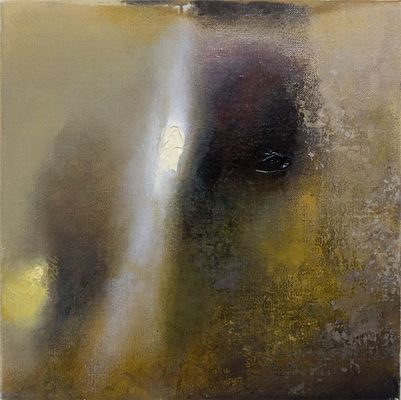
To return to Buckley’s fragment, the first two lines very much evoke how I paint nowadays. As you age, detail diminishes and patches of light become more luminous and float. I feel the most honest way of dealing with this is by smearing the oil paint on the canvas with the fingers and working close-up, blind. Only if the patches coalesce into an approaching image can the work gain a life.
-
Jonathan Walker was born in Melbourne, Australia and brought up on a dairy farm in Gippsland. In the 1970’s he studied painting at RMIT and won the Harold Wright Scholarship to the British Museum, London. During the 1980’s he exhibited at Pinacotheca Gallery, Richmond and had work shown at the NGV and Heidi City Art Gallery. Over the same period he designed the cover for the “Epigenesi” LP by Giancarlo Toniutti, Italy and conducted a mail exchange work with Achim Wollscheid, Germany. The work with artists through the post resulted in an article published in the bicentenary issue of Art and Australia 1988. He showed in artist run spaces such as WestSpace in the 90’s and 2000’s, and until 2012, taught painting at Victoria University, which is where we (Colleen Ahern and Lisa Radford) as organisers of the exhibition, among many others, had the privilege of being his student.
Walker’s knowledge was imparted to students through the careful selection of music, literature, and artists found in books that he himself had ordered for the library. Walker’s strategy was the generosity of sharing his vast knowledge with references specific to each student and their context.
Walker’s paintings share a similar focus and intimacy.
This exhibition presents a small selection of recent paintings alongside a publication that includes Walker’s writing. Observational and analytical, Walker’s work is a type of material notation — the time of day, colour and how it is blended, the both specific and fleeting location of a reflection on lino or the question of whether a chair leg should be included in a painting.
Please join us on Friday August 21 between 6-8pm to celebrate the opening of the exhibition.
Curated by Colleen Ahern and Lisa Radford.
B. Wurtz
Curated by Nic Tammens
March 26 - April 4, 2015
B.Wurtz works from a basement studio in his home on Manhattan’s Lower East Side.
This local fact is attested to by the plastic shopping bags and newsprint circulars that appear in his work. As formal objects, they don’t make loud claims about their origins but nonetheless transmit street addresses and places of business from the bottom of this long thin island. Like plenty of artists, Wurtz is affected by what is local and what is consumed. His work is underpinned by this ethic. It often speaks from a neighborhood or reads like the contents of a hamper:
“BLACK PLUMS $1.29 lb.”
“Food Bazaar”
“USDA Whole Pork Shoulder Picnic 99c lb.”
“RITE AID Pharmacy, with us it’s personal.”
“H. Brickman & Sons.”
“Sweet Yams 59c lb."
Most of the work in this exhibition was made while the artist was in residence at Dieu Donne, a workshop dedicated to paper craft in Midtown. Here Wurtz fabricated assemblages with paper and objects that are relatively lightweight, with the intention that they would be easily transportable to Australia. This consideration isn’t absolute in Wurtz’s work, but was prescriptive for making the current exhibition light and cheap. Packed in two boxes, these works were sent from a USPS post office on the Lower East Side and delivered to North Melbourne by Australia Post.
Wurtz appears courtesy of Metro Pictures, New York.
Thanks to Rob Halverson, Joshua Petherick, Sari de Mallory, Matt Hinkley, Helen Johnson, Fayen d'Evie, Ask Kilmartin, Lisa Radon, Ellena Savage, Yale Union, and "Elizabeth".
John Nixon
"Archive"
December 15 - January 20, 2014
The presentation of John Nixon's archive offered a rare showcase of this extensive collection of the artist's own publications, catalogues, posters, ephemera, editions and more, from the mid 1980s onwards, alongside a selection of his artworks.
Organized by John Nixon, Joshua Petherick and Matt Hinkley.
<a href=http://wfb.public-office.info/artist/john-nixon>All titles by John Nixon
"Habitat"
at Minerva, Sydney (organised by Joshua Petherick and Matt Hinkley)
November 15 - December 20, 2014
Lupo Borgonovo, Janet Burchill & Jennifer McCamley,
Lewis Fidock, HR Giger, Piero Gilardi, Veit Laurent Kurz,
Cinzia Ruggeri, Michael E. Smith, Lucie Stahl, Daniel Weil, Wols
Press Release:
“...It contained seven objects. The slender fluted bone, surely formed for flight, surely from the wing of some large bird. Three archaic circuitboards, faced with mazes of gold. A smooth white sphere of baked clay. An age-blackened fragment of lace. A fingerlength segment of what she assumed was bone from a human wrist, grayish white, inset smoothly with the silicon shaft of a small instrument that must once have ridden flush with the surface of the skin - but the thing’s face was seared and blackened.”
William Gibson, “Count Zero”, 1986
"Autumn Projects Archive"
Curated by Liza Vasiliou
March 6 - March 15, 2014
World Food Books, in conjunction with the Virgin Australia Melbourne Fashion Festival 2014, presented the Autumn Projects archive, consisting of a selection of early examples in Australian fashion with a particular interest in collecting designers and labels from the period beginning in the 1980’s, who significantly influenced the discourse of Australian Fashion.
Curated by Liza Vasiliou, the exhibition provided a unique opportunity to view pieces by designers Anthea Crawford, Barbara Vandenberg, Geoff Liddell and labels CR Australia, Covers, Jag along with early experimental collage pieces by Prue Acton and Sally Browne’s ‘Fragments’ collection, suspended throughout the functioning World Food Books shop in Melbourne.
H.B. Peace
presented by CENTRE FOR STYLE
November 14, 2013
"Hey Blinky, you say chic, I say same"
Anon 2013
H.B. Peace is a clothing collaboration between great friends Blake Barns and Hugh Egan Westland. Their pieces explore the divergences between 'character’ and ‘personality’ in garments....etc
Special Thanks to Joshua Petherick and Matt Hinkley of WFB and Gillian Mears
and a Very Special Thank you to Audrey Thomas Hayes for her shoe collaboration.
Janet Burchill & Jennifer McCamley
"Aesthetic Suicide"
May 10 - June 8, 2013
The first of our occasional exhibitions in the World Food Books office/shop space in Melbourne, "Aesthetic Suicide" presented a body of new and older works together by artists Janet Burchill & Jennifer McCamley, including videos, prints, a wall work, and publications.
During shop open hours videos played every hour, on the hour.
1983, Japanese
Hardcover (w. dust jacket), 208 pages, 30.5 x 22 cm
1st Edition, Out of print title / used / very good
Published by
Nippon Geijutsu Shuppan (NGS) / Japan
$120.00 - Out of stock
First and only 1983 hardcover edition of Erotic Art, edited by Japanese art historian, poet, photographer, film critic, and garden historian, Kazuhiko Fukuda, for Japanese erotic specialist publishers NGS (Nihon Geijutsu Shuppansha). Wrapped in textured faux–leather hardcovers (with gloss dust jacket), this profusely illustrated volume collects many erotic artists seldom seen outside Japan, many not published in book form anywhere else, alongside some of their most acclaimed. Features very generous galleries of high quality full–colour and black and white reproductions on gloss stock of artwork by Noboru Ikeuchi, Arata Taga, Mikio Sakai, Ozaki Aimi, Shoichi Kawai, Shinichi Suzuki, Mitsuyoshi Haruguchi, Hirofumi Nagai, Toshio Otsuka, Aguri Uchida, Shiro Iida, Reiko Sugihara, Junichiro Takamatsu, Tatsuyuki Kikuchi, with accompanying essays in Japanese. Almost entirely visual.
Near Fine copy in Very Good dust jacket, very little wear at all. Preserved in archival mylar wrap.
1999, Japanese
Softcover (w. dust jacket), 210 pages, 21 x 14.8 cm
Out of print title / used / fine
Published by
World Comics / Japan
Kubo Shoten / Japan
$160.00 - In stock -
Rare 1999 edition of the first Japanese book collection of the infamous cult classic eromanga "Bondage Fairies" by Kondom, published by Kubo Shoten way back in 1993. This was the first ever book collecting over 200 pages of the first of the original series from the early 1990s, in the original Japanese language, as they appeared in the pages of Kubo Shoten's Young Lemon magazine for the first time as "Bondage Fairies". Includes colour artwork galleries.
Created by manga artist Teruo Kakuta under the pen name "Kondom", a multilingual pun, meaning "little insect" in Japanese and "condom" in English, Bondage Fairies is an erotic series about highly sexual female forest fairies, who work as police officers protecting the forest, whilst engaging in a wild array of anthropomorphized, inter-species sexual acts. The series began in Japan in 1990 as Insect Hunter, but it was quickly banned from sale by the Tokyo Metropolitan Ordinance. Under a new title, the manga was serialized in manga magazine Lemon Kids. The series is among the earliest sexually explicit manga (eromanga) commercially translated and published uncensored in the United States where the earliest editions date from 1994 (Venus Press). Eros Comix subsequently published a multi-volume series of the collected Bondage Fairies, and subsequent stories, now all very collectible. Translated to Swedish, German, French, and Italian, Bondage Fairies is one of the most popular underground adult Japanese comics outside Japan.
Near Fine copy in original NF dust jacket.
1999, Japanese
Softcover (w. dust jacket), 162 pages, 21 x 14.8 cm
Out of print title / used / fine
Published by
World Comics / Japan
Kubo Shoten / Japan
$140.00 - In stock -
Rare 1999 edition of Volume 2 of the first Japanese book collection of the infamous cult classic eromanga "Bondage Fairies" by Kondom, published by Kubo Shoten way back in 1993. Volume 2 of the first ever book collection bringing together over 160 pages of the the original series from the early 1990s, in the original Japanese language, as they appeared in the pages of Kubo Shoten's Young Lemon magazine for the first time as "Bondage Fairies". Includes colour artwork galleries.
Created by manga artist Teruo Kakuta under the pen name "Kondom", a multilingual pun, meaning "little insect" in Japanese and "condom" in English, Bondage Fairies is an erotic series about highly sexual female forest fairies, who work as police officers protecting the forest, whilst engaging in a wild array of anthropomorphized, inter-species sexual acts. The series began in Japan in 1990 as Insect Hunter, but it was quickly banned from sale by the Tokyo Metropolitan Ordinance. Under a new title, the manga was serialized in manga magazine Lemon Kids. The series is among the earliest sexually explicit manga (eromanga) commercially translated and published uncensored in the United States where the earliest editions date from 1994 (Venus Press). Eros Comix subsequently published a multi-volume series of the collected Bondage Fairies, and subsequent stories, now all very collectible. Translated to Swedish, German, French, and Italian, Bondage Fairies is one of the most popular underground adult Japanese comics outside Japan.
Near Fine copy in original NF dust jacket.
1999, Japanese
Softcover (w. dust jacket), 164 pages, 21 x 14.8 cm
Out of print title / used / fine
Published by
World Comics / Japan
Kubo Shoten / Japan
$140.00 - In stock -
Rare 1999 edition of the Volume 3 Japanese book collection of the infamous cult classic eromanga "Bondage Fairies" by Kondom, published by Kubo Shoten way back in 1993. Volume 3 of the first ever book collection bringing together over 160 pages of the first of the original series from the early 1990s, in the original Japanese language, as they appeared in the pages of Kubo Shoten's Young Lemon magazine for the first time as "Bondage Fairies". Includes colour artwork galleries.
Created by manga artist Teruo Kakuta under the pen name "Kondom", a multilingual pun, meaning "little insect" in Japanese and "condom" in English, Bondage Fairies is an erotic series about highly sexual female forest fairies, who work as police officers protecting the forest, whilst engaging in a wild array of anthropomorphized, inter-species sexual acts. The series began in Japan in 1990 as Insect Hunter, but it was quickly banned from sale by the Tokyo Metropolitan Ordinance. Under a new title, the manga was serialized in manga magazine Lemon Kids. The series is among the earliest sexually explicit manga (eromanga) commercially translated and published uncensored in the United States where the earliest editions date from 1994 (Venus Press). Eros Comix subsequently published a multi-volume series of the collected Bondage Fairies, and subsequent stories, now all very collectible. Translated to Swedish, German, French, and Italian, Bondage Fairies is one of the most popular underground adult Japanese comics outside Japan.
Near Fine copy in original NF dust jacket.
1979, Japanese
Hardcover (w. dust jacket), 236 pages, 20.4 x 20.3 cm
1st Edition, Out of print title / used / very good
Published by
Self-published / Kobe City
$90.00 - Out of stock
First and only edition of this stunning privately-issued 1979 Japanese hardcover collection of erotic fantasy art, edited and written by Yoshiki Yamamoto. Upon retiring from the Sanyo Electric Railway Company in 1976, Yamamoto devoted himself to the art that he loved and to complete an intimate book study that traces an important lineage of artists of "eros fantasy", focussing on 16 key artists through profusely illustrated chapters, linking artists of the fin de siècle, symbolism, surrealism, and their descendants. A total labour of love. There is no other book like it. "Artists Who Decorate My Secret Room" features illustrated full chapters on Gustave Moreau, Félicien Rops, Gustav Klimt, Franz von Bayros, Egon Schiele, Paul Delvaux, Hans Bellmer, Felix Labisse, Pierre-Yves Trémois, Leonor Fini, Paul Wunderlich, Ernst Fuchs, Tomi Ungerer, H.R. Giger, Raymond Bertrand, Gilles Rimbault, including profiles, many artworks, portraits and texts by Yamamoto, closing with a chronology of further artists and authors through the centuries.
Good–Very Good some mild foxing to block edges/initials. Good dust jacket with the usual edge wear and tanning of this title, some chipping to spine ends of DJ. Sample images only. Preserved in mylar wrap.
1985, Japanese
Softcover (w. dust jacket), 60 pages, 26 x 17 cm
1st Edition, Out of print title / used / very good
Published by
Gakutokan / Japan
$160.00 - In stock -
Beautiful 1985 Japanese edition of Georges Bataille's Madame Edwarda, illustrated throughout with all the original illustrations by Hans Bellmer. Madame Edwarda first appeared in Paris under Georges Bataille's pseudonym Pierre Angelique in two small underground editions in 1941 and 1945. It was finally published under Bataille's own name by the publishing house of Jacques Pauvert in 1956. Translated here by Kosaku Ikuta, all illustrations by German artist Hans Bellmer, complete with inserted preface booklet by Georges Bataille and additional insert of publisher's catalogue.
In Madame Edwarda, a man becomes erotically obsessed with an old whore who turns out to be God. Bataille's erotic prose fuses elements of sex and spirituality in a highly personal vision of the flesh. A world of sensation in which only the vaulting demands of disruptive excess and the anguish of heightened awareness can combat the stultifying world of reason and social order. Intoxication and insanity are so carefully delineated by the author that it seems to infect the reader.
"Madame Edwarda's truth consists in confronting us with an obvious scandal that we wouldn't even know where to place. We could incriminate her words: there have never been such rigorous ones; or the circumstances, the fact that Madame Edwarda is a brothel whore, but this, indeed, it could be reassuring; or even that certain details, which must be said to be obscene, are so with a necessity that ennobles them and makes them inevitable, not so much in the name of art, but for a perhaps moral, perhaps fundamental need. (...) That the most incongruous of books, as Georges Bataille defines it in his preface, is also the most beautiful book, and perhaps the most tender, is above all scandalous."—Maurice Blanchot
Very Good copy throughout, only light cover wear/tanning.
1989, Japanese
Softcover, 176 pages, 13 x 18 cm
1st Edition, Out of print title / used / very good
Published by
Fiction Inc. / Tokyo
$70.00 - In stock -
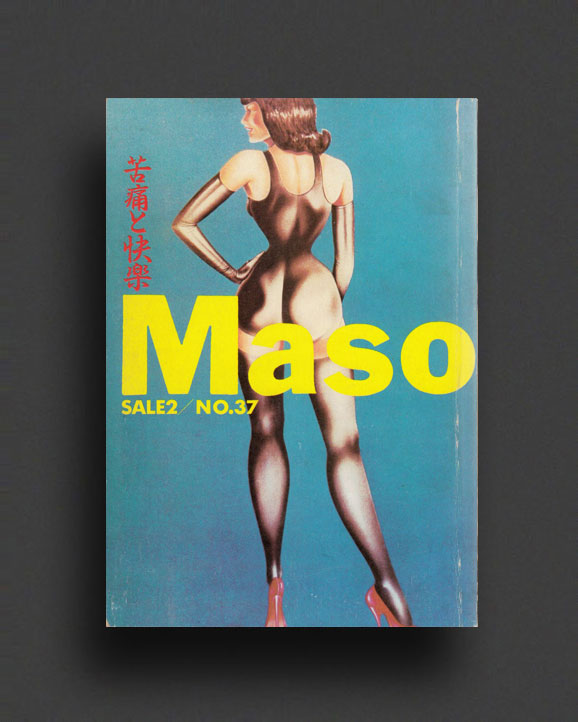
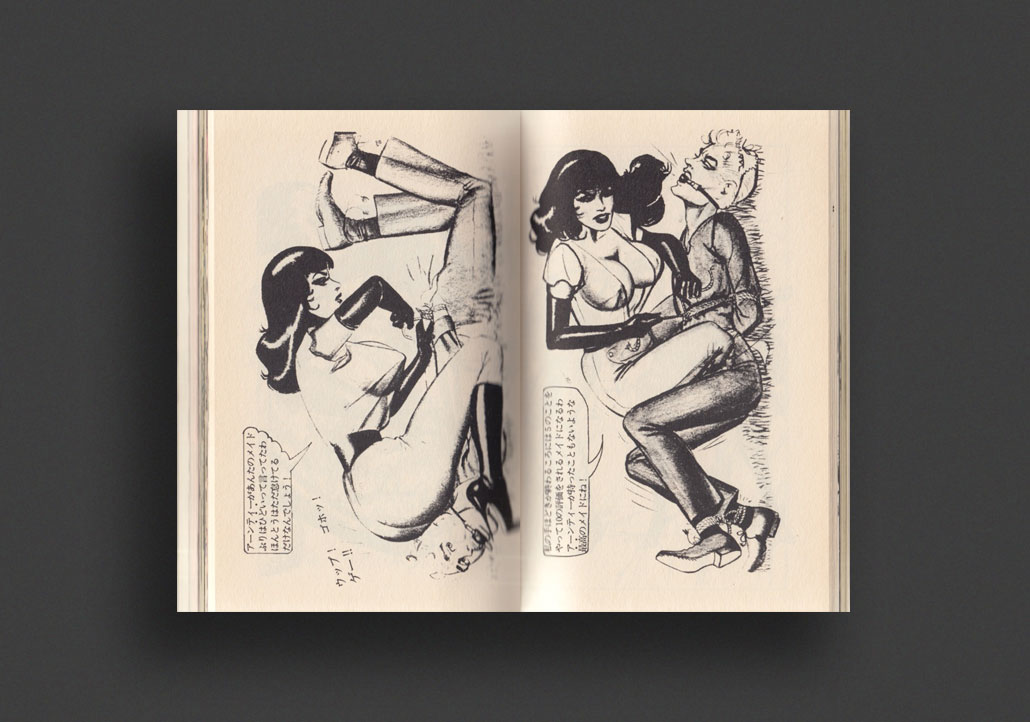
Issue No.37 of the great SALE2 periodical from Tokyo Japan, founded in 1984 by Makoto Orui, who later became art director for Purple magazine in France and Rockin’on magazine in Japan. SALE2 was active for about 14 years during the 1980s—1990s, published regularly as a sort-of fanzine/journal/catalogue/pocket-book by Fiction, Inc., a specialty shop and publisher of fetish and erotica in Tokyo in the 1980-90s. With Orui's distinct design SALE2 developed an exclusive curated editorial set on ‘erotisism and its spiritual philosophy’, with each issue exploring different themes and features, heavy on fetishism and erotic art.
Issue No.37, the Masochism issue features erotic writings and artwork throughout by Loic Dubigeon, Guido Crepax, David Bailey, Man Ray, Lucas Samaras, Annie Sprinkle's Bosom Ballet, Hans Bellmer, Paul Outerbridge, Leopold von Sacher-Masoch, Shinichi Kusamori on the paintings of Seiu Ito "the father of modern kinbaku", Yamaguchi Tsubaki, E. J. Bellocq, René Girard, Noriyuki Eda on Saint Sebastian, Edogawa Ranpo, Serge Nazarieff, Rieko Matsuura, Tetsuo Amano, Freud, Nietzsche, de Sade, interspersed with lots of mysterious vintage erotic imagery, bondage illustration, and catalogue/advertisments/clippings of Richard Cerf, Araki, Eric Stanton, Irving Klaw, Jim, John Willie, Bizarre Comix, and much more...
Very heavily illustrated throughout with erotic photography and artwork, all texts in Japanese.
Very Good copy, tanning with age.
1954, Japanese
Softcover, 174 pages, 18 x 25.4 cm
1st Edition, Out of print title / used / good
Published by
Nihon Bungeisha / Tokyo
$70.00 - In stock -
Rare copy of September 1954 issue of Fuzoku Sōshi with stunning early painted covers by legendary Japanese artist Ran Akiyoshi. Fuzoku Sōshi was a pioneering Japanese SM magazine published between 1953 and 1954, one of the earliest SM magazines alongside Yomikiri Romance and Kitan Club and the the first magazine kinbaku master Minomura Kou edited after his departure from Kitan Club and his move from Osaka to Tokyo (where he later co-founded SM Select and S&M Collector). Though short-lived (17 issues), it made a lasting impact with its bold blend of sordid pulp stories, essays, and illustrations exploring bondage, ghoulish desire and unconventional sexualities. With some of the most beautiful cover paintings in the history of SM publishing by legendary artist Ran Akiyoshi, Fuzoku Sōshi featured the most talented practitioners, writers and artists of its era, including major SM artists Reiko Kita, Seiu Ito, Hideo Furusho, and Tamaki Kitahara.
Good copy, general age/tanning.
1954, Japanese
Softcover, 174 pages, 18 x 25.4 cm
1st Edition, Out of print title / used / good
Published by
Nihon Bungeisha / Tokyo
$70.00 - Out of stock
Rare copy of July 1954 issue of Fuzoku Sōshi with stunning early painted covers by legendary Japanese artist Ran Akiyoshi. Fuzoku Sōshi was a pioneering Japanese SM magazine published between 1953 and 1954, one of the earliest SM magazines alongside Yomikiri Romance and Kitan Club and the the first magazine kinbaku master Minomura Kou edited after his departure from Kitan Club and his move from Osaka to Tokyo (where he later co-founded SM Select and S&M Collector). Though short-lived (17 issues), it made a lasting impact with its bold blend of sordid pulp stories, essays, and illustrations exploring bondage, ghoulish desire and unconventional sexualities. With some of the most beautiful cover paintings in the history of SM publishing by legendary artist Ran Akiyoshi, Fuzoku Sōshi featured the most talented practitioners, writers and artists of its era, including major SM artists Reiko Kita, Seiu Ito, Hideo Furusho, and Tamaki Kitahara.
Good copy, general age/tanning.
1994, Japanese
Softcover (staple-bound), 90 pages, 30 x 21.5 cm
1st Edition, Out of print title / used / very good
Published by
Yumeya Shuppan / Japan
$500.00 - In stock -
Wow! Insanely rare, very special, very collectible early Namio Harukawa artist book / graphic novel, published in Japan in 1994 in a limited run and long out-of-print. One of the finest examples of Harukawa's work, Queen of Execution Island exemplifies his artistic vision through the perfect combination of an art book and a masochistic graphic novel. Harukawa's narrative comic strips are seldom reproduced in his posthumous monographs, and Queen of Execution Island combines here a series of breath-taking fetish stories as chapters rendered in Harukawa's b/w line-work with his beautiful, delicate pencil drawings book-ending the scenarios of each story in loving detail. Chapters (roughly translated) are : "Tongue Service Chair"; "Thigh Hanging"; "Face Pressure Execution"; "Holy Water Drowning Death Penalty", involving activities of "femdom", Urolagnia, Scatology, etc. The chaptered stories are followed by a new series of illustrations, and one of the best work groups of Harukawa that is also seldom seen anywhere else, "Deformed Livestock Race", involving Harukawa's male masochists undergoing transformations into fantasy beasts better equipped to service their female mistresses. Ends with advertisements of many Japanese SM publications that centre around the central fetishes of Harukawa's art, and further magazines featuring his illustrations. Highly recommended — near impossible to get, even in Japan.
Namio Harukawa (1947—2020), a pseudonymous Japanese fetish artist best known for his masterful pencil works depicting female domination ("femdom"), with erotic asphyxiation through facesitting appearing as a frequent subject of his art. Born 1947 in Osaka, Japan, Harukawa’s distinctive penname combines the name of film actress Harukawa Masumi with an anagram of Naomi, the sadistic heroine in Tanizaki Jun’ichiro’s novel "Chijin no ai / A Fool’s Love". While in high school, Harukawa began contributing work to the readers’ column of leading postwar Japanese SM pulp magazine "Kitan Club". Since then, Harukawa’s drawings of male masochism have lovingly portrayed noble, voluptuously beautiful women and the men who serve them as human furniture. An extraordinary and prolific artist who remained committed to the regime of “absolute Ganmen Kijo Shugi (facesitting principle)” throughout his artistic life, Namio Harukawa passed away on April 2020, he was 72 years old.
Very good—Near Fine with only light wear to the very glossy black foiled covers printed over red card stock(!).
1980, Japanese
Softcover, 132 pages, 30 x 21 cm
1st Edition, Out of print title / used / very good
Published by
Sun Publishing / Japan
$500.00 - In stock -
Absolutely incredible, super rare, collectible first edition of the first Namio Harukawa art book, published in Japan in 1980 by leading SM magazine SM Collector and their publishing house, Sun. An absolute treasure of vintage Namio Harukawa femdom works, released a full 20 years prior to his "Big Girl Love / My Fair Fat Lady" (2000) and 32 years before his late "Garden of Domina". By 1980 Namio was already a prolific master of fetish illustration, contributing to countless cult SM magazines. Lavishly illustrated throughout in colour and black and white with gorgeous reproductions on various paper stocks, including full-colour fold-out poster, this volume introduces so many early works never seen in any later monographs with a diverse array of "femdom" fetishes and narratives, including all his SM magazine work through to the establishment of his iconic face-sitting queens. A breath-taking, comprehensive collection that is a must for any fan of Harukawa or erotic illustration, period. Appropriately this "treasured art collection" was named "Chijin No Ai" ("A Fool’s Love") by Harukawa, after Tanizaki Jun’ichiro’s novel featuring Naomi, the sadistic heroine whose name was adopted by Harukawa. Cannot recommend this book more.
Namio Harukawa (1947—2020), a pseudonymous Japanese fetish artist best known for his masterful pencil works depicting female domination ("femdom"), with erotic asphyxiation through facesitting appearing as a frequent subject of his art. Born 1947 in Osaka, Japan, Harukawa’s distinctive penname combines the name of film actress Harukawa Masumi with an anagram of Naomi, the sadistic heroine in Tanizaki Jun’ichiro’s novel "Chijin no ai / A Fool’s Love". While in high school, Harukawa began contributing work to the readers’ column of leading postwar Japanese SM pulp magazine "Kitan Club". Since then, Harukawa’s drawings of male masochism have lovingly portrayed noble, voluptuously beautiful women and the men who serve them as human furniture. An extraordinary and prolific artist who remained committed to the regime of “absolute Ganmen Kijo Shugi (facesitting principle)” throughout his artistic life, Namio Harukawa passed away on April 2020, he was 72 years old.
Very Good copy, beautifully preserved, only light cover wear.
2000, English / Japanese
Hardcover (w. dust jacket), 27.5 x 19.5 cm
1st Edition, Out of print title / used / very good
Published by
Taiyo Tosho / Japan
$480.00 - In stock -
Super rare, very collectible Namio Harukawa oversized hardcover art book, published in Japan in 2000 and long out-of-print. This deluxe art book is considered the first book devoted entirely to Harukawa's "Paradise under the grand hips" — his iconic big-girl-love-femdom-facesitting illustrations. Beautifully produced and lavishly illustrated heavy book full of the exceptional work of Namio Harukawa (1947—2020), a pseudonymous Japanese fetish artist best known for his masterful pencil works depicting female domination ("femdom"), with erotic asphyxiation through facesitting appearing as a frequent subject of his art. As well as an impeccably reproduced collection of Harukawa's works in full-bleed colour, the book features Harukawa's complete illustrated "lewd love story of a noble lady and a beast", a collection of many of his best known works beautifully reproduced alongside sado-masochist narratives. A stunning book and must for any Harukawa fan.
Namio Harukawa (1947—2020), a pseudonymous Japanese fetish artist best known for his masterful pencil works depicting female domination ("femdom"), with erotic asphyxiation through facesitting appearing as a frequent subject of his art. Born 1947 in Osaka, Japan, Harukawa’s distinctive penname combines the name of film actress Harukawa Masumi with an anagram of Naomi, the sadistic heroine in Tanizaki Jun’ichiro’s novel "Chijin no ai / A Fool’s Love". While in high school, Harukawa began contributing work to the readers’ column of leading postwar Japanese SM pulp magazine "Kitan Club". Since then, Harukawa’s drawings of male masochism have lovingly portrayed noble, voluptuously beautiful women and the men who serve them as human furniture. An extraordinary and prolific artist who remained committed to the regime of “absolute Ganmen Kijo Shugi (facesitting principle)” throughout his artistic life, Namio Harukawa passed away on April 2020, he was 72 years old.
Fine copy in original illustrated, gold foiled Very Good dust jacket, only light wear. Hardcovers also illustrated. A well-preserved copy.
1992, Japanese
Softcover (w. dust jacket + obi), 190 pages, 14.5 x 10.5 cm
1st Edition, Out of print title / used / very good
Published by
Fiction Inc. / Tokyo
Futami Shobo / Japan
$65.00 - In stock -
Amazing pocket art book of fetish masters John Willie and Eric Stanton. Bondage Comix was edited by Makoto Ohrui and Japanese novelist Mari Akasaka (both editors of SALE2/Fiction Inc.) and published in Tokyo Japan by Futami Shobo in 1992. Packed cover-to-cover with colour and b/w reproductions of classic artworks by Willie and Stanton, from "Sweet Gwendoline" to "From Girl to Pony" to "Beached", Fetish and Bizarre publications, John Willie's bondage photography, Stanton fashions, and much more. Perfectly compiled in the way SALE2 did so well, with elegant scrapbook style, dense with imagery, blown-up, full-bleed reproductions from many publications. Cover artwork and postcard insert by John Willie.
John Alexander Scott Coutts (1902—1962), better known by the pseudonym John Willie, was an artist, fetish photographer, editor and the publisher of the first 20 issues of the fetish magazine Bizarre, featuring his characters Sweet Gwendoline and Sir Dystic d'Arcy.
Eric Stanton (1926—1999) was an American underground cartoonist and fetish art pioneer. While Stanton began his career as a bondage fantasy artist for Irving Klaw, the majority of his later work depicted gender role reversal and proto-feminist female dominance scenarios.
Makoto Ohrui founded the publishing house Fiction Inc. (later Radical Silence Production), the magazine SALE2, the gallery THE deep in Tokyo, and the magazine THE International. Ohrui was art director for SALE2, Purple, Rockin' On, and designed many books.
Mari Akasaka (b. 1964) is a Japanese novelist. In 1999 her novel Vibrator was nominated for the Akutagawa Prize, which was adapted into a 2003 film directed by Ryūichi Hiroki. She was again nominated for the Akutagawa prize in 2000 for her novel, Muse, and won the Noma Literary Prize for New Writers for the same novel.
Very Good copy, with obi.
1970, Japanese
Softcover (w. slipcase & insert), 104 pages, 31 x 24 cm
1st Edition, Out of print title / used / good
Published by
Agureman-sha / Tokyo
$380.00 - In stock -
Super rare first major book of collected artworks by ero-guro master Toshio Saeki (1945—2019), published in 1970 by Agureman after his 1968 self-published collection. Stunning large-format softcover collection of uncompromising black and white images that would propel the career of this legendary underground artist of the comic macabre, housed in original publisher's cardboard slipcase.
“Toshio Saeki conjures death with a pen”—Shūji Terayama, 1969.
Toshio Saeki (1945—2019) was an illusive Japanese illustrator and painter, and icon of 1970s Tokyo counterculture, known for combining Japanese folklore, Yōkai spirits and elements of Western art with his own sophisticated aesthetics to create a unique, sensational world of eros, dark humour, and horror. Given the title “Erotic Engineer” by Timothy Leary, Saeki's provocative art broke all sexual taboos, questioned Japanese ideology and traditional views on love, desire and gender roles. Saeki’s surgically-precise graphic work is closely related to the Japanese cultural phenomenon ‘Erotic, Grotesque, Nonsense’ (ero, guro, nansensu).
Good copy book with tanning and dustiness to block edge, but interior in lovely condition, some wear to black boards/spine. Slipcase in poor condition, tanned with repairs to both sides with old tape, small loses, but well repaired as it still works nicely to hold the book, should you wish. No obi. Includes the original red inserted Japanese commentary sheet.
1993, French / Japanese
Softcover, 32 pages, 29.5 x 21 cm
1st Edition, Out of print title / used / very good
Published by
Yoshifumi Hayashi / Paris
$160.00 - In stock -
First, only edition of this a rare self-published book of drawings by Yoshifumi Hayashi, published by the artist in 1993, who moved from Japan to Paris in the 1970s and has devoted himself to his singular, existential, philosophical world of cerebral eroticism. Femmes de Plomb, is entirely comprised of a carefully selection of large reproductions of his detailed lead pencil drawings (hence the title "Lead Women"). The final page features a short biography.
‘Eroticism is to establish order, or in other words the principle of constitution, and not to destroy,' Hayashi says. First a student of philosophy, Hayashi has, for almost half a century, shamelessly asserted the importance of sexual desire and the body in all its material dimensions. His masterfully rendered obsessive visions of grotesque, disembodied eroticism within metaphysical environments occupy his unique and highly original exploration of graphic art. Hayashi's Art emerges from the depths of his subconscious, revealing his fetishistic and obsessive paranoias, creating works of great erotic power.
Yoshifumi Hayashi (b. 1948, Fukuoka, Japan) dropped out of Chuo University Department of Philosophy in 1972, moving to Paris in 1974, where he began to produce pencil drawings through self study. At first his main influence was the metaphysical world of De Chirico, but soon his focus shifted to the lower half of the female anatomy. Hayashi's art comes straight from the darkest depths of his subconscious and the artist lays his innermost paranoias, fetishes and obsessions. Exhibiting and publishing his drawings in France in the late 1970's, Hayashi gained a cult following for his dark explorations of fetishized female physiology and mutating genitalia, rendered masterfully in lead pencil. , Few artists manage to reconcile the world of Eros and that of mutation like Hayashi, though we could cite Hans Bellmer, Pierre Molinier, H.R. Giger, Sibylle Ruppert, even David Cronenberg, Hayashi's drawings are unlike anything else. Though published by specialist publishers in France and Japan, featured in specialist fetish and art magazines, and with director Walerian Borowczyk even making a film in 1980 of the artist at work, Hayashi still little is known about Hayashi, who continues to work and exhibit internationally.
Very Good copy, light wear to extremities.
2016, Japanese
Hardcover, 128 pages, 15 x 21 cm
1st Edition, Out of print title / as new
Published by
Atelier Third / Tokyo
$65.00 - In stock -
Beyond the Forbidden Fetish...
First hardcover edition of 'Envol' by Yoshifumi Hayashi, published in 2016 and now out-of-print. ‘Eroticism is to establish order, or in other words the principle of constitution, and not to destroy’ philosopher turned illustrator Yoshifumi Hayashi says. This latest collection of self-taught Hayashi's masterfully rendered obsessive visions of grotesque, disembodied eroticism and fleshy alien landscapes continue his unique and highly original exploration of graphic art. Profusely illustrated throughout, this book illustrates Hayashi's pencil work throughout the 2000s and includes his own fictional writing, a novel called 'Hisho'.
Contemporary Japanese erotic artist Yoshifumi Hayashi (b. 1948, Fukuoka, Japan) dropped out of Chuo University Department of Philosophy in 1972, moving to Paris in 1974, where he began to produce pencil drawings through self study. At first his main influence was the metaphysical world of De Chirico, but soon his focus shifted to the lower half of the female anatomy. Exhibiting and publishing his drawings in France in the late 1970's, Hayashi gained a cult following for his dark explorations of fetishized female physiology and mutating genitalia, rendered masterfully in pencil. Often mentioned in relation to the likes of Hans Bellmer, H.R. Giger, and even David Cronenberg, Hayashi's drawings were featured in specialist fetish magazines, and director Walerian Borowczyk even made a film in 1980 of the artist at work, yet still little is known about Hayashi, who continues to work and exhibit internationally.
As New copy.
2014, Japanese / English
Hardcover (w. postcard), 96 pages, 15 x 21 cm
1st Edition, Out of print title / used / very good
Published by
Atelier Third / Tokyo
$65.00 - In stock -
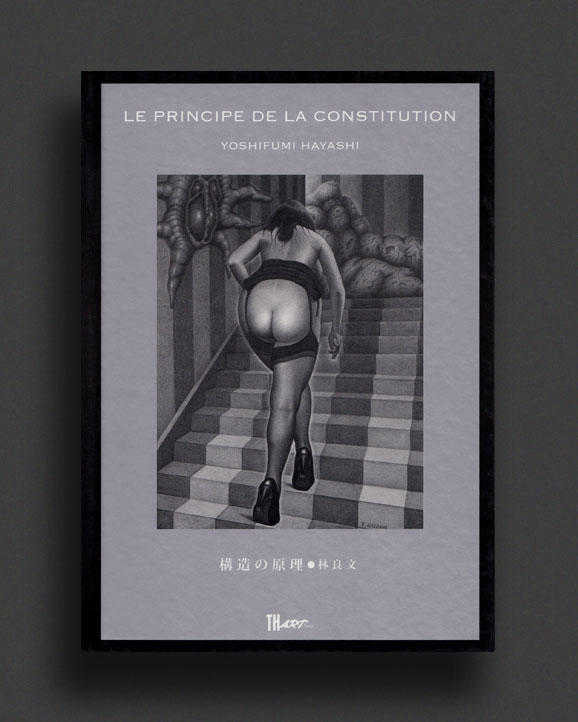
First hardcover edition of 'Le Principe de la Constitution' by Yoshifumi Hayashi, published in 2014 and now out-of-print. ‘Eroticism is to establish order, or in other words the principle of constitution, and not to destroy’ Yoshifumi Hayashi says. This latest collection of self-taught Hayashi's masterfully rendered obsessive visions of grotesque, disembodied eroticism continue his unique and highly original exploration of graphic art. Profusely illustrated throughout, this book follows-on from the comprehensive "La Jeune Marieè d'un Materialiste Enceinte de Cerveaux" monograph (mid 1970s-mid 1990s) illustrating Hayashi's pencil work throughout the 2000s. Includes a very rare essay by Hayashi, who first studied philosophy, discussing his theories about science and eros, tracing his childhood interest in astronomy through to his understanding of eroticism through dynamics.
Contemporary Japanese erotic artist Yoshifumi Hayashi (b. 1948, Fukuoka, Japan) dropped out of Chuo University Department of Philosophy in 1972, moving to Paris in 1974, where he began to produce pencil drawings through self study. At first his main influence was the metaphysical world of De Chirico, but soon his focus shifted to the lower half of the female anatomy. Exhibiting and publishing his drawings in France in the late 1970's, Hayashi gained a cult following for his dark explorations of fetishized female physiology and mutating genitalia, rendered masterfully in pencil. Often mentioned in relation to the likes of Hans Bellmer, H.R. Giger, and even David Cronenberg, Hayashi's drawings were featured in specialist fetish magazines, and director Walerian Borowczyk even made a film in 1980 of the artist at work, yet still little is known about Hayashi, who continues to work and exhibit internationally.
As New copy including Hayashi promotional postcard.
1995, Japanese
Softcover (w. dust jacket), 164 pages, 21 x 14.8 cm
1st Edition, Out of print title / used / fine
Published by
World Comics / Japan
Kubo Shoten / Japan
$160.00 - In stock -
Very rare original first printing Volume 3 Japanese book collection of the infamous cult classic eromanga "Bondage Fairies" by Kondom, published by Kubo Shoten way back in 1995. Volume 3 of the first ever book collection bringing together over 160 pages of the the original series from the early 1990s, in the original Japanese language, as they appeared in the pages of Kubo Shoten's Young Lemon magazine for the first time as "Bondage Fairies". Includes colour artwork galleries.
Created by manga artist Teruo Kakuta under the pen name "Kondom", a multilingual pun, meaning "little insect" in Japanese and "condom" in English, Bondage Fairies is an erotic series about highly sexual female forest fairies, who work as police officers protecting the forest, whilst engaging in a wild array of anthropomorphized, inter-species sexual acts. The series began in Japan in 1990 as Insect Hunter, but it was quickly banned from sale by the Tokyo Metropolitan Ordinance. Under a new title, the manga was serialized in manga magazine Lemon Kids. The series is among the earliest sexually explicit manga (eromanga) commercially translated and published uncensored in the United States where the earliest editions date from 1994 (Venus Press). Eros Comix subsequently published a multi-volume series of the collected Bondage Fairies, and subsequent stories, now all very collectible. Translated to Swedish, German, French, and Italian, Bondage Fairies is one of the most popular underground adult Japanese comics outside Japan.
Near Fine copy in original NF dust jacket.
1998, Japanese
Hardcover (w. dust jacket), 104 pages, 30.3 x 23.2 cm
1st Edition, Out of print title / used / very good
Published by
Asahi Shimbun / Japan
$120.00 - Out of stock
First 1998 hardcover edition of Kuniyoshi Kaneko's Vicious Angel, one of the finest volumes by Japanese painter, illustrator and photographer Kuniyoshi Kaneko (1936—2015). Increasingly rare, Vicious Angel collects in one place the famous literary illustration of Kaneko, including Lewis Carroll's "Alice in Wonderland" and "Alice's Dream," George Bataille's "Story of The Eye" and "Madame Edwarda," and many others works spanning the 1970s to the 1990s. Kaneko's unique figurative drawings of young men and women in enigmatic, metaphysical scenes of surreal, stylised erotic abandon, channel the spirits of Cocteau, Bellmer, and Balthus; his controversial interpretations graced the pages and covers of these literary classics as they entered the Japanese consciousness. Free of convention, Kaneko's dreamlike scenarios were very often of same-sex, homo-erotic, even fetishistic nature, and his artwork, encouraged by editor and writer Shibusawa Tatsuhiko (1928—1987), became a staple in the underground publishing scene of 1970's Tokyo. Vicious Angel includes a biography, photographic portraits, bibliography, and an introductory essay by Kuniyoshi Kaneko entitled "In honor of the Holy God".
VG copy in CG dust jacket, light edge wear.
2010, English
Hardcover (clothbound), 56 pages, 37.5 x 30 cm
1st Edition, Out of print title / used / very good
Published by
Last Gasp / San Fransisco
$680.00 - In stock -
"The Godfather of Japanese Erotica"
Rare, over–sized hardcover volume of Toshio Saeki's erotic works, published in 2010 by Last Gasp, San Fransisco in a full edition of 3000 copies worldwide. Long out–of–print.
Onikage presents a magnificent selection of Toshio Saeki's previously unseen works, uniquely printed in a large, lush format. Throughout, paper vellum overlays reproduce Saeki's unique method for adding color to his black and white artwork. He does not apply color directly, but instead uses overlays to indicate the exact colors he wants. He calls this method chinto printing - the picture is complete only after it has been printed - a modern version of the ukiyo-e, a genre of Japanese woodcut prints. Though Onikage contains nearly two-dozen full color and seven black and white images, the viewer is not allowed to see every image in all stages. Like the artist, the viewer must use his or her imagination to complete these peculiar pictures.
Includes introduction by Toshio Saeki in English.
Very Good copy with only light marking/wear to boards. Complete with publisher's illustrated slip.
2022, English
Hardcover (w. dust jacket), 192 pages, 24 x 17 cm
1st Edition, Out of print title / as new
Published by
Cornelius / Paris
$65.00 - Out of stock
A cult artist, Toshio Saeki is the inventor of a unique style in a field he has totally transformed: ero guro, which can be translated as "erotico-grotesque scenes". Attributed to the writer Edogawa Ranpo, this genre is rooted in the origins of classical Japanese drawing, feeding monsters and nightmarish scenes into numerous prints throughout the ages.
By combining traditional motifs with his own obsessions, Saeki echoes the anxieties of his generation, the youth of the 1970s, who believed they could free themselves from the conventions of a paternalistic society, only to be disillusioned.
Human society, with its violence and shortcomings, is the setting for scenes whose cruelty provokes terror or laughter, pushing the mechanics of fantasy to its limits. Here, sadomasochism covers up no reality, relying on onirism to create a form of macabre poetry. Stimulated by Japanese censorship - it is forbidden to show the sexes - Saeki turns the forbidden into an artistic constraint, transforming the world's oldest subject into absurdity and onirism. His precise style, which reminds Europeans of the famous "clear line" of Hergé and Joost Swarte, remains strange to Japanese and Western readers alike, each finding in this perfectly simple line a new form of exoticism. This perception can only be explained by the absolute originality of an extravagant imagier, straight from the pen of an artist who devoted his life to tracing as closely as possible "what goes on in his head when he closes his eyes".
This second volume of the anthology follows the work Scarlet Dream and compiles illustrations published between 1972 and 1974 in the magazine SM Selecto .
PLEASE NOTE: This illustrated book has a preface translated into three languages (French, English and Japanese).
NF—As New copy.
2016, English
Hardcover, 84 pages, 22 x 29 cm
Ed. of 300,
1st Edition, Out of print title / used / very good
Published by
Timeless Editions / Paris
$90.00 - In stock -
Do you know this thing called the “internet”? If you do, you will have met Gea’s girls! These little playful minxes. Her art is the door to the most innocently perverse world you are ever likely to enter.
Timeless is proud to give you the first monograph of pure unadulterated Gea: “Penetralia”, 84 pages printed in full glorious colour on luxurious 150gr Condat matte coated paper all wrapped up in a virgin white Popset cover adorned with a touchy-feely embossed blood-red Gea.
In Penetralia, you are allowed in a parallel universe inhabited by libertine girls. They are your caretakers, pupils, and your god. With her detailed drawings, Gea presents a no apologies look into the female id.
Quickly out of print, the book was limited to 300 copies and features words by J.G.Thirlwell (Foetus) and Guy Maddin plus a visual tribute/portrait by that arch-perverter of dollies himself, Trevor Brown.
Very Good copy with knock to lower front corner, light wear and age.
2010, Japanese
Softcover, 208 pages, 24 x 18.5 cm
1st Edition, Out of print title / used / good
Published by
Atelier Peyotl / Tokyo
$55.00 - In stock -
Incredible Hans Bellmer special feature Issue of cult Japanese underground magazine Yaso, published in 2010, edited by Yuichi Konno and Atelier Peyotl (publishers of Night Vision/Yaso/Peyotl/Wave/Silvester Club...). Being a magazine specialising in the doll arts it was only natural that they would dedicate an entire issue to the ground-breaking work of German Surrealist Hans Bellmer and the development of his dolls, and pay homage to his immense influence on Japanese doll artists by discussing his work with them. Heavily illustrated with reproductions of Bellmer's iconic doll photography and drawings, alongside reproduced and translated original texts, extensive chronology of Bellmer and Unica Zürn, the drawing and anagram work of his partner Zürn, an invaluable bibliography of publications related to Bellmer to date, and many portraits of the artist. There is an extensive chronicle of doll history and development stretching from 1902—2010 and a large part of the issue is made up of heavily illustrated exclusive interviews with Japanese artists influenced by the legacy of Bellmer, including Simon Yotsuya, Nori Doi, Ryo Yoshida, Tatsumi Hijikata, Makoto Onozuka, Kishin Shinoyama, Minori Nawata, and more, surveys contemporary doll artists Volks, PEACH-PIT, naruto, Hizuki, Tari Nakagawa, Minori Nawata, Os, Akihiko Aono, mican, Ayumi, Masanao, Katan Amano, Nishioka Bro. & Sis., and many more, and includes essays by Sue Taylor, Alice Mahon, Kumi Ogata... absolutely packed with content and a valuable Bellmer reference in the context of his Japanese influence on the arts.
Good copy woth knock/crease to top–right corner, light wear.
1990, English
Softcover (staple bound), 36 pages, 21 x 15 cm
1st Edition, Out of print title / used / very good
Published by
The FFM Association / Paris
$45.00 - In stock -
Rare copy of Fantasy Film Memory Presents "Shockers" issue no. 2 of the film digest / fanzine, published in France in October 1990, and devoted entirely to "The Poet of the Macabre", Italy's giallo gore master Lucio Fulci (1927—1996). This English text book is packed with glossy colour and b/w film stills, lobby cards, posters, and on-set photos and other visual documents, not to mention loads of spectacular Fulci mania, accompanying texts and information compiled by Jean-Claude Michel. A must for any fan. The "Shockers" series was published in 4 issues between 1990—1991.
Very Good copy.