World Food Books' programme is largely produced on Kulin Nation land. We acknowledge the Wurundjeri people of the Kulin Nation as the first and continuing custodians of this land, and pay respect to their Elders past, present, and emerging.
World Food Books is an arts and special interests bookshop in Naarm / Melbourne. Founded in 2010, World Food Books is devoted to the presentation of a rotating, hand-selection of international art, design, literary and counterculture publications with an emphasis on the anti-traditional, the experimental, the avant-garde, the heretic, the marginal.
Presenting new titles alongside rare and out-of-print books, catalogues and journals spanning the fields of modern and contemporary art, design, photography, illustration, film, literature, poetry, cultural theory, philosophy, sexuality, popular and underground culture in its many radical forms, World Food Books wishes to encourage adventurous, thoughtful and open-minded reading, looking, writing, and exchange of publishing and ideas, both current and historical.
As well as our bookshop, located in Melbourne's historical Nicholas Building, all of our inventory is available internationally via our online mail-order service.
World Food Books semi-regularly co-ordinates "Occasions", a programme of exhibits and events at the bookshop and in partnership with other hosts (such as museums and art galleries) that develop out of the activities, relationships and content of the bookshop itself.
World Food Books
The Nicholas Building
37 Swanston Street
Room 5, Level 6
Melbourne 3000
Australia
SHOP HOURS:
Thu–Fri 12–6, Sat 12–5
WEB-SHOP OPEN 24/7
World Food Books
Postal Address:
PO Box 435
Flinders Lane
Victoria 8009
Australia
Art
Theory / Essay
Architecture / Interior
Graphic Design / Typography
Photography
Fashion
Eros
LGBTQ+
Fiction / Poetry
Weird / Speculative / Science Fiction / Horror
Transgressive / Visceral / Abject
Symbolism / Decadence / Fin de siècle
Film / Video
Painting
Sculpture / Installation
Performance / Dance / Theater
Drawing
Sound / Music
Curatorial
Group Shows / Collections
Periodicals
Out-of-print / Rare
Posters / Ephemera / Discs
Signed Books
World Food Books Gift Voucher
World Food Book Bag
Australian Art
Australian Fiction
Australian Science Fiction / Speculative Fiction
Australian Poetry
Australian Photography
Japanese Photography
Conceptual Art
Minimal Art
Dada
'Pataphysics / Oulipo
Fluxus
Concrete Poetry
Pop Art
Surrealism
Arte Povera
Arte Informale / Haute Pâte / Tachism
Nouveau Réalisme / Zero / Kinetic
Situationism / Lettrism
Collage / Mail Art / Xerox Art
Art Brut / Folk / Visionary / Fantastic
Illustration / Graphic Art / Bandes Dessinées
Furniture
Italian Radical Design / Postmodernism
Textiles
Ceramics / Glass
Counterculture
Protest / Revolt
Philosophy
Psychoanalysis
Anthropology
Anarchism
Socialism / Anarchism / Communism / Capitalism
Literary Theory / Semiotics / Language
Feminism / Women's Studies
Gender Studies / Sexuality
Anthropology
Fetishism / BDSM
Drugs / Psychedelia
Crime / Violence
Animal Rights / Veganism
Occult / Esoterica
Ecology / Earth / Alternative Living
Whole Earth / Crafts
All prices in AUD (Australian dollars)
Pick-Ups
Pick-up orders can be collected in our bookshop during opening hours after order date. Please collect any Pick-up orders within 2 weeks of ordering as we have limited storage space. Orders will be released back into stock if not collected within this time. No refunds can be made for pick-ups left un-collected. If you cannot make it in to the bookshop in this time-frame, please choose postage option.
Return Policy
All sales are final. We do accept returns (for refund or exchange) for items received in error. All our orders are packed with special care using heavy-duty padding and cardboard book-mailers or bubble mailers (for smaller books), using reinforcement where required. We cannot take responsibility for any lost, stolen or damaged parcels.
Insurance
Should you wish to insure your package, please email us directly after placing your order and we can organise this at a small extra expense. Although all standard/express tracked packages are very safe and dependable, we cannot take responsibility for any lost, stolen or damaged parcels. We recommend insurance on valuable orders.
Interested in selling your old books, catalogues, journals, magazines, comics, fanzines, ephemera? We are always looking for interesting, unusual and out-of-print books to buy. We only buy books in our fields of interest and specialty, and that we feel we can resell.
We base these prices on desirability, market value, in-print prices, condition and our current stock levels. We offer cash, store credit, and can take stock on consignment. All
about 25% of the price we expect to get when we sell them, or 30% in store credit. We base these prices on desirability, market value, in-print prices, condition and our current stock levels.
Sell your books any day of the week. You can drop them off and return later. If you have a lot of books, we can visit your Sydney home.
We buy books that we feel we can resell. We offer about 25 % of the price we expect to get when we sell them, or 30% in store credit. We base these prices on desirability, market value, in-print prices, condition and our current stock levels.
Philadelphia Wireman
03 August - 01 September, 2018
World Food Books is proud to announce our next Occasion, the first presentation of sculptures by Philadelphia Wireman in Australia.
The Philadelphia Wireman sculptures were found abandoned in an alley off Philadelphia’s South Street on trash night in 1982. Their discovery in a rapidly-changing neighbourhood undergoing extensive renovation, compounded with the failure of all attempts to locate the artist, suggests that the works may have been discarded after the maker’s death. Dubbed the "Philadelphia Wireman" during the first exhibition of this work, in 1985, the maker’s name, age, ethnicity, and even gender remain uncertain. The entire collection totals approximately 1200 pieces, all intricately bound together with tightly-wound heavy-gauge wire (along with a few small, abstract marker drawings, reminiscent both of Mark Tobey and J.B. Murry). The dense construction of the work, despite a modest range of scale and materials, is singularly obsessive and disciplined in design: a wire armature or exoskeleton firmly binds a bricolage of found objects including plastic, glass, food packaging, umbrella parts, tape, rubber, batteries, pens, leather, reflectors, nuts and bolts, nails, foil, coins, toys, watches, eyeglasses, tools, and jewellery.
Heavy with associations—anthropomorphic, zoomorphic, and socio-cultural responses to wrapped detritus—the totemic sculptures by Philadelphia Wireman have been discussed in the context of work created to fulfil the shamanistic needs of alternative religions in American culture. Curators, collectors, and critics have variously compared certain pieces to sculpture from Classical antiquity, Native American medicine bundles, African-American memory jugs, and African fetish objects. Reflecting the artist’s prolific and incredibly focused scavenging impulse, and despite—or perhaps enhanced by—their anonymity, these enigmatic objects function as urban artefacts and arbiters of power, though their origin and purpose is unknown. Philadelphia Wireman, whatever their identity, possessed an astonishing ability to isolate and communicate the concepts of power and energy through the selection and transformation of ordinary materials. Over the course of the past two decades, this collection has come to be regarded as an important discovery in the field of self-taught art and vernacular art.
Presented in collaboration with Fleisher-Ollman Gallery, Philadelphia, and Robert Heald, Wellington.
Susan Te Kahurangi King
02 February - 10 March, 2018
Susan Te Kahurangi King (24 February 1951 - ) has been a confident and prolific artist since she was a young child, drawing with readily available materials - pencils, ballpoint pens and felt-tip markers, on whatever paper is at hand. Between the ages of four and six Susan slowly ceased verbal communication. Her grandparents William and Myrtle Murphy had developed a special bond with Susan so they took on caring responsibilities for extended periods. Myrtle began informally archiving her work, carefully collecting and storing the drawings and compiling scrapbooks. No drawing was insignificant; every scrap of paper was kept. The King family are now the custodians of a vast collection containing over 7000 individual works, from tiny scraps of paper through to 5 meter long rolls.
The scrapbooks and diaries reveal Myrtle to be a woman of great patience and compassion, seeking to understand a child who was not always behaving as expected. She encouraged Susan to be observant, to explore her environment and absorb all the sights and sounds. Myrtle would show Susan’s drawings to friends and people in her community that she had dealings with, such as shopkeepers and postal workers, but this was not simply a case of a grandmother’s bias. She recognised that Susan had developed a sophisticated and unique visual language and sincerely believed that her art deserved serious attention.
This was an unorthodox attitude for the time. To provide some context, Jean Dubuffet coined the term Art Brut in 1945 to describe work created by self-taught artists – specifically residents of psychiatric institutions and those he considered to be visionaries or eccentrics. In 1972 Roger Cardinal extended this concept by adopting the term Outsider Art to describe work made by non-academically trained artists operating outside of mainstream art networks through choice or circumstance. Susan was born in Te Aroha, New Zealand in 1951, far from the artistic hubs of Paris and London that Dubuffet and Cardinal operated in. That Myrtle fêted Susan as a self-taught artist who deserved to be taken seriously shows how progressive her attitudes were.
Susan’s parents Doug and Dawn were also progressive. Over the years they had consulted numerous health practitioners about Susan’s condition, as the medical establishment could not provide an explanation as to why she had lapsed into silence. Dawn educated herself in the field of homeopathy and went on to treat all twelve of her children using these principles – basing prescriptions on her observations of their physical, mental and emotional state.
Doug was a linguist with an interest in philosophy who devoted what little spare time he had to studying Maori language and culture. To some extent their willingness to explore the fringes of the mainstream made them outsiders too but it was their commitment to living with integrity and their respect for individuality that ensured Susan’s creativity was always encouraged.
Even though Susan’s family supported her artistic pursuits, some staff in schools and hospitals saw it as an impediment to her assimilation into the community and discouraged it in a variety of ways. Her family was not always aware of this and therefore did not fully understand why Susan stopped drawing in the early 1990s. However, rather than dwell on the challenges that Susan faced in pursuit of her artistic practice, they prefer to highlight her achievements. In 2008 Susan began drawing again in earnest, after an almost 20 year interruption, and her work is now shown in galleries around the world.
Susan grew up without television and has been heavily influenced by the comics she read as a child. She is absolutely fearless in the appropriation of recognizable characters, such as Donald Duck and Mickey Mouse, in her work. She twists their limbs, contorts their faces, compresses them together, blends them into complex patterned backgrounds - always imbuing them with an incredible energy. Although Susan often used pop culture characters in her work they are not naive or childlike. These are drawings by a brilliant self-taught artist who has been creating exceptional work for decades without an audience in mind.
Mladen Stilinović
"Various Works 1986 - 1999"
02 February 16 - September 10, 2016
Various works 1986 - 1999, from two houses, from the collections of John Nixon, Sue Cramer, Kerrie Poliness, Peter Haffenden and Phoebe Haffenden.
Including: Geometry of Cakes (various shelves), 1993; Poor People’s Law (black and white plate), 1993; White Absence (glasses, ruler, set square, silver spoon, silver ladel with skin photograph and wooden cubes), 1990-1996; Exploitation of the Dead (grey and red star painting, wooden painting, black spoon with red table, red plate), 1984-1990; Money and Zeros (zero tie, paintings made for friends in Australia (Sue, John, Kerrie), numbers painting), 1991-1992; Words - Slogans (various t-shirts) - “they talk about the death of art...help! someone is trying to kill me”, “my sweet little lamb”, “work is a disease - Karl Marx”; Various artist books, catalogues, monographs, videos; Poster from exhibition Insulting Anarchy; "Circular" Croatian - Australian edition; Artist book by Vlado Martek (Dostoyevsky); more.
Thanks to Mladen Stilinović and Branka Stipančić.
Jonathan Walker
Always Will Need To Wear Winter Shirt Blue + Ochre Small Check Pattern
21 August - 21 September, 2015
Untitled
I am not a great reader of poetry but I always return to the work of Melbourne poet, Vincent Buckley (1925- 1988). Perhaps I find his most tantalising piece to be not a finished poem but a fragment left on a scrap of paper discovered on his desk after the poet’s death.
The poetry gathers like oil
In the word-core, and spreads
It has its music meet,
Its music is in movement.
This fragment is more the shell left behind from a volatile thought than a finished poem. I find the last two lines honest but awkward whereas the first two lines work like an arrow. Most likely he could not find a resolution so it was left. Still, in its present form, it remains an eloquent testimony to the ultimate failure of a medium to express mobile thought and sensation, in Buckley’s case, through verbal language. It’s an important matter because this is something all artists have to deal with regardless of the medium.
I have never written a poem, however, I am forever copying fragments from books on paper scraps in a vain effort to fix certain notions in my head. At first, they function as bookmarks that are sometimes returned to when I open the book. But before long, as they accumulate, they fall out littering the table interspersed with A4 photocopies, bills, books and medications.
To return to Buckley’s fragment, the first two lines very much evoke how I paint nowadays. As you age, detail diminishes and patches of light become more luminous and float. I feel the most honest way of dealing with this is by smearing the oil paint on the canvas with the fingers and working close-up, blind. Only if the patches coalesce into an approaching image can the work gain a life.
-
Jonathan Walker was born in Melbourne, Australia and brought up on a dairy farm in Gippsland. In the 1970’s he studied painting at RMIT and won the Harold Wright Scholarship to the British Museum, London. During the 1980’s he exhibited at Pinacotheca Gallery, Richmond and had work shown at the NGV and Heidi City Art Gallery. Over the same period he designed the cover for the “Epigenesi” LP by Giancarlo Toniutti, Italy and conducted a mail exchange work with Achim Wollscheid, Germany. The work with artists through the post resulted in an article published in the bicentenary issue of Art and Australia 1988. He showed in artist run spaces such as WestSpace in the 90’s and 2000’s, and until 2012, taught painting at Victoria University, which is where we (Colleen Ahern and Lisa Radford) as organisers of the exhibition, among many others, had the privilege of being his student.
Walker’s knowledge was imparted to students through the careful selection of music, literature, and artists found in books that he himself had ordered for the library. Walker’s strategy was the generosity of sharing his vast knowledge with references specific to each student and their context.
Walker’s paintings share a similar focus and intimacy.
This exhibition presents a small selection of recent paintings alongside a publication that includes Walker’s writing. Observational and analytical, Walker’s work is a type of material notation — the time of day, colour and how it is blended, the both specific and fleeting location of a reflection on lino or the question of whether a chair leg should be included in a painting.
Please join us on Friday August 21 between 6-8pm to celebrate the opening of the exhibition.
Curated by Colleen Ahern and Lisa Radford.
B. Wurtz
Curated by Nic Tammens
March 26 - April 4, 2015
B.Wurtz works from a basement studio in his home on Manhattan’s Lower East Side.
This local fact is attested to by the plastic shopping bags and newsprint circulars that appear in his work. As formal objects, they don’t make loud claims about their origins but nonetheless transmit street addresses and places of business from the bottom of this long thin island. Like plenty of artists, Wurtz is affected by what is local and what is consumed. His work is underpinned by this ethic. It often speaks from a neighborhood or reads like the contents of a hamper:
“BLACK PLUMS $1.29 lb.”
“Food Bazaar”
“USDA Whole Pork Shoulder Picnic 99c lb.”
“RITE AID Pharmacy, with us it’s personal.”
“H. Brickman & Sons.”
“Sweet Yams 59c lb."
Most of the work in this exhibition was made while the artist was in residence at Dieu Donne, a workshop dedicated to paper craft in Midtown. Here Wurtz fabricated assemblages with paper and objects that are relatively lightweight, with the intention that they would be easily transportable to Australia. This consideration isn’t absolute in Wurtz’s work, but was prescriptive for making the current exhibition light and cheap. Packed in two boxes, these works were sent from a USPS post office on the Lower East Side and delivered to North Melbourne by Australia Post.
Wurtz appears courtesy of Metro Pictures, New York.
Thanks to Rob Halverson, Joshua Petherick, Sari de Mallory, Matt Hinkley, Helen Johnson, Fayen d'Evie, Ask Kilmartin, Lisa Radon, Ellena Savage, Yale Union, and "Elizabeth".
John Nixon
"Archive"
December 15 - January 20, 2014
The presentation of John Nixon's archive offered a rare showcase of this extensive collection of the artist's own publications, catalogues, posters, ephemera, editions and more, from the mid 1980s onwards, alongside a selection of his artworks.
Organized by John Nixon, Joshua Petherick and Matt Hinkley.
<a href=http://wfb.public-office.info/artist/john-nixon>All titles by John Nixon
"Habitat"
at Minerva, Sydney (organised by Joshua Petherick and Matt Hinkley)
November 15 - December 20, 2014
Lupo Borgonovo, Janet Burchill & Jennifer McCamley,
Lewis Fidock, HR Giger, Piero Gilardi, Veit Laurent Kurz,
Cinzia Ruggeri, Michael E. Smith, Lucie Stahl, Daniel Weil, Wols
Press Release:
“...It contained seven objects. The slender fluted bone, surely formed for flight, surely from the wing of some large bird. Three archaic circuitboards, faced with mazes of gold. A smooth white sphere of baked clay. An age-blackened fragment of lace. A fingerlength segment of what she assumed was bone from a human wrist, grayish white, inset smoothly with the silicon shaft of a small instrument that must once have ridden flush with the surface of the skin - but the thing’s face was seared and blackened.”
William Gibson, “Count Zero”, 1986
"Autumn Projects Archive"
Curated by Liza Vasiliou
March 6 - March 15, 2014
World Food Books, in conjunction with the Virgin Australia Melbourne Fashion Festival 2014, presented the Autumn Projects archive, consisting of a selection of early examples in Australian fashion with a particular interest in collecting designers and labels from the period beginning in the 1980’s, who significantly influenced the discourse of Australian Fashion.
Curated by Liza Vasiliou, the exhibition provided a unique opportunity to view pieces by designers Anthea Crawford, Barbara Vandenberg, Geoff Liddell and labels CR Australia, Covers, Jag along with early experimental collage pieces by Prue Acton and Sally Browne’s ‘Fragments’ collection, suspended throughout the functioning World Food Books shop in Melbourne.
H.B. Peace
presented by CENTRE FOR STYLE
November 14, 2013
"Hey Blinky, you say chic, I say same"
Anon 2013
H.B. Peace is a clothing collaboration between great friends Blake Barns and Hugh Egan Westland. Their pieces explore the divergences between 'character’ and ‘personality’ in garments....etc
Special Thanks to Joshua Petherick and Matt Hinkley of WFB and Gillian Mears
and a Very Special Thank you to Audrey Thomas Hayes for her shoe collaboration.
Janet Burchill & Jennifer McCamley
"Aesthetic Suicide"
May 10 - June 8, 2013
The first of our occasional exhibitions in the World Food Books office/shop space in Melbourne, "Aesthetic Suicide" presented a body of new and older works together by artists Janet Burchill & Jennifer McCamley, including videos, prints, a wall work, and publications.
During shop open hours videos played every hour, on the hour.
1985, Japanese
Softcover (w. acetate dust jacket), 128 pages, 33 x 25 cm
1st Edition, Out of print title / used / good
Published by
Bijutsu Shuppan-sha / Japan
$190.00 $90.00 - In stock -
First edition of the incredible book of Japanese doll artist Simon Yotsuya, Doll Love / L'amour des Poupées, shot by Kishin Shinoyama, published in 1985 by Bijutsu Shuppan-sha, Tokyo. This stunning over-sized book is the finest photographic document of Simon's dolls created throughout his career, all dramatically shot by legendary Japanese photographer, and close friend of Yotsuya, Kishin Shinoyama, profusely illustrated in full colour gloss with each doll, including various angles, details, and display cases, accompanied by a section of Japanese texts by Tatsuhiko Shibusawa, Yoshiaki Tono, Minoruyoshioka, Shuzotakiguchi, and Kunio Iwaya, illustrated in b/w with portraits of Simon Yotsuya in his studio, his drawings and graphic works. Our favourite book on this magical artist.
Simon Yotsuya (b. 1944, Tokyo) started making dolls as a child, visiting exhibitions of dolls, and reads all the books he can find on the subject. In his mid-teens he visited Puppe Kawasaki, a doll maker and animator he greaty admired, devoting himself to the craft and becoming a poor high school student. In the early '60s, while working at a jazz coffee shop in Shinjuku, Yotsuya earned the nickname "Simon" (pronounced “Simone”), after his love for singer Nina Simone. He befriends Kuniyoshi Kaneko (painter) and Junko Koshino (fashion designer) and joins in the arts and literary scene. In 1965, he discovers the work of German Surrealist Hans Bellmer through an article authored by Tatsuhiko Shibusawa in the magazine “Shinfujin”, promptly abandoning his previous methods of doll-making to find his way as an artist, incorporating ball-joints into his dolls. Thereafter he becomes an admirer of Surrealism and immerses himself in the controversial Shibusawa's litterary works. In 1965, he also goes to see Tatsumi Hijikata's Butoh Performance for the first time. In the late 60s—early 70s Yotsuya pursued a parallel career to his doll-making as an actor and member of Juro Kara's legendary underground theater company Jokyo Gekijo, Situation Theater, regularly portraying a female doll. He appears in the movie "Diary of a Shinjuku Thief" directed by Nagisa Oshima with the actors of the Situation Theater, but by 1971 he leaves the stage to concentrate on his own work. Simon exhibited at Expo 1970 in Osaka, the Tokyo Biennale in 1974 and by the end of the decade had opened his own doll-making school in Harajuku.
Tatsuhiko Shibusawa (1928—1987), the author of the influential Bellmer article (and novelist, editor, art critic, and translator of Bataille and Marquis de Sade), become a life-long friend of Yotsuya's and his most important advocate, editing the first major book of Yotsuya's work, entitled Pygmalionisme, in 1985. Devastated by Shibusawa's death in 1987, Yotsuya found it impossible to work for nearly two years. He eventually found solace in the Eastern Orthodox Church and was inspired to make a series of angels, which he dedicated to Shibusawa, and straightforward images of Christ. Having carved out his own masterful and unique form of expression, today Yotsuya enjoys international renown as the first ball-jointed doll maker in Japan.
Good—Very Good copy with general wear to book and publisher's jacket shrinkage with age, some light foxing.
1985, German
Hardcover, 184 pages, 27.5 x 21.5 cm
1st Edition, Out of print title / used / good
Published by
Kölnischer Kunstverein / Köln
$40.00 - In stock -
Lovely 1985 hardcover catalogue published on the occasion of the exhibition of the same name at the Kölnischer Kunstverein, March 23—June 2, 1985, curated by German art historian and curator Wulf Herzogenrath, featuring Josef Albers, Joseph Beuys, John Cage, Carl Gustav Carus, Marcel Duchamp, Jannis Kounellis, René Magritte, Kasimir Malevich, La Monte Young / Marian Zazeela, Barnett Newman, Nam June Paik, Arnulf Rainer, Odilon Redon, Mark Rothko, Reiner Ruthenbeck, and Georges Seurat. Heavily illustrated in colour and b/w with accompanying texts in German.
Good copy with some rubbing/flaking to silkscreened carbon black hardcovers, otherwise Very Good throughout. Previous owner's name to title page (that of Melbourne artist Bernhard Sachs).
1985, German
Hardcover, unpaginated, 28 x 25 cm
1st Edition, Out of print title / used / good
Published by
Kunst und Gesellschaft / Berlin
$60.00 - In stock -
Hardcover monograph on German artist Max Klinger (1857—1920) published by Kunst und Gesellschaft, Berlin in 1985. Profusely illustrated throughout with Klinger's incredible engravings, paintings and sculptures, reproduced in colour and b/w, accompanied by text in German by Renate Hartleb.
Max Klinger was a German artist known for his Symbolist paintings, prints, and sculptures. Influenced by the work of Francisco Goya, Arnold Böcklin, and the Italian Renaissance, Klinger’s art often focused on romantic yearning, eerie figures, and a sense of mystery, while his earliest work leaned towards the socio-critical. His series titled Paraphrase on the Finding of a Glove (1881) earned him recognition for his skill in illustrating elaborate narratives of modern life. It was after the publication of the more dark, mystic work A Life (1884)—depicting a young woman abandoned, forced into prostitution, and rejected by bourgeois society—that he dedicated himself to more experimental, imaginative subjects, exploring dreamlike space. Born on February 18, 1857 in Leipzig, Germany, Klinger began his training at the Karlsuhe Art School under social Realist painter Karl Gussow, whom he followed to Berlin. In Berlin, Klinger studied at the Royal Academy of Fine Arts and became acquainted with Japanese woodblock prints at the Kupferstichkabinett. The artist later moved to Paris, where in 1891 he self-published Painting and Drawing, marking the merit of the graphic arts as a medium suited to original expression and experimentation. Klinger’s work had a profound influence on the Metaphysical painter Giorgio de Chirico, the Surrealists, and a generation of German graphic artists. Seven years after his death on July 5, 1920 in Naumburg, Germany, a high school in his hometown of Leipzig was named the Max Klinger Schule. The artist’s works are in the collections of the Art Institute of Chicago, the Musée d’Orsay in Paris, and the National Gallery of Art in Washington, D.C., among many others.
Good—VG copy with only notable damage some chipping to top of spine, otherwise VG only light age.
1985, English
Hardcover (w. dust jacket), 300 pages, 27.5 x 21 cm
1st Edition, Out of print title / used / very good
Published by
Quartet Books / London
$150.00 - In stock -
First 1985 hardcover edition of the first fundamental and comprehensive study of Hans Bellmer (1902—1975), the most provocative representative of Surrealism, authored by Peter Webb with Robert Short and published by Quartet in London. English edition. Heavily illustrated throughout with many rare images, in colour and b/w, many photographs and artworks, with bibliography, catalogue and references.
"Surrealism was one of the most exciting and influential of twentieth century art movements and much has been written about it since its great flowering in the 1930s. The lives and work of its leading figures (Ernst, Magritte, Dali and Miró) have been extensively researched, but Hans Bellmer, perhaps the most controversial and misunderstood of all the surrealists, has until now remained a mystery. Peter Webb, who interviewed Bellmer shortly before his death, has spent two years unravelling the story of this photographer, sculptor, painter, engraver and writer, and his book provides the first opportunity to evaluate Bellmer's considerable artistic achievement."—book jacket blurb
Very Good copy in VG dust jacket.
1970, German
Softcover (printed cloth), 154 pages, 23 x 23.5 cm
1st Edition, Out of print title / used / fine
Published by
Württembergischer Kunstverein / Stuttgart
$65.00 - In stock -
First printing of this wonderful cloth-covered, 1970 monographic catalogue on the work of German artist Max Ernst, published to accompany his solo exhibition at Württembergischer Kunstverein, in Stuttgart in 1970.
Max Ernst "Gemälde, Plastiken, Collagen, Frottagen, Bücher" ("Paintings, Sculptures, Collages, Frottage, Books") is a handsomely designed and profusely illustrated book covering much of his astounding career of work in full-colour and black and white plates. Includes a chronology (1909-1968), bibliography, list of works, and texts by Werner Spies, Lothar Pretzell, Helmut R. Leppien, Uwe M. Schneede, and a series of texts by Max Ernst himself, covering topics of Dada, Nature, Collage, Surrealism, etc. All texts in German.
Max Ernst (1891–1976) was a German painter, sculptor, graphic artist, and poet. A prolific artist, Ernst was a primary pioneer of the Dada movement and Surrealism, and among the most original artists of the 20th century.
Very Good—Near Fine, well preserved and clean copy.
2004, English
Hardcover (clothbound w. illustrated obi strip), 160 pages, 22 x 30 cm
1st Edition, Out of print title / used / very good
Published by
Petit Gras / Japan
$220.00 - Out of stock
First edition of the long out-of-print 2004 hardcover monograph on the work of New York fashion designer/artist Susan Cianciolo. This extensive, profusely illustrated book features a photographic archive of Cianciolo's RUN collections, workshops, performances, exhibitions, collaborations and workshops from the mid 1990s into the early 2000s. An artist who expresses the DIY spirit in all mediums, this wonderful document is a must for any fan. Edited by Taka Kawauchi, includes texts by Aaron Rose.
For the past twenty years, Susan Cianciolo has moved between fields and formats including fashion, performance, installation and filmmaking. After working as an assistant for X-Girl led by Kim Gordon, she produced her critically acclaimed and commercially successful RUN collection (1995–2001), a fashion line of hand crafted clothing made from found or recycled garments and textiles. Cianciolo collections are regularly featured in museums and galleries internationally; her designs, artworks, and films have been included in recent solo exhibitions at Yale Union in Portland, Oregon, 356 Mission Road in Los Angeles, California, and Bridget Donahue in New York, as well as in group exhibitions at White Columns, Lisa Cooley, and MoMA PS1, among others. Cianciolo identifies as "a designer who also makes art, and a conceptual artist who occasionally designs clothes".
Very Good copy with original illustrated obi-strip, some light marking and wear to cloth and edges.
1983, Japanese
Hardcover (clothbound w. dustjacket), 152 pages, 20.5 x 30 cm
1st Edition, Out of print title / used / very good
Published by
Orion Press / Tokyo
$150.00 - In stock -
Exquisitely designed and produced book dedicated entirely to the photography of the German artist Hans Bellmer (1902—1975). Produced in French by Editions Filipacchi, Centre Georges Pompidou, and Musee National D'art Moderne in Paris in 1983, this scarce Japanese hardcover printing (produced and printed in Japan that same year) features a different cover, with translations to the Japanese language of the introductory essay and texts. A beautiful photo book densely illustrated with colour and black and white reproductions of Bellmer's infamous doll photography, his many studies of the female nude (including those of his wife, artist Unica Zürn), and rare photography of his objects and sculptural assemblages, his studio, and more, this volume captures an important Surrealist visionary and one of the most daring artists of the 20th century through his stunning photography. Features the wonderful "La Poupee" — Hans Bellmer's articulated, anatomically amorphous Surrealist doll, reconfigured and captured through Bellmer's intimate hand-painted photographic images. "La Poupee" acquired iconic status as perhaps the purest exemplification of the Surrealist ideal of "convulsive beauty." Bellmer constructed his first doll in the early 1930s. André Breton and Paul Eluard described it as "the first and only Surrealist object with a universal, provocative power".
German artist Hans Bellmer (1902—1975) was one of the most subversive artists associated with Surrealism, famous—notorious, even—for his erotic engravings, objects and photographs. Many of Bellmer's works were inspired by the literary works of Comte de Lautréamont, Marquis de Sade and Georges Bataille, amongst others.
Very Good copy in VG dust jacket with light wear/light foxing.
1962, German
Softcover, 190 pages, 21 x 16.8 cm
1st Edition, Out of print title / used / very good
Published by
Gerhardt Verlag / Berlin
$300.00 - Out of stock
Rare 1962 edition of Bellmer's "Die Puppe", published by Gerhardt Verlag in Berlin. German artist Hans Bellmer (1902-1975) was one of the most subversive artists associated with Surrealism, famous—notorious, even--for his erotic engravings, objects and photographs. This collectable first edition of Die Puppe (The Doll) comprises a series of Bellmer's hand-painted photographs in the form of 10 monochrome and 15 coloured tipped-in plates accompanying his remarkable texts, here published for the first time. Bellmer's hand-coloured photographs subsequently acquired an iconic status as perhaps the purest exemplification of the Surrealist ideal of "convulsive beauty." Bellmer weaves a remarkably disparate set of concepts and intuitions—from fields as diverse as mathematics, morphology, optics and psychology—into a theory of eroticism that provides a totally unexpected rationale for his uncompromising art. His ideas are, in the words of poet Joë Bousquet, a "scandal to reason." The book also contains many b/w drawings by Bellmer along with prose poems by Paul Eluard. A book like no other!
Very Good—Near Fine preserved copy of this stunning edition with the die-cut decal cover. Light corner bump, light block shelf wear.
2002, English
Softcover, 310 pages, 23 x 18 cm
1st Edition, Out of print title / used / very good
Published by
The MIT Press / Massachusetts
$100.00 - Out of stock
First 2002 paperback edition of this out-of-print study on Bellmer.
"The German-born surrealist Hans Bellmer (1902-1975), best known for his life-size pubescent dolls, devoted an artistic lifetime to creating sexualized images of the female body-distorted, dismembered, or menaced in sinister scenarios. In this book Sue Taylor draws on psychoanalytic theory to suggest why Bellmer was so driven by erotomania as well as a desire for revenge, suffering, and the safety of the womb. Tracing a repressed homoerotic attachment to his father, castration anxiety, and an unconscious sense of guilt, Taylor proposes that a feminine identification informs all the disquieting aspects of Bellmer's art.
Most scholarship to date has focused on Bellmer's work of the 1930s, especially the infamous dolls and the photographs he made of them. Taylor extends her discussion to the sexually explicit prints, drawings, paintings, and photographs he produced throughout the ensuing three decades. The book includes a color frontispiece and 121 black-and-white images (eight published here for the first time), as well as appendixes containing several significant texts by Bellmer previously unavailable in English.
Sue Taylor is Assistant Professor of Art History at Portland State University, Oregon.
"While ultimately subscribing to the conventional wisdom that the misogynist implications of Bellmer's many sinister images can never be altogether dismissed, [Taylor] insists that we look beyond their manifest content towards their latent meanings. Her tone and method is thus a long way from the punitive... literalism and crudity of much Bellmer criticism."—R. S. Short, Times Literary Supplement
"An impressive book by any standards. Every page displays intelligence, erudition and visual acuity."—Metapsychology
VG copy, light edge wear, faint edge tanning.
2025, English
Hardcover, 368 pages, 28 x 28 cm
Published by
Hauser & Wirth / Zurich
Hauser & Wirth / Los Angeles
$160.00 - In stock -
Hammons' body prints, flags and found-object sculptures come together in this artist's book documenting his thought-provoking conceptual exhibition.
This post-exhibition catalog revisits David Hammons’ 2019 show at Hauser & Wirth Los Angeles. A singular book created entirely under the artist’s direction, this publication illustrates the most expansive exhibition of this legendary artist’s work to date.
Said critic Jonathan Griffin of the original exhibition, "Alongside finished artworks, including framed examples of Hammons’s sublime drawings made with bounced basketballs and powdered Kool-Aid, there are plenty of apparently ad hoc, readymade interventions, installations in which it is unclear where one ends and the next begins. … Hammons, it seems, wants his viewers to relax, historiography be damned."
Born in 1943 in Springfield, Illinois, David Hammons moved to Los Angeles in 1963 at the age of 20 and began making his body prints several years later. He studied at Otis Art Institute with Charles White and became part of a younger generation of Black avant-garde artists loosely associated with the Black Arts Movement. In Los Angeles, Hammons was a cofounder of Studio Z, a group which included Senga Nengudi, Maren Hassinger, Joe Ray and others. Hammons has lived in New York since 1978.
2002, English
Softcover (glue-bound w. fold-out pages), 96 pages, 21 x 25 cm
1st Edition, Out of print title / used / very good
Published by
ICA / Philadelphia
$80.00 - In stock -
Scarce copy of the elaborate "In Parts: 1998-2001", wherein Richard Tuttle draws on 13 discrete bodies of work dating from 1998 to the early 2000s. This fully illustrated catalogue (with fold-out poster pages that capture details of Tuttle's work close-up with surrounding interiors and objects), expertly designed in collaboration with the Purtill Family Business, also includes an essay by Ingrid Schaffner, Senior Adjunct Curator at the Institute of Contemporary Art, and text by the poet Charles Bernstein, a frequent collaborator with Tuttle.
Very Good, light foxing to top edge, light tanning to boards.
2008, English
Hardcover (w. dust jacket), 400 pages, 31.5 x 24 cm
1st Edition, Out of print title / used / fine
Published by
Rizzoli / New York
$350.00 - In stock -
Rare first English hardcover edition of the immediately out-of-print, immediately collectible and invaluable monograph on visionary modern French designer Jean-Michel Frank, published by Rizzoli in 2008 after he original French edition by Norma in 2006. A beautifully printed hardcover book in original publisher's illustrated dust-jacket, profusely and lavishly illustrated in colour and b/w with hundreds of photographs including vintage shots of room settings and individual pieces. Preface by Bruno Foucart. Foreword by Alice Frank. Bibliography.
This monograph, now very scarce in English, examines both his life and work as a furniture and interior designer, and remains the key work on Frank.
"I wish one could more often see artists collaborating in arranging houses," said Frank, who admired the sets masterminded by the ballet impresario Sergey Diaghilev in conjunction with Picasso, Braque, Derain and Matisse. "The result would be, at the very least, something of our time, and alive."
Jean-Michel Frank (1895–1941) was perhaps the most influential Parisian designer and decorator of the 1930s and 1940s, a refugee desolated by the Nazi occupation of France who had a short and tragic life which ended in suicide in 1941. Frank established his reputation and signature look with his 1926–27 design for Marie-Laure and Charles de Noailles's hôtel particulier at 11 place des Etats-Unis in Paris. Man Ray's black-and-white images of the salon have become shorthand for le style Frank. The Noailles were leading progressives of their day and patrons of the major painters of Paris. Frank's style of understated luxury, vellum-sheathed walls, bleached leather, lacquer, quartz and shagreen perfectly complemented the Picassos and Braques on the walls. He collaborated with the artist Christian Bérard, the brothers Alberto and Diego Giacometti, Dali, and the architect-designer Emilio Terry. Frank's blocky, rectangular club chairs and sofas have been endlessly copied and produced by many admirers. He is credited for the design of the modern Parsons table, a stark form that Frank embellished with the most luxurious finish. His style continues to exert its influence through the powerful combination of the simplest forms and the most exquisite materials to produce objects that are truly noble and utterly modern. This book is a testimony to Frank's rigour and the timelessness of his design.
Pierre-Emmanuel Martin-Vivier is a noted art historian based in Paris whose specialty is twentieth-century applied arts. He is a frequent contributor to leading French publications including Connaissance des arts and Maison francaise.
Near Fine copy.
2004, Japanese
Softcover (w. dust jacket), 120 pages, 28 x 21 cm
1st Edition, Out of print title / used / fine
Published by
Graphic-sha / Tokyo
$90.00 - Out of stock
Wonderful 2004 special edition of Japan's Dolly-Dolly magazine devoted entirely to girl dolls created by Japanese doll artists. An incredible collection of lush full-colour photographic galleries of girl dolls of the gothic lolita variety—many incredible life-size ball-jointed dolls, corpse-brides, Faeries, and macabre Alices—alongside artist profiles, featuring the work of many now well-known leading Japanese artists of the subculture and many rarely seen. Artists featured include Koizukihime, Ryo Yoshida, Mahoko Akiyama, Yuriko Yamayoshi, Ryu Kimura, Hiiro Yuka Yuri, Yoshiko Hori, Miho Sato, sun moon, Etsuko Miura, Ryo Hata, Yumi Urano, Gentaro Araki, IZARRA, Tamako, Toko Usui, Sumire Obata, pomegranate, Miu, melyu, Yogu. This issue moves far away from the usual Blythe dolls and barbies of Dolly-Dolly magazine into the artistic underground of Japanese doll-makers.
Dolly-Dolly was a Japanese book magazine (mook), "a book for those who love dolls and small, cute things. It features a wealth of photographs and helpful information to showcase wonderful dolls that will resonate with doll lovers. We hope that by looking at this book, making, and shopping for dolls, your doll life will become even more enjoyable."—publisher
Fine copy in Fine dust jacket.
1971, French
Hardcover (clothbound w. dustjacket), 88 pages, 25 x 31 cm
1st Edition, Out of print title / used / very good
Published by
Editions Filipacchi / Paris
$100.00 - Out of stock
First hardcover edition of this great monographic book on the work of Surrealist visionary Hans Bellmer, published in 1971 by Editions Filipacchi, Paris. Heavily illustrated throughout with wonderful reproductions of Bellmer's incredible drawings, photography, sculptures, paintings, alongside texts in French, biography and bibliography.
German artist Hans Bellmer (1902 – 1975) was one of the most subversive artists associated with Surrealism, famous—notorious, even—for his erotic engravings, objects and photographs. Many of Bellmer's works were inspired by the literary works of Comte de Lautréamont and Georges Bataille, amongst others. He was best known for the exquisite life-sized pubescent female dolls he produced in the mid-1930s. "Bellmer was born in the city of Kattowitz, then part of the German Empire (now Katowice, Poland). Up until 1926, he'd been working as a draftsman for his own advertising company. He initiated his doll project to oppose the fascism of the Nazi Party by declaring that he would make no work that would support the new German state. Represented by mutated forms and unconventional poses, his dolls were directed specifically at the cult of the perfect body then prominent in Germany. Bellmer was influenced in his choice of art form by reading the published letters of Oskar Kokoschka (Der Fetisch, 1925)."
Very Good copy with light foxing to initials in VG dust jacket with some age and closed tears, preserved under removable mylar wrap.
1989, English
Softcover (w. dust jacket), 88 pages, 28 x 22 cm
1st Edition, Out of print title / used / good
Published by
CAPC / Bordeaux
$90.00 - Out of stock
English language edition of this lovely 1989 catalogue of artist Haim Steinbach, well-known for his ‘shelves’ which put into question the identity of objects through selection, arrangement and presentation, published by capc Musée d'art contemporain de Bordeaux, profusely illustrated throughout in colour and b/w with Steinbach's sculptural works from the 1980s, plus reference imagery, Steinbach's typographical works lacing accompanying essays by Germano Celant, John Miller, Jean-Louis Froment, Élisabeth Lebovici, plus an interview with Steinbach, exhibition history, bibliography, photographic portrait by Lina Bertucci, and more. A magnificent catalogue.
For more than four decades, Haim Steinbach has explored the psychological, aesthetic, cultural and ritualistic aspects of collecting and arranging already existing objects. His work engages the concept of “display” as a form that foregrounds objects, raising consciousness of the play of presentation. Steinbach selects and arranges objects – which range from the natural to the ordinary, the artistic to the ethnographic – thereby emphasizing their identities, inherent meanings and associations. An important influence in the growth of post-modern artistic dialogue, Steinbach’s work has radically redefined the status of the object in art.
VG copy in G dust jacket with wear to the extremities, light creasing.
2005, English / German
Softcover (w. folded poster dust-jacket), 192 pages, 22.5 x 27 cm
1st Edition, Out of print title / used / very good
Published by
Walther König / Köln
$320.00 - In stock -
Rare 2006 edition (w. original fold-out dust-jacket poster) of Rosemarie Trockel's Post Menopause catalogue (raisonné), published on the occasion of the major 2005—2006 exhibition Rosemarie Trockel: Menopause, at the Museum Ludwig, Köln, and MAXXI-Museo nazionale delle arti del XXI secolo, Rome.
This wonderful, major survey disappeared from print very fast, quickly becoming a valuable item in the mid-2000s. A catalogue raisonné of sorts, collecting Rosemarie Trockel's work from 1980—2005 (sculpture, wool works, drawings, publications, garments, photography, video — including many very rarely seen objects), Post Menopause remains one the best, most comprehensive, and Trockel-esque books produced on one of Germany's most important and influential conceptual artists. Not surprisingly, since Post Menopause was realised in close collaboration between Trockel herself with Museum Ludwig curator Barbara Engelbach, and designed by her regular design collaborator, and sometimes muse, the great graphic designer Yvonne Quirmbach. Extensive chronological cataloguing of all works, biography, bibliography, and bilingual (English and German) essays by Brigid Doherty, Silvia Eiblmayr, Barbara Engelbach, Kasper König, and Gregory Williams.
A highly recommended and invaluable resource on the artist.
Rosemarie Trockel (*1952) is widely regarded as one of the most important and influential conceptual artists in Germany. Her sculptures, collages, ceramics, knitted works, drawings and photographs are noted for their subtle social critique and range of subversive, aesthetic strategies—including the reinterpretation of “feminine” techniques, the ironic shifting of cultural codes, a delight in paradox, and a refusal to conform to the commercial and institutional ideologies of the art system.
VG/VG.
2006, English
Softcover, 336 pages, 26 x 21.5 cm
1st Edition, Out of print title / used / very good
Published by
Center for Curatorial Studies Bard College / New York
$280.00 - In stock -
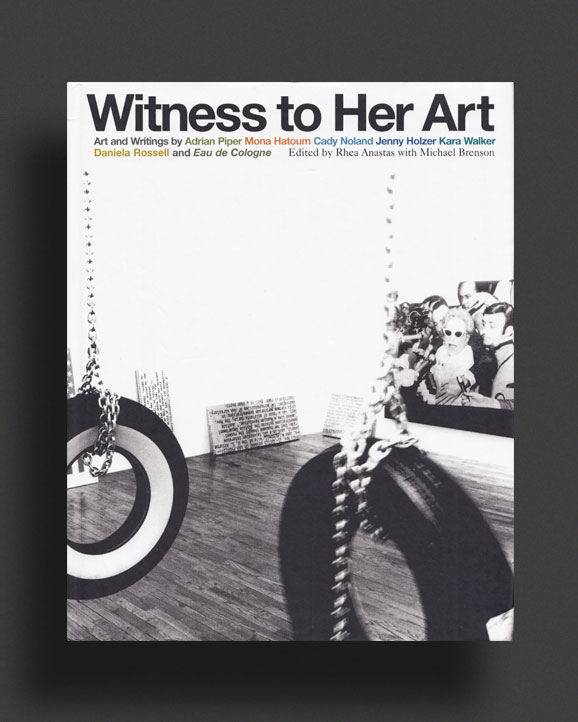
First edition of this very special, now very rare catalogue published in 2006 on the occasion of the major survey exhibition Witness To Her Art, featuring the work of Adrian Piper, Mona Hatoum, Cady Noland, Jenny Holzer, Kara Walker, Daniela Rossell and the seminal magazine Eau de Cologne, published by gallerist Monika Sprüth between 1985 and 1989. Profusely illustrated throughout with artworks by all artists, reproductions of important artist publications, installation views, and many works by other related artists, alongside texts by Adrian Piper, Kara Walker, Daniela Rossell, Mona Hatoum, Cady Noland, Jenny Holzer, Monika Sprüth, Rhea Anastas, Michael Brenson, Norton Batkin, Johanna Burton, Aruna D’Souza, Pamela Franks, Janet Kraynak, David Levi Strauss, Cuauhtémoc Medina, Ann Reynolds, Hamza Walker, and many more.
Publisher's blurb:
"This radical new study aims to change the way that some of the most influential artists of the past 40 years are seen—all of them women. Emphasizing questions of autonomy, critical intelligence and artistic intention, "Witness to Her Art" presents works by Adrian Piper, Mona Hatoum, Cady Noland, Jenny Holzer, Kara Walker, Daniela Rossell and "Eau de Cologne," a magazine published by gallerist Monika Sprüth. The artworks are accompanied by original writings by the artists, contemporaneous criticism and newly commissioned essays by Pamela Franks, Aruna D'Souza, Johanna Burton, David Levi Strauss, Hamza Walker and Cuauhtémoc Medina. The ambitious works presented and interpreted herein invite us to consider the impact of the feminist revolution across generations while rendering obsolete any stigma associated with shows or catalogues limited to women artists. Taking its lead from Conceptualism, feminism, and from its included artists, "Witness to Her Art" reaches for art history's capacity as a medium of world-making."
Highly recommended. Very Good copy with light edge wear/rounding to stiff overlay boards.
1992, English
Softcover (french-folds), 144 pages, 28 x 22 cm
1st Edition, Out of print title / used / good
Published by
FAE Musee d'Art Contemporaine Pully / Lausanne
$160.00 - In stock -
First 1992 English edition of the legendary Post Human exhibition catalogue, published on the occasion of the touring exhibition curated by Jeffrey Deitch, June 1992—October 1993. Post Human brought together the work of leading young international artists confronting a new artificial “real” world; a new figuration. The participating artists examine the media’s obsession with the “virtual reality” of the body beautiful through works that reveal the neuroses that plague contemporary society. In Deitch's words, this lavishly designed catalogue "explores the implications of genetic engineering, plastic surgery, mind expansion, and other forms of body alteration, to ask whether our society is developing a new model of the human being. It poses the question of whether our society is creating a new kind of post-human person that replaces previous constructions of the self. Images from the new technological and consumer culture and the new, conceptually oriented figurative art of thirty-six young artists will endeavor to give us a glimpse of the coming post-human world."
Featuring the work of Dennis Adams, Janine Antoni, John M Armleder, Stephan Balkenhol, Matthew Barney, Ashley Bickerton, Taro Chiezo, Clegg & Guttmann, Wim Delvoye, Suzan Etkin, Fischli / Weiss, Slyvie Fleury, Robert Gober, Felix Gonzalez-Torres, Damien Hirst, Martin Honert, Mike Kelley, Karen Kilimnik, Martin Kippenberger, Jeff Koons, George Lappas, Annette Lemieux, Christian Marclay, Paul McCarthy, Yasumasa Morimura, Kodai Nakahara, Cady Noland, Daniel Oates, Pruitt & Early, Charles Ray, Thomas Ruff, Cindy Sherman, Kiki Smith, Pia Stadtbäumer, Meyer Vaisman, Jeff Wall.
"Post Human was virtually a manifesto trumpeting a new art for a new breed of human. As Deitch’s text explained in the fragmented mottos that punctuated the billboard-style graphics of Dan Friedman’s catalogue design, “It is becoming routine for people to try to alter their appearance, their behavior, and their consciousness beyond what was once thought possible.” And we go on to read, “With the embrace of artificiality, Realism as we used to know it may no longer be possible.” The glossy color plates spoke volumes, whether the illustrations came from art or from “life.” The catalogue was to become something of a cult item that triggered the imaginations of many younger artists. Here was a permanent anthology of the “posthumanity” that surrounds us not only in galleries but on television, in magazines, even in real life, where the friendly androids among us chatter on about Botox and face-lifts. In the catalogue pages, one could see, for instance, four photos of Jane Fonda in four completely different but equally synthetic guises; Pat Buchanan being made up by a cosmetician for a TV appearance; computer morphs of once- human faces; before-and-after bellies and buttocks; and dead center, a profile view of Michael Jackson, clearly the sun god of this new solar system, who would later be deified by Jeff Koons.
This pure plastic environment, whether peopled by Ivana Trump or Barbie, set the stage for the artists in the show, whose works played perfectly in this parallel universe that was quickly replacing that old-fashioned thing called Nature. The result was a complete reshuffling of the contemporary-art deck, with an international mix of thirty-six artists (singles and pairs) that embraced Thomas Ruff and Jeff Wall, Clegg & Gutmann and Pruitt/Early, Damien Hirst and Cindy Sherman, Matthew Barney and Yasumasa Morimura, Charles Ray and Martin Kippenberger. A new dynasty had installed itself, and this ruling class demanded fitting ancestry."—Robert Rosenblum, Artforum (October 2004)
"Looked at from the point of view of being difficult cultural issues to a broader public than usual, the project Post Human could not have come about at a better time. (…) Deitch’s central thesis—that the voluntary manipulation of the human body through surgery, cosmetics and exercise, combined with recent technologies allowing us to simulate the experience of reality, have produced a culture in which the body no longer serves as a cohesive, organic reference point—fits well in an age in which pop starts, politicians and even artists themselves seem to delight in changing their physical identities to suit their purposes. No longer the domain of privacy and difference, the body has become a public crossroads where the merging of real and artificial, organic and synthetic, and even good and evil, is taking place right before our very (ahem) eyes."—Dan Cameron, Frieze (September–October 1992)
Good—Very Good copy of the sought after English language edition (the catalogue was produced in five languages) some wear to extremities, light light knocking/creasing to boards and spine, but overall a handsome copy.
1994, English / German
Softcover, 72 pages, 15.5 x 24 cm
1st Edition, Out of print title / used / fine
Published by
Cantz Verlag / Berlin
$65.00 - Out of stock
Excellent, long out-of-print Rosemarie Trockel book, published in 1994 on the occasion of an exhibition at MAK Vienna. Designed by the artist herself, this publication focuses primarily on her video works of the nineties. Rosemarie Trockel began working with the medium of film in 1993, pursuing the line of development that had begun with her sculptures and objects. Her videos are concerned with people and animals, as in the slow-motion video entitled Out of the kitchen into the fire (1993), in which a female nude viewed from the rear lays an egg filled with black ink. Bizarre constellations and sequences reveal a certain irony in these works. Rosemarie Trockel's precise observations of natural processes, her use of materials, which she alters, reinterprets and places in unusual and surprising contexts, make her a very interesting contemporary artist. Rather than producing new "images" herself, she has the capacity to generate new images in the mind of the viewer.
As New copy.
1990, English
Softcover (w. dust jacket), 512 pages, 29.5 x 23 cm
1st Edition, Out of print title / used / very good
Published by
Biennale of Sydney / Sydney
$100.00 - In stock -
First edition of the incredible (huge) catalogue published to accompany the 8th Biennale of Sydney 1990 "The Readymade Boomerang: Certain Relations in 20th Century Art", held 11 April-3 June 1990 in Sydney across various venues. The eighth Biennale began from ‘a trio of Dada originators’: Marcel Duchamp, Man Ray and Francis Picabia. A large number of artists across generations joined these key figures in Artistic Director René Block’s exploration of the ‘readymade’ in twentieth-century art, which aimed to highlight ‘its invention and pure use by Duchamp, to its resurgence in Nouveau Realism, Pop Art, and Fluxus of the 60s, all the way to new versions by young contemporary artists’. Pop, fluxus and conceptual artists such as Andy Warhol, Richard Hamilton, Marcel Broodthaers, Joseph Beuys, John Cage, Alison Knowles, César, George Brecht, Nam Jun Paik and Piero Manzoni were shown alongside Rosemarie Trockel, John Nixon, Ian Burn, Mel Ramsden, Janet Burchill, Peter Tyndall, Robert Rooney, Rosalie Gascoigne, Cindy Sherman, Bruce Nauman, Hans Haacke, Rebecca Horn, Sophie Calle, Jeff Koons, Allan Kaprow, Jenny Holzer, Robert Gober, Jill Scott, Bill Culbert, Stanley Brouwn, Peter Cripps, Terry Fox, Ian Hamilton Finlay, Fischli & Weiss, KP Brehmer, Sigmar Polke, Dieter Rot, Hanne Darboven, Robert MacPherson, Jackie Redgate, Ed Ruscha, Barbara Bloom, Oyvind Fahlstrom, amongst so many others. The industrial Bond Store at Millers Point featured site-specific works by artists such as Olaf Metzel and Simone Mangos, and several works were created on-site in Sydney, amplifying Block’s notion of the Biennale as a ‘workshop’. A comprehensive satellite program of music, performance, lectures, symposia, workshops and exhibitions at various Sydney venues complemented the exhibition, with Carles Santos’ piano recital on a barge in Sydney Harbour a highlight. Five satellite exhibitions included On Kawara, Joseph Beuys, Alain Fleischer, Fluxus and Broken Record, which featured artist’s experimentations with audio recordings, vinyl and album artwork – from John Cage’s 33 1/3 composition for 12 record players to Milan Knížák’s record-collages.
An incredible Sydney biennale, captured here across over 500 pages conceived and realised by René Block and Jennifer Cook - profusely illustrated with examples of all artists works and accompanying texts throughout by Lynne Cooke, Bernice Murphy, Anne Marie Freybourg, Dick Higgins, René Block and Jennifer Cook. Very Good copy with only general wear/ageing. Bright and clean, includes tanned original dust jacket now preserved under plastic wrap.
Having represented Beuys, Richter and Polke, German gallery owner, art publisher, art collector and curator René Block (born 1942) ranks among the central figures of the 1960s avant-garde.
Very Good copy with original dust jacket. Common tanning to dust jacket spine, now preserved under mylar wrap.
2025, English
Hardcover, 304 pages, 29 x 22 cm
Published by
Hatje Cantz / Berlin
$105.00 - In stock -
A spectacular appraisal of one of the most innovative avant-garde artists of the Dada scene
Raoul Hausmann fought convention all his life. Radically resolved to be "unscrupulously honest" in both art and life, the Dadaist was a multimedia activist of the first hour and a sharp-tongued critic of society. Now his visionary output can be enjoyed in all its breadth. With more than 300 illustrations, this catalogue from the Berlinische Galerie traces his path: the early Expressionist works, gems of Dada from the Berlin years, Hausmann's photography, but also fashion, dance and literature, and the artist's lesser-known productivity in exile. Twelve essays by international experts in the history of art and literature, media studies, and psychoanalysis examine the multilayered oeuvre to offer a multifaceted panorama of Hausmann's astonishing significance—even today. Another appealing feature of the catalogue is its attractive, artistic design.
Raoul Hausmann (1886-1971) was an exceptionally innovative avant-garde artist. He co-invented collage, explored body, words, and space in early happenings, merged the visual with the haptic, and translated sound into images. In and beyond art, the provocative "Dadasoph" called out the establishment.
Edited by: Ralf Burmeister, Thomas Köhler
Graphic Design: Gregor Schreiter
Texts by: Hanne Bergius, Peter Bexte, Ralf Burmeister, Amélie Castellanet, Annina Guntli, Nadine Hartmann, Thomas Köhler, Annelie Lütgens, Agatha Mareuge, Nils Philippi, Bernd Stiegler, Hélène Thiérard, Timm Ulrichs, Michael White
2000, Japanese
Hardcover (w. dust jacket), 80 pages, 27 x 19.2 cm
1st Edition, Out of print title / used / very good
Published by
Kadokawa Shoten / Tokyo
$70.00 - In stock -
First 2000 hardcover edition of this lavish photo book, Derrière les paupières (Behind the Eyelids), collecting the delicate ball-jointed bisque doll works of renowned Japanese doll artist Koizukihime (b. 1955). Koizukihime's ethereal gothic dolls exude a quiet, timeless beauty, imbued with the softness of enternal youth. Shot intimately by Japanese photographer Sakichi Kataoka, her nymphish girl creations—whether coffined, stigmatic, in slumber, or in erotic undress—are set in macabre, dreamlike scenarios of ritual, eros and death. Koizukihime began creating ball-jointed dolls in 1980 – the entire body is divided into parts, each connected by a sphere at the joints, allowing the joints to move freely. An artistic method radicalised by Hans Bellmer. By 1996, Koizukihime was creating all-bisque ball-jointed dolls, introducing high-end antique doll methods of late 19th century France, making all of the doll's parts out of fired porcelain and joining them with strong elastic bands.
VG copy in VG dust jacket.
2014, English
Softcover, 112 pages, 28 x 21.59 cm
Published by
Creation Books / London
$48.00 - In stock -
The modern era of underground doll-making in Japan began in the late 1960s, with the experiments of Simon Yotsuya and Nori Doi. Directly inspired by the Surrealist Doll constructed by Hans Bellmer in 1932, Simon Yotsuya created a series of ball-jointed, life-sized dolls which featured in his ground-breaking "Eve In The Past And The Future" exhibition in Tokyo, in 1973.
Simon Yotsuya's work inspired a new wave of avant-garde Japanese doll-making, headed by artists such as Ryo Yoshida and Katan Amano, which has continued to flourish to the present day. SECRET DOLL UNDERGROUND, presented by Yuichi Konno, features dolls by fifteen artists, from Simon Yotsuya onwards, with over 80 full-sized colour photographs never before published outside Japan. It also includes Konno's introductory history of the underground doll in Japan.
Yuichi Konno is the editor of Yaso, an independent arts and culture publication founded in 1979.
2025, English / German
Softcover, 288 pages, 28 x 23 cm
Published by
Walther König / Köln
$130.00 - In stock -
The first monograph on an German artist Michaela Eichwald (b. 1967) who consistently explores the "fundamental and inexhaustible problems of art" in her work, engaging with the interplay between material and form.
The publication charts more than three decades of Michaela Eichwald’s singular and shapeshifting practice that spans painting, sculpture, writing, and more elusive forms, creating idiosyncratic visions and (visual) worlds. Eichwald shifts expertly between the disciplines, drawing her unconventional work titles from sources that range from Medieval mysticism to bureaucratic solecisms. Alongside rich reproductions of her works, the publication delves deep into her creative universe – featuring rare archival material and selections from her long-running, legendary blog, uhutrust.com, active since 2006.
Contributions by Michaela Eichwald, Elena Filipovic & Renate Wagner, John Kelsey, Matthias Mühling, Monika Rinck & Stephanie Weber.