World Food Books' programme is largely produced on Kulin Nation land. We acknowledge the Wurundjeri people of the Kulin Nation as the first and continuing custodians of this land, and pay respect to their Elders past, present, and emerging.
World Food Books is an arts and special interests bookshop in Naarm / Melbourne. Founded in 2010, World Food Books is devoted to the presentation of a rotating, hand-selection of international art, design, literary and counterculture publications with an emphasis on the anti-traditional, the experimental, the avant-garde, the heretic, the marginal.
Presenting new titles alongside rare and out-of-print books, catalogues and journals spanning the fields of modern and contemporary art, design, photography, illustration, film, literature, poetry, cultural theory, philosophy, sexuality, popular and underground culture in its many radical forms, World Food Books wishes to encourage adventurous, thoughtful and open-minded reading, looking, writing, and exchange of publishing and ideas, both current and historical.
As well as our bookshop, located in Melbourne's historical Nicholas Building, all of our inventory is available internationally via our online mail-order service.
World Food Books semi-regularly co-ordinates "Occasions", a programme of exhibits and events at the bookshop and in partnership with other hosts (such as museums and art galleries) that develop out of the activities, relationships and content of the bookshop itself.
World Food Books
The Nicholas Building
37 Swanston Street
Room 5, Level 6
Melbourne 3000
Australia
SHOP HOURS:
Thu–Fri 12–6, Sat 12–5
WEB-SHOP OPEN 24/7
World Food Books
Postal Address:
PO Box 435
Flinders Lane
Victoria 8009
Australia
Art
Theory / Essay
Architecture / Interior
Graphic Design / Typography
Photography
Fashion
Eros
LGBTQ+
Fiction / Poetry
Weird / Speculative / Science Fiction / Horror
Transgressive / Visceral / Abject
Symbolism / Decadence / Fin de siècle
Film / Video
Painting
Sculpture / Installation
Performance / Dance / Theater
Drawing
Sound / Music
Curatorial
Group Shows / Collections
Periodicals
Out-of-print / Rare
Posters / Ephemera / Discs
Signed Books
World Food Books Gift Voucher
World Food Book Bag
Australian Art
Australian Fiction
Australian Science Fiction / Speculative Fiction
Australian Poetry
Australian Photography
Japanese Photography
Conceptual Art
Minimal Art
Dada
'Pataphysics / Oulipo
Fluxus
Concrete Poetry
Pop Art
Surrealism
Arte Povera
Arte Informale / Haute Pâte / Tachism
Nouveau Réalisme / Zero / Kinetic
Situationism / Lettrism
Collage / Mail Art / Xerox Art
Art Brut / Folk / Visionary / Fantastic
Illustration / Graphic Art / Bandes Dessinées
Furniture
Italian Radical Design / Postmodernism
Textiles
Ceramics / Glass
Counterculture
Protest / Revolt
Philosophy
Psychoanalysis
Anthropology
Anarchism
Socialism / Anarchism / Communism / Capitalism
Literary Theory / Semiotics / Language
Feminism / Women's Studies
Gender Studies / Sexuality
Anthropology
Fetishism / BDSM
Drugs / Psychedelia
Crime / Violence
Animal Rights / Veganism
Occult / Esoterica
Ecology / Earth / Alternative Living
Whole Earth / Crafts
All prices in AUD (Australian dollars)
Pick-Ups
Pick-up orders can be collected in our bookshop during opening hours after order date. Please collect any Pick-up orders within 2 weeks of ordering as we have limited storage space. Orders will be released back into stock if not collected within this time. No refunds can be made for pick-ups left un-collected. If you cannot make it in to the bookshop in this time-frame, please choose postage option.
Return Policy
All sales are final. We do accept returns (for refund or exchange) for items received in error. All our orders are packed with special care using heavy-duty padding and cardboard book-mailers or bubble mailers (for smaller books), using reinforcement where required. We cannot take responsibility for any lost, stolen or damaged parcels.
Insurance
Should you wish to insure your package, please email us directly after placing your order and we can organise this at a small extra expense. Although all standard/express tracked packages are very safe and dependable, we cannot take responsibility for any lost, stolen or damaged parcels. We recommend insurance on valuable orders.
Interested in selling your old books, catalogues, journals, magazines, comics, fanzines, ephemera? We are always looking for interesting, unusual and out-of-print books to buy. We only buy books in our fields of interest and specialty, and that we feel we can resell.
We base these prices on desirability, market value, in-print prices, condition and our current stock levels. We offer cash, store credit, and can take stock on consignment. All
about 25% of the price we expect to get when we sell them, or 30% in store credit. We base these prices on desirability, market value, in-print prices, condition and our current stock levels.
Sell your books any day of the week. You can drop them off and return later. If you have a lot of books, we can visit your Sydney home.
We buy books that we feel we can resell. We offer about 25 % of the price we expect to get when we sell them, or 30% in store credit. We base these prices on desirability, market value, in-print prices, condition and our current stock levels.
Philadelphia Wireman
03 August - 01 September, 2018
World Food Books is proud to announce our next Occasion, the first presentation of sculptures by Philadelphia Wireman in Australia.
The Philadelphia Wireman sculptures were found abandoned in an alley off Philadelphia’s South Street on trash night in 1982. Their discovery in a rapidly-changing neighbourhood undergoing extensive renovation, compounded with the failure of all attempts to locate the artist, suggests that the works may have been discarded after the maker’s death. Dubbed the "Philadelphia Wireman" during the first exhibition of this work, in 1985, the maker’s name, age, ethnicity, and even gender remain uncertain. The entire collection totals approximately 1200 pieces, all intricately bound together with tightly-wound heavy-gauge wire (along with a few small, abstract marker drawings, reminiscent both of Mark Tobey and J.B. Murry). The dense construction of the work, despite a modest range of scale and materials, is singularly obsessive and disciplined in design: a wire armature or exoskeleton firmly binds a bricolage of found objects including plastic, glass, food packaging, umbrella parts, tape, rubber, batteries, pens, leather, reflectors, nuts and bolts, nails, foil, coins, toys, watches, eyeglasses, tools, and jewellery.
Heavy with associations—anthropomorphic, zoomorphic, and socio-cultural responses to wrapped detritus—the totemic sculptures by Philadelphia Wireman have been discussed in the context of work created to fulfil the shamanistic needs of alternative religions in American culture. Curators, collectors, and critics have variously compared certain pieces to sculpture from Classical antiquity, Native American medicine bundles, African-American memory jugs, and African fetish objects. Reflecting the artist’s prolific and incredibly focused scavenging impulse, and despite—or perhaps enhanced by—their anonymity, these enigmatic objects function as urban artefacts and arbiters of power, though their origin and purpose is unknown. Philadelphia Wireman, whatever their identity, possessed an astonishing ability to isolate and communicate the concepts of power and energy through the selection and transformation of ordinary materials. Over the course of the past two decades, this collection has come to be regarded as an important discovery in the field of self-taught art and vernacular art.
Presented in collaboration with Fleisher-Ollman Gallery, Philadelphia, and Robert Heald, Wellington.
Susan Te Kahurangi King
02 February - 10 March, 2018
Susan Te Kahurangi King (24 February 1951 - ) has been a confident and prolific artist since she was a young child, drawing with readily available materials - pencils, ballpoint pens and felt-tip markers, on whatever paper is at hand. Between the ages of four and six Susan slowly ceased verbal communication. Her grandparents William and Myrtle Murphy had developed a special bond with Susan so they took on caring responsibilities for extended periods. Myrtle began informally archiving her work, carefully collecting and storing the drawings and compiling scrapbooks. No drawing was insignificant; every scrap of paper was kept. The King family are now the custodians of a vast collection containing over 7000 individual works, from tiny scraps of paper through to 5 meter long rolls.
The scrapbooks and diaries reveal Myrtle to be a woman of great patience and compassion, seeking to understand a child who was not always behaving as expected. She encouraged Susan to be observant, to explore her environment and absorb all the sights and sounds. Myrtle would show Susan’s drawings to friends and people in her community that she had dealings with, such as shopkeepers and postal workers, but this was not simply a case of a grandmother’s bias. She recognised that Susan had developed a sophisticated and unique visual language and sincerely believed that her art deserved serious attention.
This was an unorthodox attitude for the time. To provide some context, Jean Dubuffet coined the term Art Brut in 1945 to describe work created by self-taught artists – specifically residents of psychiatric institutions and those he considered to be visionaries or eccentrics. In 1972 Roger Cardinal extended this concept by adopting the term Outsider Art to describe work made by non-academically trained artists operating outside of mainstream art networks through choice or circumstance. Susan was born in Te Aroha, New Zealand in 1951, far from the artistic hubs of Paris and London that Dubuffet and Cardinal operated in. That Myrtle fêted Susan as a self-taught artist who deserved to be taken seriously shows how progressive her attitudes were.
Susan’s parents Doug and Dawn were also progressive. Over the years they had consulted numerous health practitioners about Susan’s condition, as the medical establishment could not provide an explanation as to why she had lapsed into silence. Dawn educated herself in the field of homeopathy and went on to treat all twelve of her children using these principles – basing prescriptions on her observations of their physical, mental and emotional state.
Doug was a linguist with an interest in philosophy who devoted what little spare time he had to studying Maori language and culture. To some extent their willingness to explore the fringes of the mainstream made them outsiders too but it was their commitment to living with integrity and their respect for individuality that ensured Susan’s creativity was always encouraged.
Even though Susan’s family supported her artistic pursuits, some staff in schools and hospitals saw it as an impediment to her assimilation into the community and discouraged it in a variety of ways. Her family was not always aware of this and therefore did not fully understand why Susan stopped drawing in the early 1990s. However, rather than dwell on the challenges that Susan faced in pursuit of her artistic practice, they prefer to highlight her achievements. In 2008 Susan began drawing again in earnest, after an almost 20 year interruption, and her work is now shown in galleries around the world.
Susan grew up without television and has been heavily influenced by the comics she read as a child. She is absolutely fearless in the appropriation of recognizable characters, such as Donald Duck and Mickey Mouse, in her work. She twists their limbs, contorts their faces, compresses them together, blends them into complex patterned backgrounds - always imbuing them with an incredible energy. Although Susan often used pop culture characters in her work they are not naive or childlike. These are drawings by a brilliant self-taught artist who has been creating exceptional work for decades without an audience in mind.
Mladen Stilinović
"Various Works 1986 - 1999"
02 February 16 - September 10, 2016
Various works 1986 - 1999, from two houses, from the collections of John Nixon, Sue Cramer, Kerrie Poliness, Peter Haffenden and Phoebe Haffenden.
Including: Geometry of Cakes (various shelves), 1993; Poor People’s Law (black and white plate), 1993; White Absence (glasses, ruler, set square, silver spoon, silver ladel with skin photograph and wooden cubes), 1990-1996; Exploitation of the Dead (grey and red star painting, wooden painting, black spoon with red table, red plate), 1984-1990; Money and Zeros (zero tie, paintings made for friends in Australia (Sue, John, Kerrie), numbers painting), 1991-1992; Words - Slogans (various t-shirts) - “they talk about the death of art...help! someone is trying to kill me”, “my sweet little lamb”, “work is a disease - Karl Marx”; Various artist books, catalogues, monographs, videos; Poster from exhibition Insulting Anarchy; "Circular" Croatian - Australian edition; Artist book by Vlado Martek (Dostoyevsky); more.
Thanks to Mladen Stilinović and Branka Stipančić.
Jonathan Walker
Always Will Need To Wear Winter Shirt Blue + Ochre Small Check Pattern
21 August - 21 September, 2015
Untitled
I am not a great reader of poetry but I always return to the work of Melbourne poet, Vincent Buckley (1925- 1988). Perhaps I find his most tantalising piece to be not a finished poem but a fragment left on a scrap of paper discovered on his desk after the poet’s death.
The poetry gathers like oil
In the word-core, and spreads
It has its music meet,
Its music is in movement.
This fragment is more the shell left behind from a volatile thought than a finished poem. I find the last two lines honest but awkward whereas the first two lines work like an arrow. Most likely he could not find a resolution so it was left. Still, in its present form, it remains an eloquent testimony to the ultimate failure of a medium to express mobile thought and sensation, in Buckley’s case, through verbal language. It’s an important matter because this is something all artists have to deal with regardless of the medium.
I have never written a poem, however, I am forever copying fragments from books on paper scraps in a vain effort to fix certain notions in my head. At first, they function as bookmarks that are sometimes returned to when I open the book. But before long, as they accumulate, they fall out littering the table interspersed with A4 photocopies, bills, books and medications.
To return to Buckley’s fragment, the first two lines very much evoke how I paint nowadays. As you age, detail diminishes and patches of light become more luminous and float. I feel the most honest way of dealing with this is by smearing the oil paint on the canvas with the fingers and working close-up, blind. Only if the patches coalesce into an approaching image can the work gain a life.
-
Jonathan Walker was born in Melbourne, Australia and brought up on a dairy farm in Gippsland. In the 1970’s he studied painting at RMIT and won the Harold Wright Scholarship to the British Museum, London. During the 1980’s he exhibited at Pinacotheca Gallery, Richmond and had work shown at the NGV and Heidi City Art Gallery. Over the same period he designed the cover for the “Epigenesi” LP by Giancarlo Toniutti, Italy and conducted a mail exchange work with Achim Wollscheid, Germany. The work with artists through the post resulted in an article published in the bicentenary issue of Art and Australia 1988. He showed in artist run spaces such as WestSpace in the 90’s and 2000’s, and until 2012, taught painting at Victoria University, which is where we (Colleen Ahern and Lisa Radford) as organisers of the exhibition, among many others, had the privilege of being his student.
Walker’s knowledge was imparted to students through the careful selection of music, literature, and artists found in books that he himself had ordered for the library. Walker’s strategy was the generosity of sharing his vast knowledge with references specific to each student and their context.
Walker’s paintings share a similar focus and intimacy.
This exhibition presents a small selection of recent paintings alongside a publication that includes Walker’s writing. Observational and analytical, Walker’s work is a type of material notation — the time of day, colour and how it is blended, the both specific and fleeting location of a reflection on lino or the question of whether a chair leg should be included in a painting.
Please join us on Friday August 21 between 6-8pm to celebrate the opening of the exhibition.
Curated by Colleen Ahern and Lisa Radford.
B. Wurtz
Curated by Nic Tammens
March 26 - April 4, 2015
B.Wurtz works from a basement studio in his home on Manhattan’s Lower East Side.
This local fact is attested to by the plastic shopping bags and newsprint circulars that appear in his work. As formal objects, they don’t make loud claims about their origins but nonetheless transmit street addresses and places of business from the bottom of this long thin island. Like plenty of artists, Wurtz is affected by what is local and what is consumed. His work is underpinned by this ethic. It often speaks from a neighborhood or reads like the contents of a hamper:
“BLACK PLUMS $1.29 lb.”
“Food Bazaar”
“USDA Whole Pork Shoulder Picnic 99c lb.”
“RITE AID Pharmacy, with us it’s personal.”
“H. Brickman & Sons.”
“Sweet Yams 59c lb."
Most of the work in this exhibition was made while the artist was in residence at Dieu Donne, a workshop dedicated to paper craft in Midtown. Here Wurtz fabricated assemblages with paper and objects that are relatively lightweight, with the intention that they would be easily transportable to Australia. This consideration isn’t absolute in Wurtz’s work, but was prescriptive for making the current exhibition light and cheap. Packed in two boxes, these works were sent from a USPS post office on the Lower East Side and delivered to North Melbourne by Australia Post.
Wurtz appears courtesy of Metro Pictures, New York.
Thanks to Rob Halverson, Joshua Petherick, Sari de Mallory, Matt Hinkley, Helen Johnson, Fayen d'Evie, Ask Kilmartin, Lisa Radon, Ellena Savage, Yale Union, and "Elizabeth".
John Nixon
"Archive"
December 15 - January 20, 2014
The presentation of John Nixon's archive offered a rare showcase of this extensive collection of the artist's own publications, catalogues, posters, ephemera, editions and more, from the mid 1980s onwards, alongside a selection of his artworks.
Organized by John Nixon, Joshua Petherick and Matt Hinkley.
<a href=http://wfb.public-office.info/artist/john-nixon>All titles by John Nixon
"Habitat"
at Minerva, Sydney (organised by Joshua Petherick and Matt Hinkley)
November 15 - December 20, 2014
Lupo Borgonovo, Janet Burchill & Jennifer McCamley,
Lewis Fidock, HR Giger, Piero Gilardi, Veit Laurent Kurz,
Cinzia Ruggeri, Michael E. Smith, Lucie Stahl, Daniel Weil, Wols
Press Release:
“...It contained seven objects. The slender fluted bone, surely formed for flight, surely from the wing of some large bird. Three archaic circuitboards, faced with mazes of gold. A smooth white sphere of baked clay. An age-blackened fragment of lace. A fingerlength segment of what she assumed was bone from a human wrist, grayish white, inset smoothly with the silicon shaft of a small instrument that must once have ridden flush with the surface of the skin - but the thing’s face was seared and blackened.”
William Gibson, “Count Zero”, 1986
"Autumn Projects Archive"
Curated by Liza Vasiliou
March 6 - March 15, 2014
World Food Books, in conjunction with the Virgin Australia Melbourne Fashion Festival 2014, presented the Autumn Projects archive, consisting of a selection of early examples in Australian fashion with a particular interest in collecting designers and labels from the period beginning in the 1980’s, who significantly influenced the discourse of Australian Fashion.
Curated by Liza Vasiliou, the exhibition provided a unique opportunity to view pieces by designers Anthea Crawford, Barbara Vandenberg, Geoff Liddell and labels CR Australia, Covers, Jag along with early experimental collage pieces by Prue Acton and Sally Browne’s ‘Fragments’ collection, suspended throughout the functioning World Food Books shop in Melbourne.
H.B. Peace
presented by CENTRE FOR STYLE
November 14, 2013
"Hey Blinky, you say chic, I say same"
Anon 2013
H.B. Peace is a clothing collaboration between great friends Blake Barns and Hugh Egan Westland. Their pieces explore the divergences between 'character’ and ‘personality’ in garments....etc
Special Thanks to Joshua Petherick and Matt Hinkley of WFB and Gillian Mears
and a Very Special Thank you to Audrey Thomas Hayes for her shoe collaboration.
Janet Burchill & Jennifer McCamley
"Aesthetic Suicide"
May 10 - June 8, 2013
The first of our occasional exhibitions in the World Food Books office/shop space in Melbourne, "Aesthetic Suicide" presented a body of new and older works together by artists Janet Burchill & Jennifer McCamley, including videos, prints, a wall work, and publications.
During shop open hours videos played every hour, on the hour.
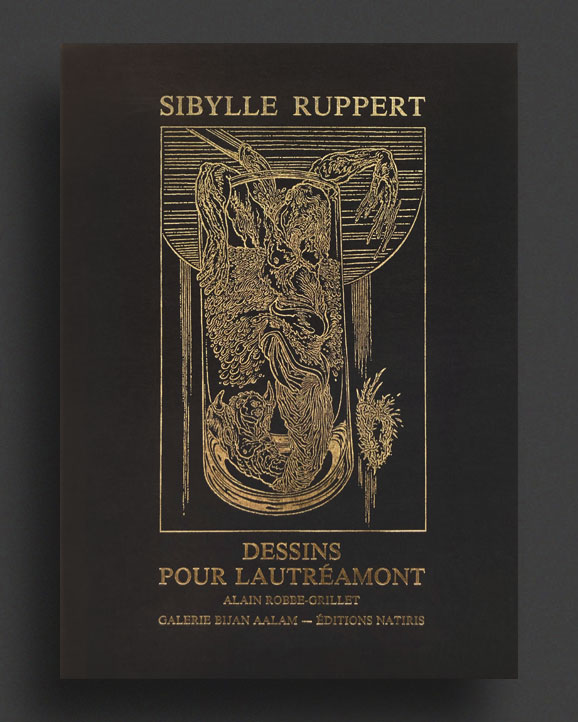
1980, French
Hardcover cloth-bound slipcase, 13 plates + text insert, 42.2 x 30.9 cm
Signed and numbered,
1st Edition, Out of print title / used / very good
Published by
Galerie Bijan Aalam / Paris
Editions Natiris / Paris
$550.00 - In stock -
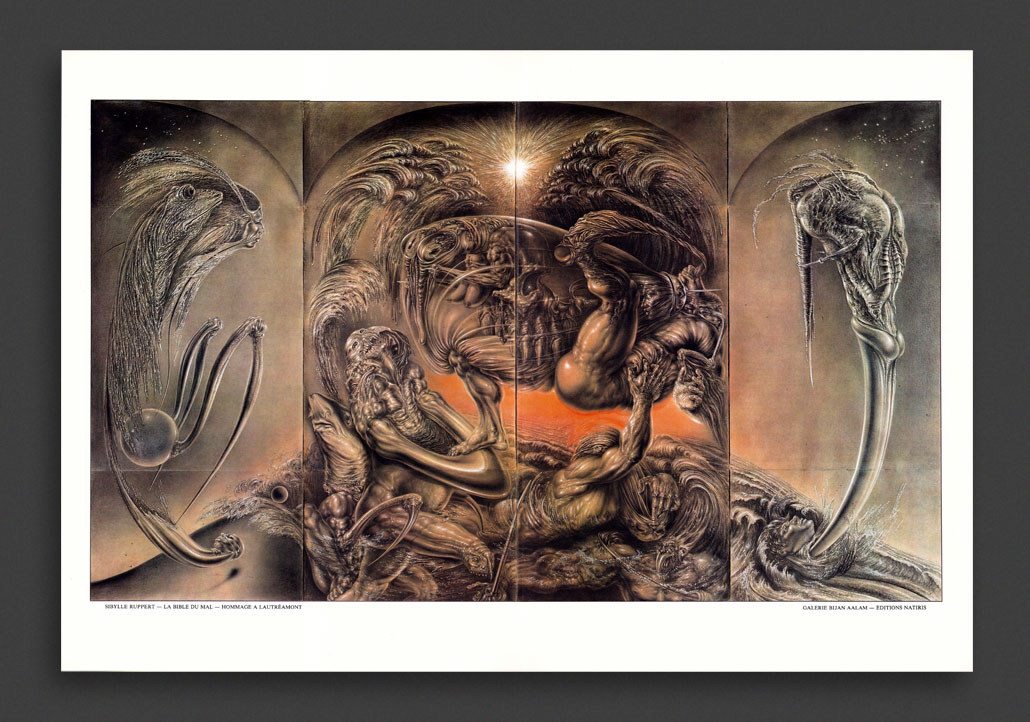
"An artist with a secret, terrible and painful gaze, Ruppert's work boldly plunges us into the darkest abysses of our souls, to the depths of our unconfessed sexuality, into these cursed areas that we refuse with a self-protective horror instilled by the taboos of society."
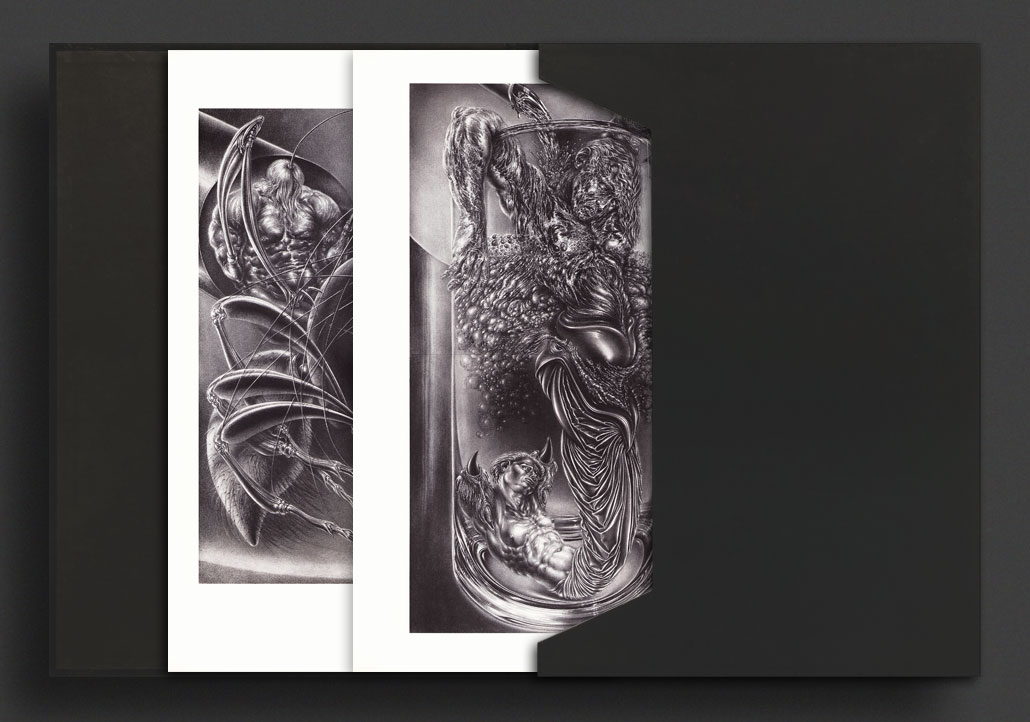
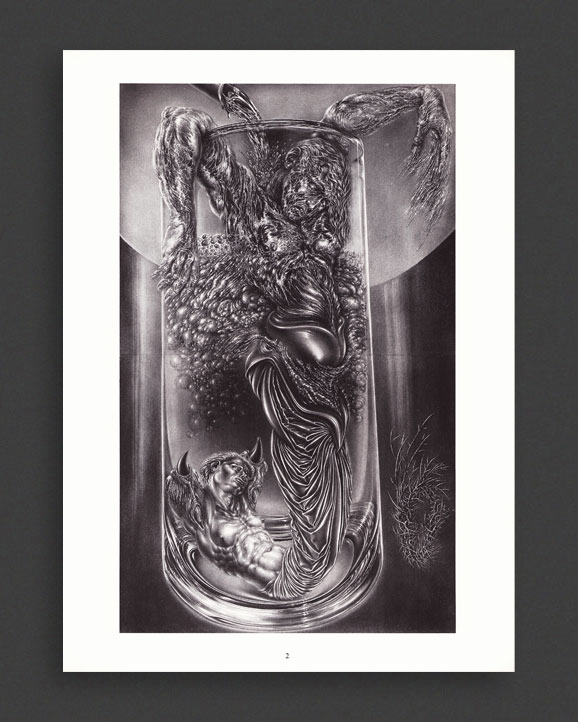
Extremely rare, signed and numbered cloth-bound portfolio by German artist Sibylle Ruppert (1942—2011), published in 1980 by Galerie Bijan Aalam / Editions Natiris, Paris, published in an edition of 1300. With a preface by Alain Robbe-Grillet, this magnificent portfolio illustrating Lautréamont's Les Chants de Maldoror (1868) presents 13 litho-printed loose-leaf plates in colour and monochrome, exquisitely reproducing Ruppert's artworks in striking large-format. The leading plate folds-out to a double-size spread. Accompanied by a selection of passages by Comte de Lautréamont (Isidore Lucien Ducasse) to whom this title is dedicated and from which these illustrations are inspired. Numbered and signed by the artist in the colophon. A complete copy of this major published work of this incredible artist.
"The opening pages of Georges Bataille’s 1928 novella, Story of the Eye, recount a violent three-way sex scene on the edge of a cliff. As the libidinal frenzy nears its peak, rain starts to fall, introducing mud and dirt into the already visceral cocktail of piss, cum, and other bodily fluids in free flow. If this literary vignette had a visual equivalent, it might well be the Sisyphean compositions of Sibylle Ruppert, in which hybrid limbs, flesh, machinery, and the natural elements all commingle and fuse into one another without beginning or end, obliterating any notion of bodily integrity. Bataille, the Marquis de Sade, and Comte de Lautréamont make up the unholy trinity who nourished Ruppert’s dark fantasies. The violent explosiveness of eroticism, desire, pain, destruction, and resurgence so dear to those authors is channeled in Ruppert's works"—Anya Harrison
Sibylle Ruppert (1942, Frankfurt—2011, Paris) created a radical oeuvre of paintings, drawings and collages throughout the 1960s—1980s in a brutal aesthetic of dark surrealism, mixing death and sexuality in a swirling dislocation, a frenetic tearing shared by aggregates of tangled bodies such as the morbid and obscene writings of Marquis de Sade, Comte de Lautréamont, both which she illustrated, or that of Georges Bataille. Ruppert was born during an air raid on September 8th, 1942, the first night of massive bombing of Frankfurt during World War II. At age of 10 she had a religious enlightenment and she insisted on becoming a nun. Discouraged by her parents, in 1959, at the age of 17, Sibylle was instead admitted to the Städelschule in Frankfurt to study art. Shortly after, she left for Paris, where she enrolled in a ballet school and became a successful dancer. During a visit to New York with her friend H.R. Giger, Ruppert decided to give up her dancing career, returned to Germany and became a full-time artist and to teach at her father's drawing school. In 1976 she moved back to Paris and exhibited her large format charcoal drawings, inspired by the writings of de Sade, Lautréamont and Georges Bataille, and her collages and paintings at the Gallery Bijan Aalam. French intellectuals and great minds like Alain Robbe-Grillet, Pierre Restany, Henri Michaux and Gert Schiff were fascinated by her work and tried to interpret her infernal world. When the gallery closed in 1982, she returned to teaching and she started giving art classes in prisons, mental hospitals and drug addiction rehabilitation centers. Sibylle Ruppert died in 2011, withdrawn from any social and public life.
"Here offered to the revulsed senses, the secret shames of anatomy: torn orifices, spilled entrails, secretions, losses. A sharp point, I said. Yes, the sticky and the sharp seem, now, to generate each other in a circle, the fine knife of torture to belong to the same monster as the ignominious flesh which is cut (unbunched), the sexes are invert, insidiously, and invaginate the murder weapon[...]"—A. Robbe-Grillet
Very Good copy with some light wear, light marking and tanning. Sample images only.
1972, German
Softcover, 96 pages, 28 x 205 cm
1st Edition, Out of print title / used / good
Published by
Heyne Verlag / Münich
$35.00 - Out of stock
Wonderful 1972 German book of erotic art selected by Phyllis and Dr. Eberhard Kronhausen, rightly considered international experts in the field. "Their exhibition "Erotic Art," which has been shown in many countries around the world, formed the basis for this illustrated volume. Because this exhibition included loans from museums and galleries, as well as works from the Kronhausen couple's collection and other private collections, it was possible to present images that had previously been inaccessible to the public. In selecting works for this volume, care was taken, on the one hand, to depict these unknown works, and, on the other, to provide a reliable overview of the erotic work of the leading artists (painting, graphic art, and sculpture) of our century. Thus, this book is a fortunate exception; it is a precious document, but also a demonstration of the sexual and cultural revolution of our century."
Features the work of Franz von Bayros, Hans Bellmer, Marc Chagall, Lovis Corinth, Salvador Dali, Paul Delvaux, Otto Dix, J. Dubuffet, Max Ernst, Ernst Fuchs, Willi Geiger, George Grosz, Horst Janssen, Allen Jones, Gustav Klimt, Felix Labisse, Jan Lebenstein, Edward Munch, Claes Oldenburg, Pablo Picasso, Herbert Rauschenberg, George Segal, Max Walter Swanberg, Tomi Ungerer, Andy Warhol, Tom Wesselmann.
Good—VG copy with some laminate seperation to cover extremities and slight corner bump.
1991, Japanese
Softcover (w. dust jacket, 128 pages, 26 x 18.5 cm
1st Edition, Out of print title / used / very good
Published by
Heibonsha / Tokyo
$60.00 - In stock -
Wonderful photo-book chronology of the world of Shūji Terayama (1935—1983) and his experimental theatre troupe Tenjō Sajiki (with Kujō Kyōko, Yutaka Higashi, Tadanori Yokoo, Fumiko Takagi, ...), a major phenomenon on the Japanese Angura ("underground") theater scene of the 1960s and 70s. Terayama's activities encompass a who's-who of the Japanese avant-garde arts and literature of the time. This book visually documents it all; the filmography, performances, installations, happenings, exhibitions, posters, publications, and all else that resonated from Japan’s most revered and provocative avant-garde film-maker and his collaborators. Profusely illustrated with hundreds of illustrations in colour, duo and b/w with Japanese commentary, biographies and chronology. A wonderful, visually mind-blowing reference for anyone interested in the work of Terayama, Tenjō Sajiki, Surrealist performance, or Japanese avant-garde underground (Angura) theatre.
Shūji Terayama (1935 — 1983) was a Japanese avant-garde poet, dramatist, writer, film director, and photographer. His works range from radio drama, experimental television, underground (Angura) theatre, countercultural essays, to Japanese New Wave and "expanded" cinema. In 1967 Terayama founded Tenjō Sajiki with Kujō Kyōko, Yutaka Higashi, Tadanori Yokoo, and Fumiko Takagi, a Japanese experimental theater troupe. A major phenomenon on the Japanese Angura ("underground") theater scene, the group produced a number of stage works marked by experimentalism, folklore influences, social provocation, grotesque eroticism and the flamboyant fantasy characteristic of Terayama's oeuvre. Terayama is considered one of the most productive and provocative creative artists to come out of Japan, with a wide-reaching influence on many artists from the 1970s onward.
Very Good—Near Fine (w/o obi — image just a sample)
2009, English / German
Softcover, 80 pages, 22 x 20 cm
1st Edition, Out of print title / as new
Published by
Neue Galerie Graz und Künstlerhaus / Graz
$80.00 - In stock -
Scarce catalogue published on the occasion of the exhibition “Günter Brus - Max Klinger: Confluences & Differences. Print Cycles from the Collection of the Neue Galerie Graz”, Bruseum, Neue Galerie Graz at the Landesmuseum Joanneum, March 5 – June 7, 2009, curated by Anke Orgel.
Graz: Neue Galerie am Landesmuseum Joanneum, 2009.
The BRUSEUM at the Neue Galerie Graz dared to create a confrontation whose intention was to recognize subtle harmony—alongside dissonance. Although the work of Günter Brus (born 1938) is not directly influenced by Max Klinger (1857–1920), both artists reference shared intellectual giants from art, philosophy, and science, such as Goya, Novalis, Nietzsche, and Darwin. A shared interest in human existence provides a foundation for related thematic questions. A discontinuity in the thematic structure of Klinger's graphic cycles, which leads to a constant redirection of the narrative direction, finds a parallel in Günter Brus's pictorial poems, which are based on the autonomy of the individual prints and autonomous, at most associative, image and text passages. Only drawing and printmaking, which Klinger called "pen art," seemed suitable to him not only to illustrate external reality but also to capture the "inner gaze." The resulting "dual vision" is capable of connecting reality with the irrational and lending poetry to the representation. The accompanying catalogue, featuring selected prints by Günter Brus and Max Klinger from the collection of the Neue Galerie Graz, also explores their affinity in terms of their essential nature, with texts by Anke Orgel and Birgit Prack.
As New copy.
1995, Japanese
Hardcover (w. dust jacket and obi), 164 pages, 30 x 21 cm
1st Edition, Out of print title / used / very good
Published by
Treville / Tokyo
$350.00 - In stock -
His erotic masterpiece, "Chimushi" is the first comprehensive collection of Toshio Saeki's erotic nightmare artwork, published in 1995 by Treville, only available in Japan, and now very collectible in every edition, but especially in this first hardcover edition. One of his most popular books, and certainly his most demented and sexually graphic, each page of Chimushi sees every darkest sexual depravity rendered in vibrant, explicit colour by the unmistakable hand of Saeki, all impeccably printed in Japan by Treville Editions. Although almost entirely packed with full-page and double-page artworks, the book includes a biography and several crucial essays in Japanese by Suehiro Tanemura, Teruhiko Kuze, Masami Akita, Suehiro Maruo, Keiji Ueshima, Shuji Terayama and Tatsuhiko Shibusawa (!!!)
Toshio Saeki (1945—2019) was an illusive Japanese illustrator and painter, and icon of 1970s Tokyo counterculture, known for combining Japanese folklore, Yōkai spirits and elements of Western art with his own sophisticated aesthetics to create a unique, sensational world of eros, dark humour, and horror. Given the title “Erotic Engineer” by Timothy Leary, Saeki's provocative art broke all sexual taboos, questioned Japanese ideology and traditional views on love, desire and gender roles. Saeki’s surgically-precise graphic work is closely related to the Japanese cultural phenomenon ‘Erotic, Grotesque, Nonsense’ (ero, guro, nansensu).
“Toshio Saeki conjures death with a pen”—Shūji Terayama, 1969.
Very Good—Near Fine copy, same dj, same obi. Light wear only.
2023, English
Softcover, 152 pages, 17.5 x 11 cm
Published by
Index Journal / Melbourne
$30.00 - In stock -
Norman Lindsay (1879–1969) was a prolific, popular and controversial Australian artist. He is best known for his children’s book The Magic Pudding and his skilled prints, which mostly draw on Greek and Roman mythology and nineteenth century literature and philosophy. The Australian cultural consciousness is indelibly marked by Lindsay’s output, his prominence in the Sydney bohemian intellectual scene and by The Magic Pudding, which entrances the imagination of generation after generation of Australian children. This consciousness is marked too by the paradoxical conjunctions of Lindsay’s life: artistic bohemia and fascistic tendencies, avant-gardism and a fervour for the rule of law, libertinism and conservatism, worship and denigration.
This collection of essays examines Lindsay’s current position in Australian art history. The authors’ opinions are erudite, varied and often incendiary; few figures are as divisive as Lindsay.
Film critic Adrian Martin writes alongside Ian McLean, the Hugh Ramsay Chair of Australian Art History at the University of Melbourne, art historian Cameron Hurst, and literary critic Jeremy George. Art historian Soo-Min Shim responds to a video work by artist James Nguyen.
The project develops research conducted during an exhibition of the University of Melbourne’s Norman Lindsay collection, also titled Venus in Tullamarine, held at the George Paton Gallery in 2022.
1983, English
Hardcover (w. dust jacket), 380 pages (approx), 36 x 24 cm
1st Edition, Out of print title / used / very good
Published by
Abbeville Press / New York
$650.00 - In stock -
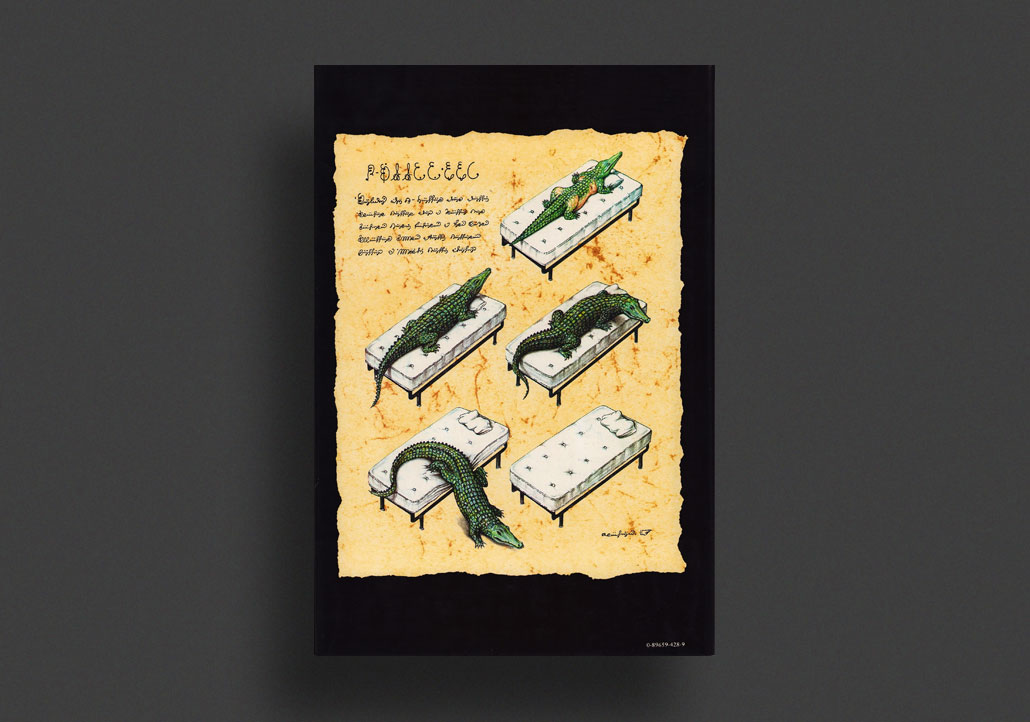
Very rare copy of the first 1983 Abbeville English hardcover edition of the ever mysterious Codex Seraphinianus by Italian artist and designer Luigi Serafini (1949—), a book like no-other. Ever since the Codex Seraphinianus was first published in Italy in limited edition by Franco Maria Ricci in 1981, the book has been recognized as one of the strangest and most beautiful art books ever made. This phantasmagorical visual encyclopedia of an unknown world written in an unknown language has fueled much debate over its meaning. Written for the information age and addressing the import of coding and decoding in genetics, literary criticism, and computer science, the Codex confused, fascinated, and enchanted a generation, including Roland Barthes and Italo Calvino. While its message may be unclear, its appeal is obvious: it is a most exquisite artifact. Blurring the distinction between art book and art object.
Very Good book in Very Good dust jacket with a couple of straches to edges and light wear, preserved in mylar wrap. Light wear to block edge on a few pages.
1990, Japanese
Softcover, 300 pages, 21 x 15 cm
1st Edition, Out of print title / used / very good
Published by
Million Publishing / Tokyo
$60.00 - In stock -
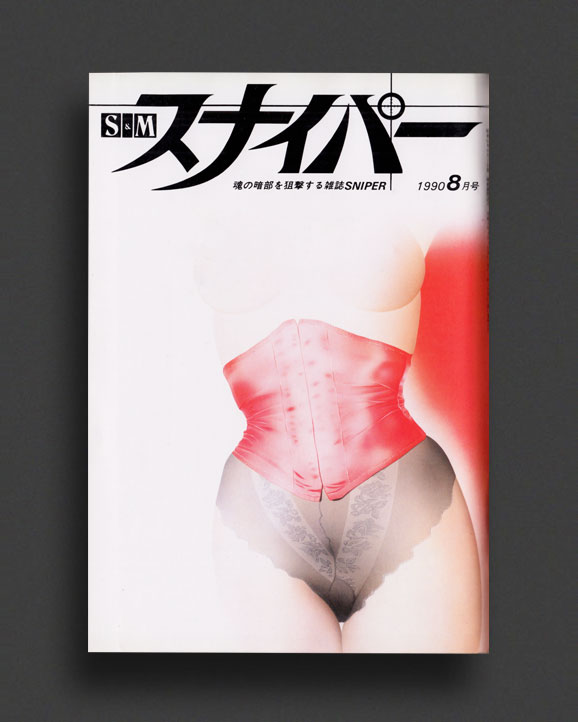
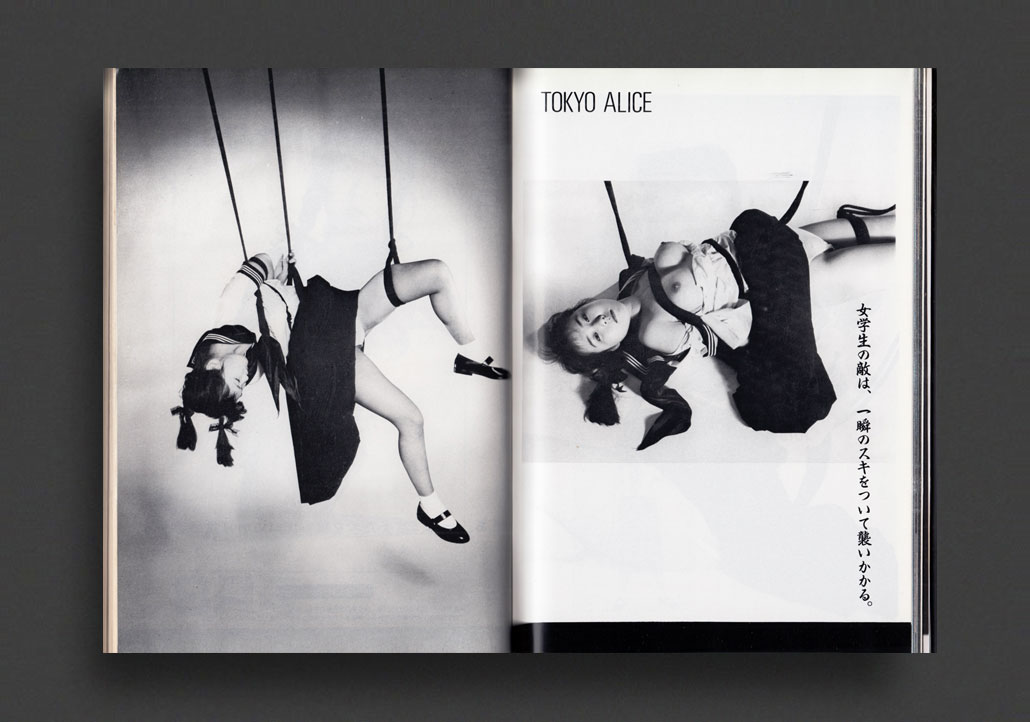
August 1990 issue of S&M Sniper, the cutting-edge cult glossy fetish magazine published in Japan between 1979—2009 that, unlike previous SM magazines, didn't centre so much around professional kinbakushi, favouring instead the exploration of new innovations of fetish and underground sex culture and emphasising the work of the models, stylists, make-up artists, and fashions designers, as much as the writers or photographers. The "new wave" of SM counterculture, embedded in 1980s underground music, fashion and visual art culture in Japan. Explicitly and profusely illustrated, each issue came wrapped in the iconic hyper-stylized airbrushed front covers of artist Yosuke Onishi, veiling the core content of non-fiction realist degradation and an eclectic, expressive editorial of kinbaku and all manner of SM, and extreme fetish photoshoots, illustrations, comics, essays, diaries, reports, exhibitions, reviews, interviews, and included regular contributors such as SM archivist and noise musician Masami Akita (Merzbow), legendary SM writer and editor Dan Oniroku ("the most celebrated writer of popular SM novels in Japan"), features by legendary SM and seppuku performer, actress, and author Hiromi Saotome, features by contributing photographers Nobuyoshi Araki, Masaaki Toyoura, Kenichi Murata, Nobuhiko Ansai, Kinichi Tanaka, Domu Kitahara, sadistic BDSM trainer Shima Shikou, and regular writings by convicted murderer and cannibal Issei Sagawa!! Including his translations of Guido Crepax comics from Italian to Japanese. This was not a magazine like the others. Each issue is also brimming with amazing Japanese advertisements and classifieds for the latest bondage clubs, boutiques, dungeons, fashion, toys, video and publication catalogues, hook-ups, phone sex, and much more. This issue includes Nobuyoshi Araki, Yosuke Onishi, Katsu Yoshida, Ansai Nobuhiko, Kinichi Tanaka, Masao Takahashi, Tadao Chigusa, Masatoshi Aki, Shima Shikou, Tokuro Takahashi, Yukimasa Okumura, Naito Hisashi, all the usual and more... Not for the faint of heart.
Very Good copy.
1985, Japanese
Softcover, 300 pages, 21 x 15 cm
1st Edition, Out of print title / used / very good
Published by
Million Publishing / Tokyo
$65.00 - In stock -
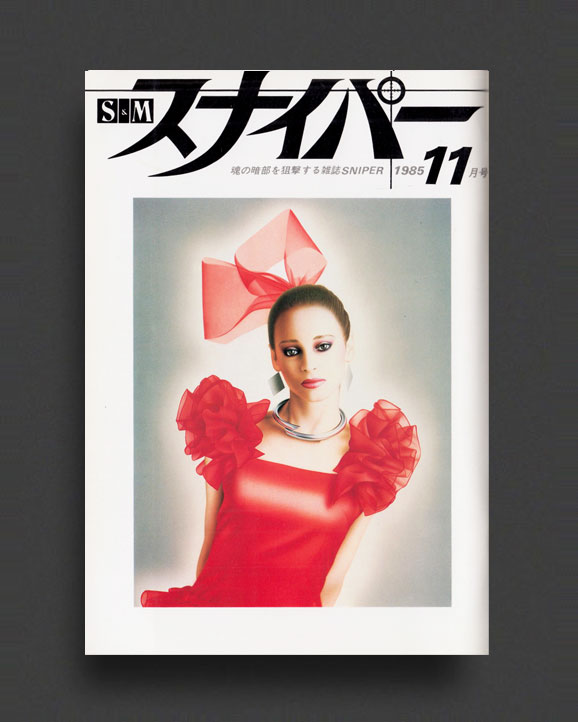
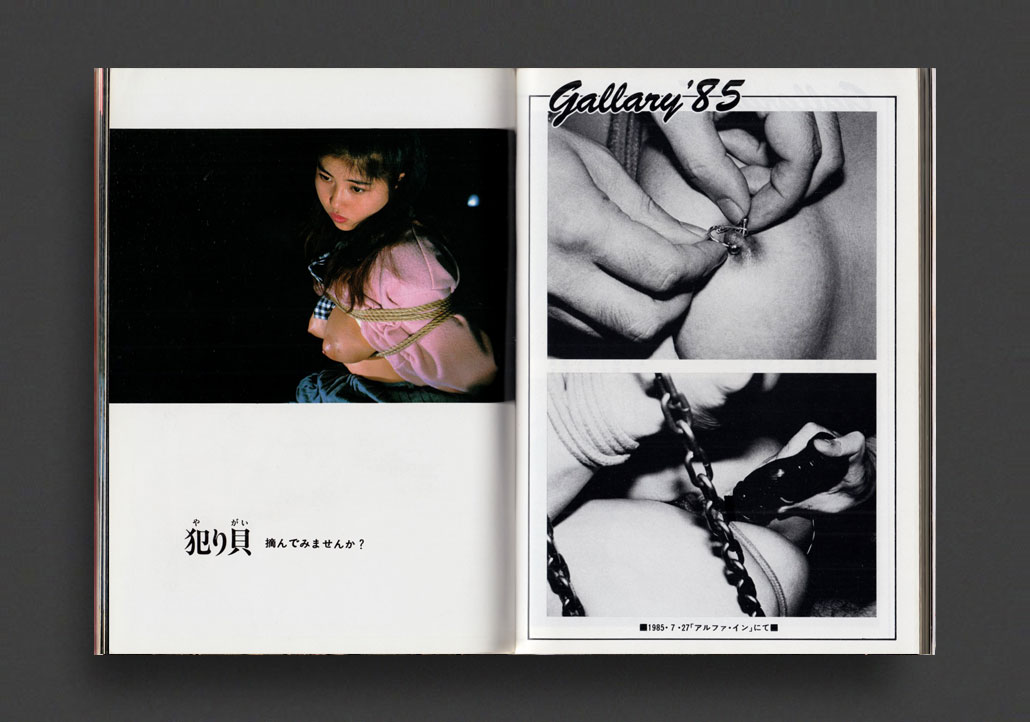
November 1985 issue of S&M Sniper, the cutting-edge cult glossy fetish magazine published in Japan between 1979—2009 that, unlike previous SM magazines, didn't centre so much around professional kinbakushi, favouring instead the exploration of new innovations of fetish and underground sex culture and emphasising the work of the models, stylists, make-up artists, and fashions designers, as much as the writers or photographers. The "new wave" of SM counterculture, embedded in 1980s underground music, fashion and visual art culture in Japan. Explicitly and profusely illustrated, each issue came wrapped in the iconic hyper-stylized airbrushed front covers of artist Yosuke Onishi, veiling the core content of non-fiction realist degradation and an eclectic, expressive editorial of kinbaku and all manner of SM, and extreme fetish photoshoots, illustrations, comics, essays, diaries, reports, exhibitions, reviews, interviews, and included regular contributors such as SM archivist and noise musician Masami Akita (Merzbow), legendary SM writer and editor Dan Oniroku ("the most celebrated writer of popular SM novels in Japan"), features by legendary SM and seppuku performer, actress, and author Hiromi Saotome, features by contributing photographers Nobuyoshi Araki, Masaaki Toyoura, Kenichi Murata, Nobuhiko Ansai, Kinichi Tanaka, Domu Kitahara, sadistic BDSM trainer Shima Shikou, and regular writings by convicted murderer and cannibal Issei Sagawa!! Including his translations of Guido Crepax comics from Italian to Japanese. This was not a magazine like the others. Each issue is also brimming with amazing Japanese advertisements and classifieds for the latest bondage clubs, boutiques, dungeons, fashion, toys, video and publication catalogues, hook-ups, phone sex, and much more.
This issue includes Nobuyoshi Araki, Yosuke Onishi, Fumika Kitahara, actress Mami Fujimura, Hiromi Hiraguchi, Junji Yoshizaki, Satoshi Tokuno, Yayoi Honda, Mitsuhiko Yoshida, Tadao Chigusa, Kinichi Tanaka, Nobuhiko Ansai, Nakai Sugimura, all the usual and more... Not for the faint of heart.
Very Good copy.
1985, Japanese
Softcover, 300 pages, 21 x 15 cm
1st Edition, Out of print title / used / very good
Published by
Million Publishing / Tokyo
$65.00 - In stock -
October 1985 issue of S&M Sniper, the cutting-edge cult glossy fetish magazine published in Japan between 1979—2009 that, unlike previous SM magazines, didn't centre so much around professional kinbakushi, favouring instead the exploration of new innovations of fetish and underground sex culture and emphasising the work of the models, stylists, make-up artists, and fashions designers, as much as the writers or photographers. The "new wave" of SM counterculture, embedded in 1980s underground music, fashion and visual art culture in Japan. Explicitly and profusely illustrated, each issue came wrapped in the iconic hyper-stylized airbrushed front covers of artist Yosuke Onishi, veiling the core content of non-fiction realist degradation and an eclectic, expressive editorial of kinbaku and all manner of SM, and extreme fetish photoshoots, illustrations, comics, essays, diaries, reports, exhibitions, reviews, interviews, and included regular contributors such as SM archivist and noise musician Masami Akita (Merzbow), legendary SM writer and editor Dan Oniroku ("the most celebrated writer of popular SM novels in Japan"), features by legendary SM and seppuku performer, actress, and author Hiromi Saotome, features by contributing photographers Nobuyoshi Araki, Masaaki Toyoura, Kenichi Murata, Nobuhiko Ansai, Kinichi Tanaka, Domu Kitahara, sadistic BDSM trainer Shima Shikou, and regular writings by convicted murderer and cannibal Issei Sagawa!! Including his translations of Guido Crepax comics from Italian to Japanese. This was not a magazine like the others. Each issue is also brimming with amazing Japanese advertisements and classifieds for the latest bondage clubs, boutiques, dungeons, fashion, toys, video and publication catalogues, hook-ups, phone sex, and much more.
This issue includes Nobuyoshi Araki, Yosuke Onishi, Kitahara Fumika, Aki Ryo, Todoroki Sukeroku, Kinichi Tanaka, Tokuno Masahito, Naomi Hagio, Hiromi Haraguchi, Yukiko Hayashi, actress Mai Momonoki, all the usual and more... Not for the faint of heart.
Very Good copy.
1988, Japanese
Softcover, 300 pages, 21 x 15 cm
1st Edition, Out of print title / used / very good
Published by
Million Publishing / Tokyo
$55.00 - In stock -
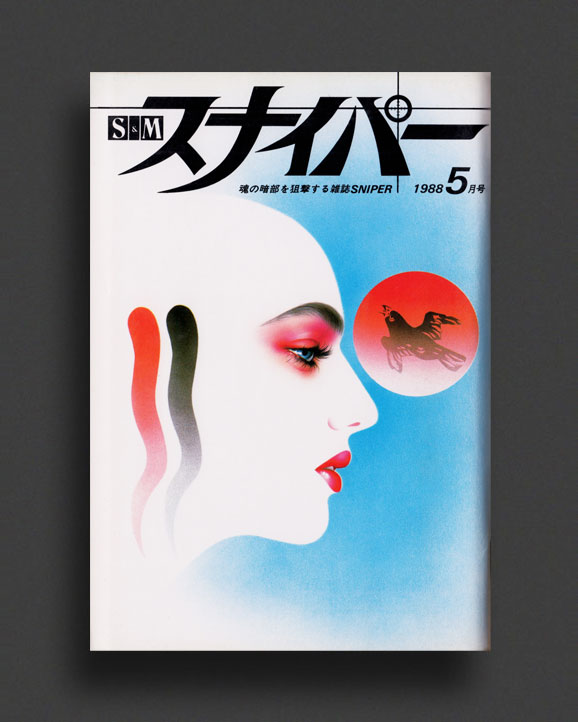
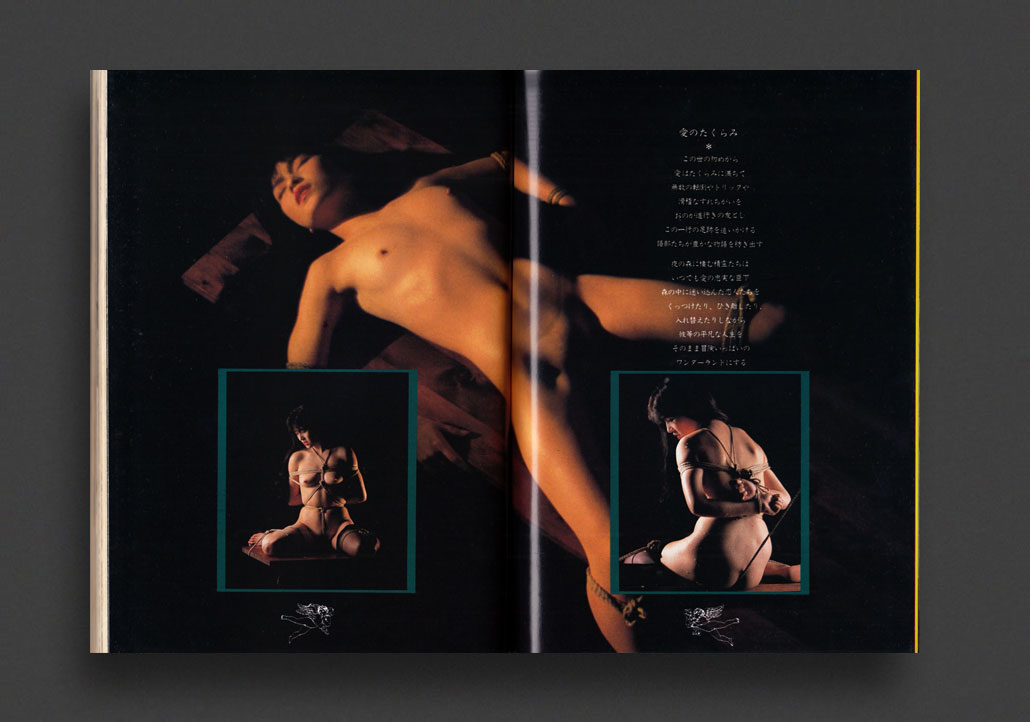
May 1988 issue of S&M Sniper, the cutting-edge cult glossy fetish magazine published in Japan between 1979—2009 that, unlike previous SM magazines, didn't centre so much around professional kinbakushi, favouring instead the exploration of new innovations of fetish and underground sex culture and emphasising the work of the models, stylists, make-up artists, and fashions designers, as much as the writers or photographers. The "new wave" of SM counterculture, embedded in 1980s underground music, fashion and visual art culture in Japan. Explicitly and profusely illustrated, each issue came wrapped in the iconic hyper-stylized airbrushed front covers of artist Yosuke Onishi, veiling the core content of non-fiction realist degradation and an eclectic, expressive editorial of kinbaku and all manner of SM, and extreme fetish photoshoots, illustrations, comics, essays, diaries, reports, exhibitions, reviews, interviews, and included regular contributors such as SM archivist and noise musician Masami Akita (Merzbow), legendary SM writer and editor Dan Oniroku ("the most celebrated writer of popular SM novels in Japan"), features by legendary SM and seppuku performer, actress, and author Hiromi Saotome, features by contributing photographers Nobuyoshi Araki, Masaaki Toyoura, Kenichi Murata, Nobuhiko Ansai, Kinichi Tanaka, Domu Kitahara, sadistic BDSM trainer Shima Shikou, and regular writings by convicted murderer and cannibal Issei Sagawa!! Including his translations of Guido Crepax comics from Italian to Japanese. This was not a magazine like the others. Each issue is also brimming with amazing Japanese advertisements and classifieds for the latest bondage clubs, boutiques, dungeons, fashion, toys, video and publication catalogues, hook-ups, phone sex, and much more. This issue includes Nobuyoshi Araki, Yosuke Onishi, Nobuhiko Ansai, Katsu Yoshida, Shima Shikou, Tadao Chigusa, Shōzō Numa, Aki Masatoshi, Kinichi Tanaka, Domu Kitahara, Akira Minomura, Jiro Takahashi, all the usual and more... Not for the faint of heart.
Very Good copy.
1992, Japanese
Softcover, 320 pages, 21 x 15 cm
1st Edition, Out of print title / used / very good
Published by
Million Publishing / Tokyo
$55.00 - Out of stock
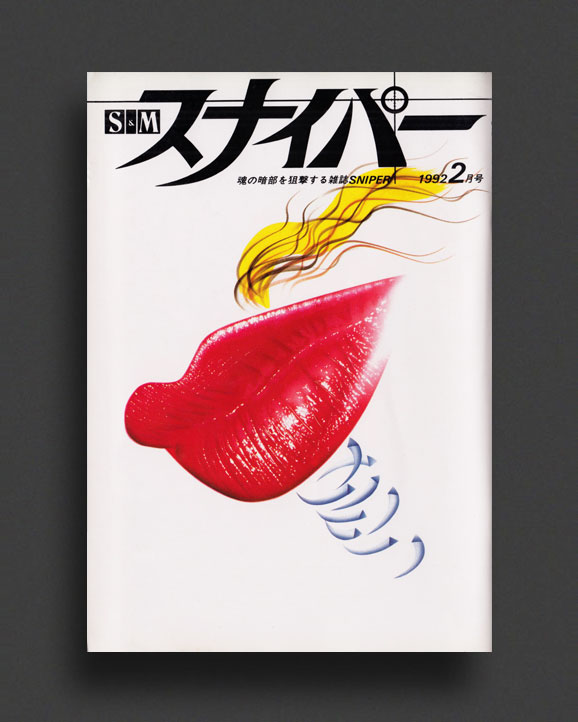
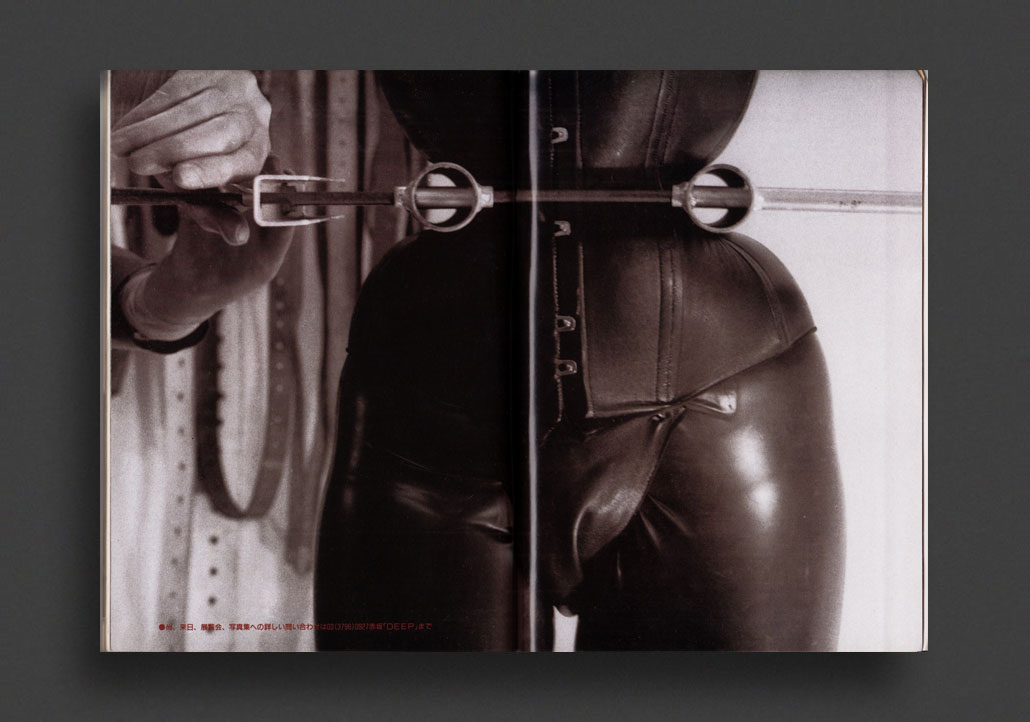
February 1992 issue of S&M Sniper, the cutting-edge cult glossy fetish magazine published in Japan between 1979—2009 that, unlike previous SM magazines, didn't centre so much around professional kinbakushi, favouring instead the exploration of new innovations of fetish and underground sex culture and emphasising the work of the models, stylists, make-up artists, and fashions designers, as much as the writers or photographers. The "new wave" of SM counterculture, embedded in 1980s underground music, fashion and visual art culture in Japan. Explicitly and profusely illustrated, each issue came wrapped in the iconic hyper-stylized airbrushed front covers of artist Yosuke Onishi, veiling the core content of non-fiction realist degradation and an eclectic, expressive editorial of kinbaku and all manner of SM, and extreme fetish photoshoots, illustrations, comics, essays, diaries, reports, exhibitions, reviews, interviews, and included regular contributors such as SM archivist and noise musician Masami Akita (Merzbow), legendary SM writer and editor Dan Oniroku ("the most celebrated writer of popular SM novels in Japan"), features by legendary SM and seppuku performer, actress, and author Hiromi Saotome, features by contributing photographers Nobuyoshi Araki, Masaaki Toyoura, Kenichi Murata, Nobuhiko Ansai, Kinichi Tanaka, Domu Kitahara, sadistic BDSM trainer Shima Shikou, and regular writings by convicted murderer and cannibal Issei Sagawa!! Including his translations of Guido Crepax comics from Italian to Japanese. This was not a magazine like the others. Each issue is also brimming with amazing Japanese advertisements and classifieds for the latest bondage clubs, boutiques, dungeons, fashion, toys, video and publication catalogues, hook-ups, phone sex, and much more.
This issue includes Nobuyoshi Araki, Nobuhiko Ansai, Yosuke Onishi, Shima Shikou, Claude Alexandre, Sachiko Nakamura, Kinichi Tanaka, Naomi Masuda, Guido Crepax, Issei Sagawa, Tadao Chigusa, Nao Saejima, all the usual and more... Not for the faint of heart.
Very Good copy.
1988, Japanese
Softcover, 300 pages, 21 x 15 cm
1st Edition, Out of print title / used / very good
Published by
Million Publishing / Tokyo
$55.00 - In stock -
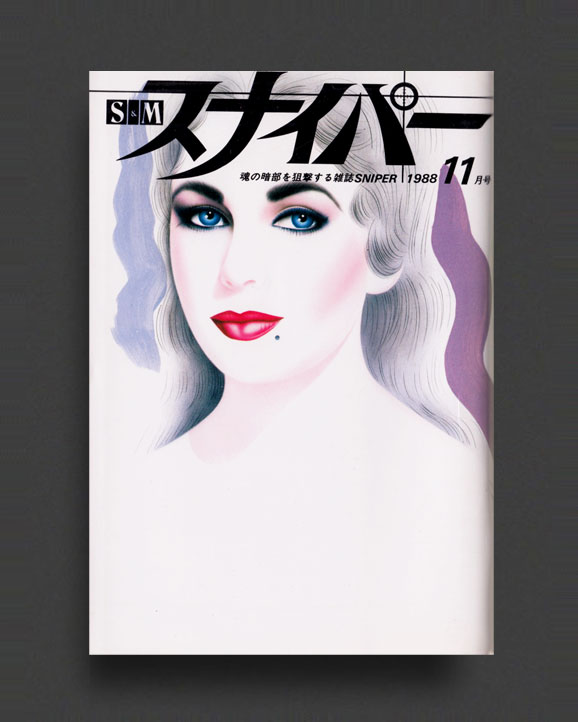
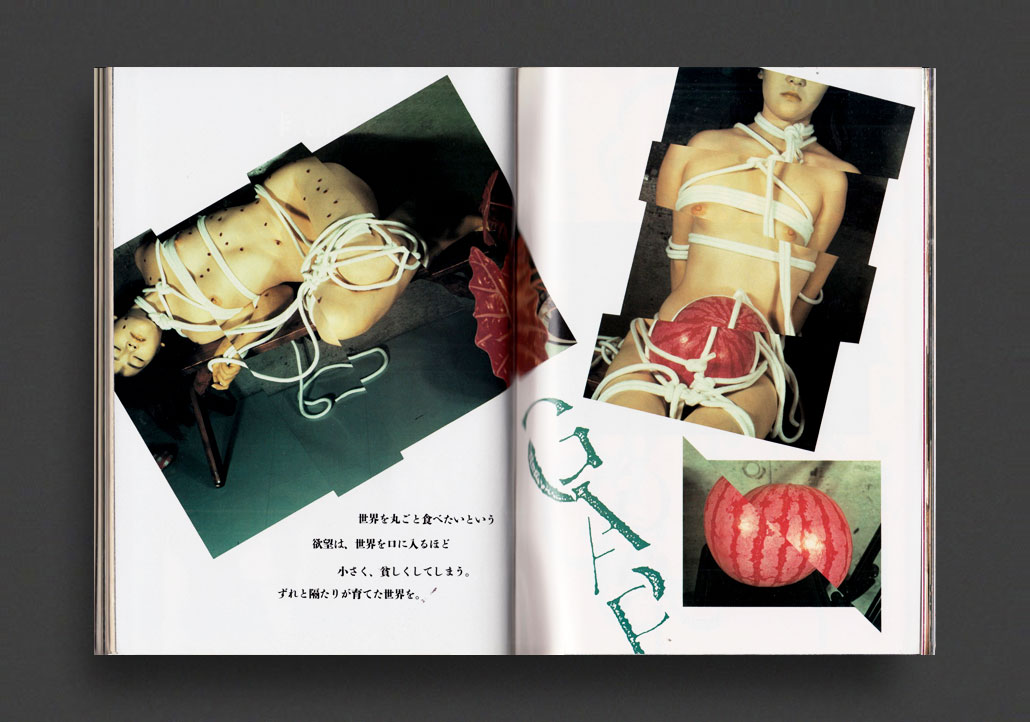
November 1988 issue of S&M Sniper, the cutting-edge cult glossy fetish magazine published in Japan between 1979—2009 that, unlike previous SM magazines, didn't centre so much around professional kinbakushi, favouring instead the exploration of new innovations of fetish and underground sex culture and emphasising the work of the models, stylists, make-up artists, and fashions designers, as much as the writers or photographers. The "new wave" of SM counterculture, embedded in 1980s underground music, fashion and visual art culture in Japan. Explicitly and profusely illustrated, each issue came wrapped in the iconic hyper-stylized airbrushed front covers of artist Yosuke Onishi, veiling the core content of non-fiction realist degradation and an eclectic, expressive editorial of kinbaku and all manner of SM, and extreme fetish photoshoots, illustrations, comics, essays, diaries, reports, exhibitions, reviews, interviews, and included regular contributors such as SM archivist and noise musician Masami Akita (Merzbow), legendary SM writer and editor Dan Oniroku ("the most celebrated writer of popular SM novels in Japan"), features by legendary SM and seppuku performer, actress, and author Hiromi Saotome, features by contributing photographers Nobuyoshi Araki, Masaaki Toyoura, Kenichi Murata, Nobuhiko Ansai, Kinichi Tanaka, Domu Kitahara, sadistic BDSM trainer Shima Shikou, and regular writings by convicted murderer and cannibal Issei Sagawa!! Including his translations of Guido Crepax comics from Italian to Japanese. This was not a magazine like the others. Each issue is also brimming with amazing Japanese advertisements and classifieds for the latest bondage clubs, boutiques, dungeons, fashion, toys, video and publication catalogues, hook-ups, phone sex, and much more.
This issue includes Nobuyoshi Araki, Yosuke Onishi, Nobuhiko Ansai, Katsu Yoshida, Robert Mapplethorpe, Kinichi Tanaka, Masahito Tokuno, Aki Masatoshi, Hajime Tomokyo, controversial Japanese author Shōzō Numa (Yapoo, the Human Cattle), bondage master and legendary Kitan editor Akira Minomura, Erika Sakurazawa, Yukimasa Okumura, Yayoi Honda, all the usual and more... Not for the faint of heart.
Very Good copy.
2020, Japanese / English
Softcover (w. dust jacket and obi-strip), 366 pages, 15 x 21 cm
Published by
Treville / Tokyo
$90.00 - In stock -
Wonderful new memorial monograph dedicated to the exceptional work of Namio Harukawa (1947 – 2020), a pseudonymous Japanese fetish artist best known for his masterful pencil works depicting female domination ("femdom"), with erotic asphyxiation through facesitting appearing as a frequent subject of his art. Born 1947 in Osaka, Japan, Harukawa’s distinctive penname combines the name of film actress Harukawa Masumi with an anagram of Naomi, the sadistic heroine in Tanizaki Jun’ichiro’s novel "Chijin no ai / A Fool’s Love". While in high school, Harukawa began contributing work to the readers’ column of leading postwar Japanese SM pulp magazine "Kitan Club". Since then, Harukawa’s drawings of male masochism have lovingly portrayed noble, voluptuously beautiful women and the men who serve them as human furniture. Namio Harukawa passed away on April 2020, he was 72 years old. This book is a requiem dedicated to the memory of an extraordinary artist who remained committed to the regime of “absolute Ganmen Kijo Shugi (facesitting principle)” throughout his artistic life.
The profusely illustrated "Facesittings Are Forever" consists of a fine selection over 300 of Namio Harukawa’s works spanning his entire career, including many unpublished works, rough sketches, late works, and coloured works of his mid-career. It features an illustrated archive of his publications, including a rare Gekiga (hard-boiled style) work “Shokeijima no Oujo” and never before seen photographs of his workshop. There are also written contributions in Japanese from Shigeru Kashima, Jun Miura, Rockin Jelly Bean, and Hitomi Onuma.
1993, Japanese
Softcover (w. dust jacket), 210 pages, 21 x 14.8 cm
1st Edition, Out of print title / used / fine
Published by
World Comics / Japan
Kubo Shoten / Japan
$180.00 - Out of stock
Very rare original first Japanese book collection of the infamous cult classic eromanga "Bondage Fairies" by Kondom, published by Kubo Shoten way back in 1993. This is the first ever book collecting over 200 pages of the first of the original series from the early 1990s, in the original Japanese language, as they appeared in the pages of Kubo Shoten's Young Lemon magazine for the first time as "Bondage Fairies". Includes colour artwork galleries.
Created by manga artist Teruo Kakuta under the pen name "Kondom", a multilingual pun, meaning "little insect" in Japanese and "condom" in English, Bondage Fairies is an erotic series about highly sexual female forest fairies, who work as police officers protecting the forest, whilst engaging in a wild array of anthropomorphized, inter-species sexual acts. The series began in Japan in 1990 as Insect Hunter, but it was quickly banned from sale by the Tokyo Metropolitan Ordinance. Under a new title, the manga was serialized in manga magazine Lemon Kids. The series is among the earliest sexually explicit manga (eromanga) commercially translated and published uncensored in the United States where the earliest editions date from 1994 (Venus Press). Eros Comix subsequently published a multi-volume series of the collected Bondage Fairies, and subsequent stories, now all very collectible. Translated to Swedish, German, French, and Italian, Bondage Fairies is one of the most popular underground adult Japanese comics outside Japan.
Near Fine copy in original NF dust jacket.
1994, Japanese
Softcover (w. dust jacket), 162 pages, 21 x 14.8 cm
1st Edition, Out of print title / used / fine
Published by
World Comics / Japan
Kubo Shoten / Japan
$160.00 - In stock -
Very rare original first printing Volume 2 Japanese book collection of the infamous cult classic eromanga "Bondage Fairies" by Kondom, published by Kubo Shoten way back in 1994. Volume 3 of the first ever book collection bringing together over 160 pages of the the original series from the early 1990s, in the original Japanese language, as they appeared in the pages of Kubo Shoten's Young Lemon magazine for the first time as "Bondage Fairies". Includes colour artwork galleries.
Created by manga artist Teruo Kakuta under the pen name "Kondom", a multilingual pun, meaning "little insect" in Japanese and "condom" in English, Bondage Fairies is an erotic series about highly sexual female forest fairies, who work as police officers protecting the forest, whilst engaging in a wild array of anthropomorphized, inter-species sexual acts. The series began in Japan in 1990 as Insect Hunter, but it was quickly banned from sale by the Tokyo Metropolitan Ordinance. Under a new title, the manga was serialized in manga magazine Lemon Kids. The series is among the earliest sexually explicit manga (eromanga) commercially translated and published uncensored in the United States where the earliest editions date from 1994 (Venus Press). Eros Comix subsequently published a multi-volume series of the collected Bondage Fairies, and subsequent stories, now all very collectible. Translated to Swedish, German, French, and Italian, Bondage Fairies is one of the most popular underground adult Japanese comics outside Japan.
Near Fine copy in original NF dust jacket.
1995, Japanese
Softcover (w. dust jacket), 164 pages, 21 x 14.8 cm
1st Edition, Out of print title / used / fine
Published by
World Comics / Japan
Kubo Shoten / Japan
$160.00 - In stock -
Very rare original first printing Volume 3 Japanese book collection of the infamous cult classic eromanga "Bondage Fairies" by Kondom, published by Kubo Shoten way back in 1995. Volume 3 of the first ever book collection bringing together over 160 pages of the the original series from the early 1990s, in the original Japanese language, as they appeared in the pages of Kubo Shoten's Young Lemon magazine for the first time as "Bondage Fairies". Includes colour artwork galleries.
Created by manga artist Teruo Kakuta under the pen name "Kondom", a multilingual pun, meaning "little insect" in Japanese and "condom" in English, Bondage Fairies is an erotic series about highly sexual female forest fairies, who work as police officers protecting the forest, whilst engaging in a wild array of anthropomorphized, inter-species sexual acts. The series began in Japan in 1990 as Insect Hunter, but it was quickly banned from sale by the Tokyo Metropolitan Ordinance. Under a new title, the manga was serialized in manga magazine Lemon Kids. The series is among the earliest sexually explicit manga (eromanga) commercially translated and published uncensored in the United States where the earliest editions date from 1994 (Venus Press). Eros Comix subsequently published a multi-volume series of the collected Bondage Fairies, and subsequent stories, now all very collectible. Translated to Swedish, German, French, and Italian, Bondage Fairies is one of the most popular underground adult Japanese comics outside Japan.
Near Fine copy in original NF dust jacket.
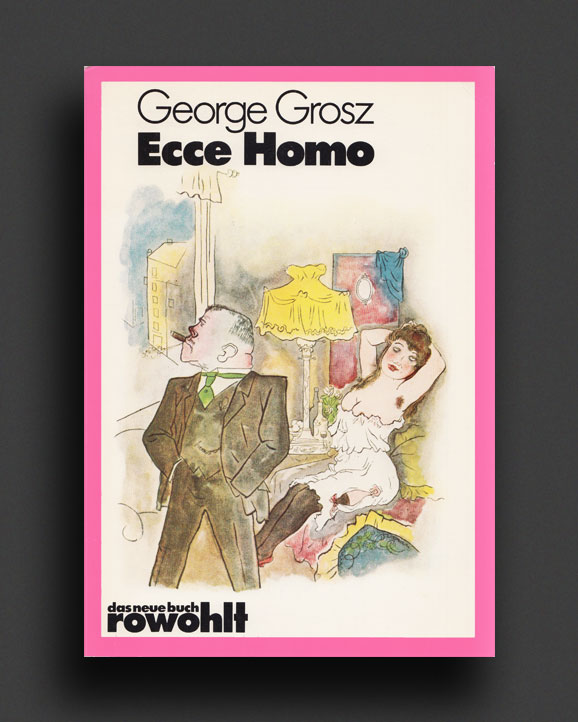
1980, German
Softcover, 84 page, 26 x 17 cm
Out of print title / used / very good
Published by
Rowohlt / Hamburg
$45.00 - Out of stock
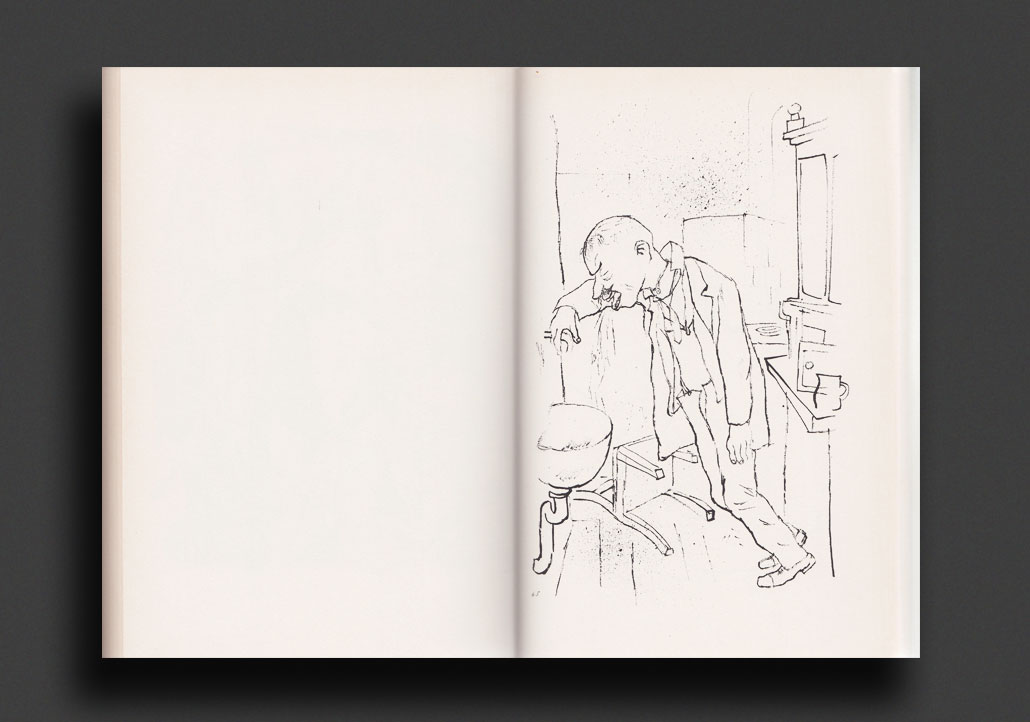
Perhaps the most famous of Grosz's collections is Ecce Homo (Berlin: Malik Verlag, 1923). The title echoes Pilate's presentation of Jesus as King of the Jews, beaten, with a crown of thorns, bloody and ready for crucifixion, and clearly not the Messiah he had been proclaimed to be six days earlier when he was greeted by rapturous crowds. Just so, the image of the heroic German, brave in war and moral in peacetime, took such a beating in Grosz's drawings, watercolors, and paintings, that he was prosecuted for "offences against public morality and for besmirching the values of the German people" (Kranzfelder, 59). Offering an unsparing vision of human nakedness, lust, greed and cruelty, Ecce Homo was found to be a slanderous attack upon the army, which won damages and the removal of 5 color plates and 17 black and white plates from the portfolio in a law suit. Grosz was also fined 6000 marks. Since Grosz had been attacking the Nazis since the early 1920s and since he had singled out Hitler in particular, it is not surprising that after the Nazi's took power in Germany, his works were singled out for ridicule and destruction. 285 of his works were removed from German collections and destroyed and the 1937 Munich Exhibition of Nazi-labelled "Degenerate Art" included five of his paintings, two watercolours, and thirteen drawings. After relocating to the U.S., Grosz wrote to J. B. Neuman concerning his own place in the history of art: "My drawings will naturally stay true–they are fireproof. They will later be seen as Goya's work [is]. They are not documents of the class struggle, but eternally living documents of human stupidity and brutality"
1980 reprint of the collection reproduced in black and white and colour, published by Rowohlt in Hamburg, 1980.
Very good copy.
1970, German
Softcover, unpaginated, 18 x 12 cm
1st Edition, Out of print title / used / very good
Published by
Kiepenheuer & Witsch / Köln
$100.00 - In stock -
Scarce first 1970 German edition of Roland Topor's famous book collection Die Masochisten (The Masochists), one of the finest examples of the artist's profound command of illustrated dark humour. Almost entirely made up of wordless b/w illustrations, with a foreword in german by German designer, illustrator and typographer, Hannes Jähn.
Roland Topor (1938—1997) was one of the most unique and versatile French artists of the second half of the 20th century, working prolifically as a provocative and spirited illustrator, author, humorist, satirist, poet, painter, performer, sculptor, playwright, film and TV writer, filmmaker and actor, and much more. A founder of the Panic Movement, an art collective formed by Fernando Arrabal, Alejandro Jodorowsky, and Roland Topor in Paris in 1962, Topor was known for the surreal and absurdist nature of his work.
Very Good copy. A crisp, solidly bound copy with some foxing/tanning to pages, usual spine edge tanning to bright fluro pink boards (most often bleached out).
1995, English
Softcover (staple-bound), 16 pages, 25.8 x 17 cm
1st Edition, Out of print title / used / very good
Published by
Verotik / Los Angles
$15.00 - In stock -
August 1995 issue 5 of Verotika comics (The New Covenant), the "Bad Girls of Horror" issue, featuring the work of Martin Emond, Nancy A. Collins, Lucy Taylor, Kim Hagen, Stan Shaw and Simon Bisley. First printing.
VG copy.
2000, Japanese
Hardcover (w. dust jacket and obi strip), 48 pages, 31 x 22 cm
1st Edition, Out of print title / used / fine
Published by
Bungeisha / Tokyo
$150.00 - In stock -
The one and only hardcover monograph dedicated to the fantastic world of artist Ran Akiyoshi (1922—1982), now rare and out-of-print. Virtually unknown and undocumented outside of Japan, Akiyoshi never held an exhibition nor sold any of his drawings in his lifetime. Much like the work of Toshio Saeki or Namio Harukawa, Akiyoshi's creations proliferated throughout the bountiful pages of Tokyo's underground, particularly SM / kinbaku, publishing scene in the 1960s—1970s. Yet Akiyoshi's phantasmagoric world of erotic fantasy is like no other, building sado-masochistic themes within unique, somewhat Lovecraftian and Bosch-esque dreamscapes populated by mythological goddesses and grotesque creatures. His peculiar fantasy drawings were highly praised by Japanese novelist and art critic, Tatsuhiko Shibusawa, an instrumental figure in the Japanese avant-garde who translated de Sade and Bataille to Japanese, and specialised in the study of medieval demonology. This lavishly illustrated hardcover volume collects Akiyoshi's many works together for the first time, surveying his entire career.
Born in Kyongsong (present Seoul), Korea in 1922, Akiyoshi was publicly schooled and self-taught in drawing. After WWII, he moved to Japan, traveled around Kyushu area and finally settled in Tokyo in 1946. Akiyoshi started working for adult entertainment magazines such as "Decameron","Fuzoku Soushi", and "Uramado" in 1950. Around 1958, he began focusing on original drawings while continuing to draw illustrations for various magazines. In the 1970s, Akiyoshi provided iconic cover and insert illustrations to a number of prominent SM magazines, including "SM King", "SM Kitan", and "SM Club". He never held an exhibition nor sold any of his drawings in his lifetime. Akiyoshi died from heart failure in 1982 at the age of 58.
Very Good—Fine copy.
2024, Japanese
Softcover (w. dust jacket + obi), 176 pages, 19 x 15 cm
Published by
Atelier Third / Tokyo
$70.00 - Out of stock
Brand new book collecting 200 rare and phenomenal illustrations of the legendary underground Japanese artist Ran Akiyoshi (1922—1982), many never seen before in print. Virtually unknown and undocumented outside of Japan, Akiyoshi never held an exhibition nor sold any of his drawings in his lifetime. Much like the work of Toshio Saeki or Namio Harukawa, Akiyoshi's creations proliferated throughout the bountiful pages of Tokyo's underground SM / fetish publishing scene in the 1960s—1970s. Yet Akiyoshi's phantasmagoric world of erotic fantasy is like no other, building sado-masochistic themes within unique, somewhat Lovecraftian and Bosch-esque dreamscapes populated by mythological goddesses and grotesque creatures. His peculiar fantasy drawings were highly praised by Japanese novelist and art critic, Tatsuhiko Shibusawa, an instrumental figure in the Japanese avant-garde who translated de Sade and Bataille to Japanese, and specialised in the study of medieval demonology.
Born in Kyongsong (present Seoul), Korea in 1922, Akiyoshi was publicly schooled and self-taught in drawing. After WWII, he moved to Japan, traveled around Kyushu area and finally settled in Tokyo in 1946. Akiyoshi started working for adult entertainment magazines such as "Decameron","Fuzoku Soushi", and "Uramado" in 1950. Around 1958, he began focusing on original drawings while continuing to draw illustrations for various magazines. In the 1970s, Akiyoshi provided iconic cover and insert illustrations to a number of prominent SM magazines, including "SM King", "SM Kitan", and "SM Club". A prolific and private artists, he never held an exhibition nor sold any of his drawings in his lifetime. Akiyoshi died from heart failure in 1982 at the age of 58.
2009, Japanese
Softcover, 190 pages, 21 x 15 cm
1st Edition, Out of print title / used / very good
Published by
Atelier Third / Tokyo
$60.00 - Out of stock
Special 2009 issue of Talking Heads magazine with the feature "My Love is Corpse", entirely devoted to death in the arts and culture. Profusely illustrated throughout in colour and b/w featuring Japanese corpse photographer Kiyotaka Tsurisaki, doll portraits by Tari Nakagawa (with model Yuko Igeta), polish painter Zdzisław Beksiński, Hermann Nitsch, the erotic macabre photography of Atsushi Tani, Eros and Thanatos and the work of artist Yasuyuki Nishio, Unica Zürn and Hans Bellmer, puppeteer Kurotani Miyako, illustrator Toru Nishimaki, painter Hartmut Lincke, illustrator Rie Yamashina, Occult and Revelation, medical museums, corpse love in film and publishing, and much more.
Talking Heads is the glossy arts magazine of Japanese publisher Atelier Third, specialists in the cutting-edge of subcultural Japanese artists working across doll art, ero guro, gothic-lolita and the historical erotic SM works of the abnormal museum, publishing the work of Seiu Ito, Yoshifumi Hayashi, Shintaro Kago, Ran Akiyoshi, Kanaki Tama, Saori Furukawa, Toru Nishimaki, and many more.
VG copy.
1996, Japanese
Softcover (w. dust jacket and obi-strip), 256 pages, 21 x 14.8 cm
1st Edition, Out of print title / used / very good
Published by
Core Magazine / Tokyo
$120.00 - In stock -
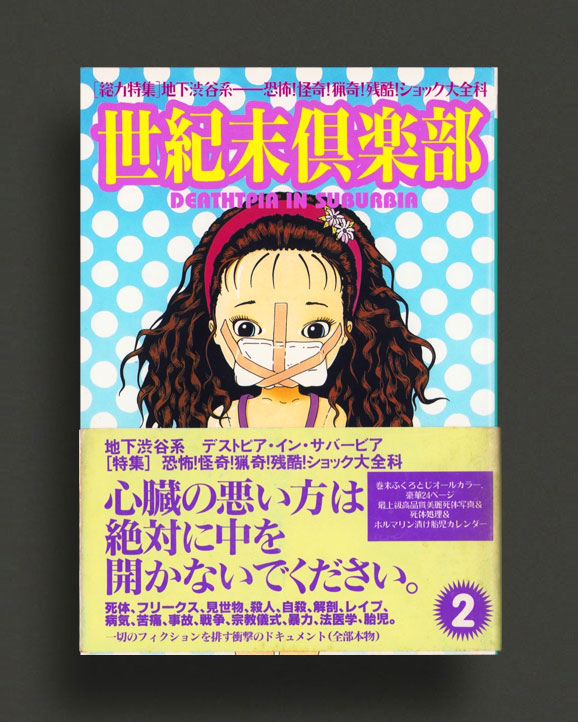
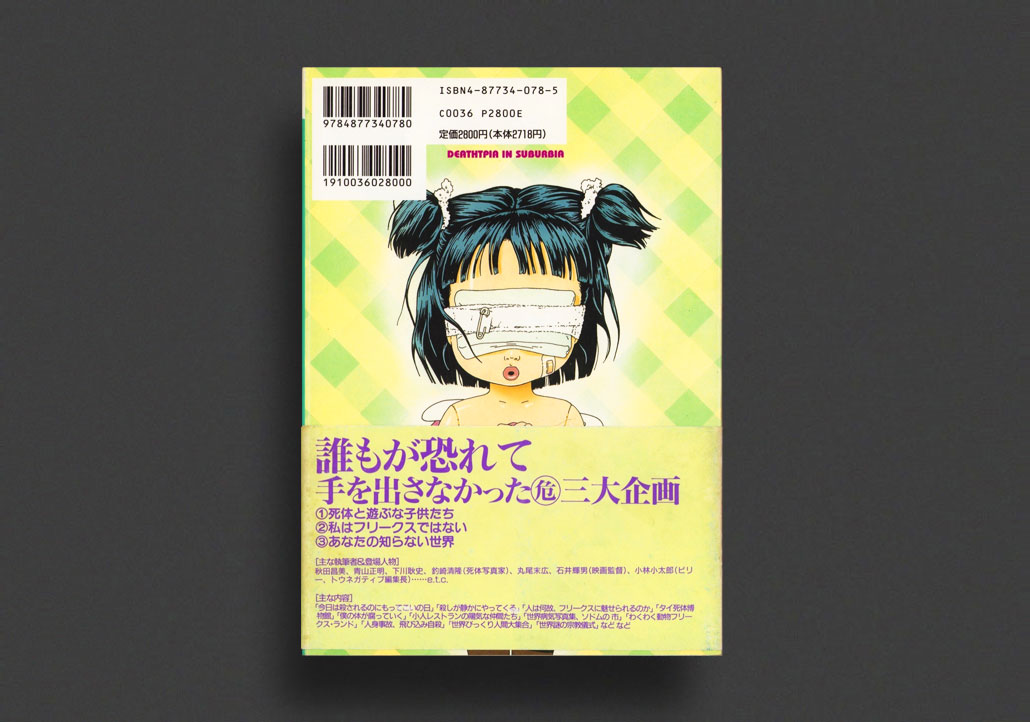
Don't judge a book by it's cover — you've been warned! Straight out of the young nihilist 90s, the second volume of the very short-lived and absolutely demented Seikimatsu Club (End of the Century Club), published in Tokyo between 1996—2000 for a total of only five volumes. This second volume, "Deathtpia in Suburbia", has the feature theme of Horror! Bizarre! Bizarre! Cruelty! and is packed to the absolute brim with "corpses, freaks, spectacles, murders, suicides, autopsies, rapes, sickness, pain, accident, war, religious rituals, violence, forensics, foetuses. A shocking document that eliminates all fiction (all genuine)!"
With contributors to this issue including Masami Akita (Merzbow), Masaaki Aoyama (author), Kiyotaka Tsurisaki (corpse photographer), Suehiro Maruo (ero guro manga artist), Teruo Ishii (ero guro film director), Kotaro Kobayashi (Too Negative editor-in-chief), Trevor Brown (artist), you should know what you are getting yourself into.
Following the trajection of fellow Japanese abnormal subculture magazines such as Kotaro Kobayashi's notorious Too Negative, Ultra Negative, ORG, etc., and in the spirit of a new wave of 90's nihilist publishing around the world (Answer Me!, Killing Times, Fuck!, AMOK, Feral House, etc.) End of the Century Club stares directly into the dark recesses of humanity and presents its viewers with the uncompromising extremes of our global culture. The real stuff. Where Too Negative presents itself as a glossy colour photo/art magazine, End of the Century Club is almost like a Whole Earth Catalog to the authentic macabre. With articles, interviews, reports, catalogues and hundreds of images spanning all manner of medical/autopsy/corpse photography, death journalism, serial killers, formalihide babies, war/shock accident/crime scenes, hara-kiri, murder, rape, slaughterhouse, forensic books, international underground magazines, Photobook of World Diseases, City of Sodom, corpses on the internet, Underground Baby Contest, Atlas of Dermatology, complete guide to Freaks movies, the Garbage Pail Kids, religious ceremonies, animal deformities, Interview with "The King of Cult" ero guro film director Teruo Ishii, bizarro sex, acrotomophila, artist Joel Peter Witkin's world, interview with Masaaki Aoyama, interview with corpse photographer Kotaro Kobayashi (Death, Hardcore Works, Too Negative, Billy, etc.), photography of George Dureau, interview with fetish film director and producer Kaoru Adachi, interview with experimental film director Shozin Fukui (Metal Days, Gerorisuto, Caterpillar, 964 Pinocchio, Rubber's Lover...), article on "Serial Killers & Record Junkies" by Toshihiko Hironaka (of Boris, Balzac, Hellbent fame), and all sorts of other curios from the mondo, bizarro realm.
Includes "gorgeous" 24-page high-quality corpse photo booklet feature and cover art by Trevor Brown.
Not for the fain-hearted. You'll feel like a shower after.
Very Good copy with dust jacket and obi.