World Food Books' programme is largely produced on Kulin Nation land. We acknowledge the Wurundjeri people of the Kulin Nation as the first and continuing custodians of this land, and pay respect to their Elders past, present, and emerging.
World Food Books is an arts and special interests bookshop in Naarm / Melbourne. Founded in 2010, World Food Books is devoted to the presentation of a rotating, hand-selection of international art, design, literary and counterculture publications with an emphasis on the anti-traditional, the experimental, the avant-garde, the heretic, the marginal.
Presenting new titles alongside rare and out-of-print books, catalogues and journals spanning the fields of modern and contemporary art, design, photography, illustration, film, literature, poetry, cultural theory, philosophy, sexuality, popular and underground culture in its many radical forms, World Food Books wishes to encourage adventurous, thoughtful and open-minded reading, looking, writing, and exchange of publishing and ideas, both current and historical.
As well as our bookshop, located in Melbourne's historical Nicholas Building, all of our inventory is available internationally via our online mail-order service.
World Food Books semi-regularly co-ordinates "Occasions", a programme of exhibits and events at the bookshop and in partnership with other hosts (such as museums and art galleries) that develop out of the activities, relationships and content of the bookshop itself.
World Food Books
The Nicholas Building
37 Swanston Street
Room 5, Level 6
Melbourne 3000
Australia
SHOP HOURS:
Thu–Fri 12–6, Sat 12–5
WEB-SHOP OPEN 24/7
World Food Books
Postal Address:
PO Box 435
Flinders Lane
Victoria 8009
Australia
Art
Theory / Essay
Architecture / Interior
Graphic Design / Typography
Photography
Fashion
Eros
LGBTQ+
Fiction / Poetry
Weird / Speculative / Science Fiction / Horror
Transgressive / Visceral / Abject
Symbolism / Decadence / Fin de siècle
Film / Video
Painting
Sculpture / Installation
Performance / Dance / Theater
Drawing
Sound / Music
Curatorial
Group Shows / Collections
Periodicals
Out-of-print / Rare
Posters / Ephemera / Discs
Signed Books
World Food Books Gift Voucher
World Food Book Bag
Australian Art
Australian Fiction
Australian Science Fiction / Speculative Fiction
Australian Poetry
Australian Photography
Japanese Photography
Conceptual Art
Minimal Art
Dada
'Pataphysics / Oulipo
Fluxus
Concrete Poetry
Pop Art
Surrealism
Arte Povera
Arte Informale / Haute Pâte / Tachism
Nouveau Réalisme / Zero / Kinetic
Situationism / Lettrism
Collage / Mail Art / Xerox Art
Art Brut / Folk / Visionary / Fantastic
Illustration / Graphic Art / Bandes Dessinées
Furniture
Italian Radical Design / Postmodernism
Textiles
Ceramics / Glass
Counterculture
Protest / Revolt
Philosophy
Psychoanalysis
Anthropology
Anarchism
Socialism / Anarchism / Communism / Capitalism
Literary Theory / Semiotics / Language
Feminism / Women's Studies
Gender Studies / Sexuality
Anthropology
Fetishism / BDSM
Drugs / Psychedelia
Crime / Violence
Animal Rights / Veganism
Occult / Esoterica
Ecology / Earth / Alternative Living
Whole Earth / Crafts
All prices in AUD (Australian dollars)
Pick-Ups
Pick-up orders can be collected in our bookshop during opening hours after order date. Please collect any Pick-up orders within 2 weeks of ordering as we have limited storage space. Orders will be released back into stock if not collected within this time. No refunds can be made for pick-ups left un-collected. If you cannot make it in to the bookshop in this time-frame, please choose postage option.
Return Policy
All sales are final. We do accept returns (for refund or exchange) for items received in error. All our orders are packed with special care using heavy-duty padding and cardboard book-mailers or bubble mailers (for smaller books), using reinforcement where required. We cannot take responsibility for any lost, stolen or damaged parcels.
Insurance
Should you wish to insure your package, please email us directly after placing your order and we can organise this at a small extra expense. Although all standard/express tracked packages are very safe and dependable, we cannot take responsibility for any lost, stolen or damaged parcels. We recommend insurance on valuable orders.
Interested in selling your old books, catalogues, journals, magazines, comics, fanzines, ephemera? We are always looking for interesting, unusual and out-of-print books to buy. We only buy books in our fields of interest and specialty, and that we feel we can resell.
We base these prices on desirability, market value, in-print prices, condition and our current stock levels. We offer cash, store credit, and can take stock on consignment. All
about 25% of the price we expect to get when we sell them, or 30% in store credit. We base these prices on desirability, market value, in-print prices, condition and our current stock levels.
Sell your books any day of the week. You can drop them off and return later. If you have a lot of books, we can visit your Sydney home.
We buy books that we feel we can resell. We offer about 25 % of the price we expect to get when we sell them, or 30% in store credit. We base these prices on desirability, market value, in-print prices, condition and our current stock levels.
Philadelphia Wireman
03 August - 01 September, 2018
World Food Books is proud to announce our next Occasion, the first presentation of sculptures by Philadelphia Wireman in Australia.
The Philadelphia Wireman sculptures were found abandoned in an alley off Philadelphia’s South Street on trash night in 1982. Their discovery in a rapidly-changing neighbourhood undergoing extensive renovation, compounded with the failure of all attempts to locate the artist, suggests that the works may have been discarded after the maker’s death. Dubbed the "Philadelphia Wireman" during the first exhibition of this work, in 1985, the maker’s name, age, ethnicity, and even gender remain uncertain. The entire collection totals approximately 1200 pieces, all intricately bound together with tightly-wound heavy-gauge wire (along with a few small, abstract marker drawings, reminiscent both of Mark Tobey and J.B. Murry). The dense construction of the work, despite a modest range of scale and materials, is singularly obsessive and disciplined in design: a wire armature or exoskeleton firmly binds a bricolage of found objects including plastic, glass, food packaging, umbrella parts, tape, rubber, batteries, pens, leather, reflectors, nuts and bolts, nails, foil, coins, toys, watches, eyeglasses, tools, and jewellery.
Heavy with associations—anthropomorphic, zoomorphic, and socio-cultural responses to wrapped detritus—the totemic sculptures by Philadelphia Wireman have been discussed in the context of work created to fulfil the shamanistic needs of alternative religions in American culture. Curators, collectors, and critics have variously compared certain pieces to sculpture from Classical antiquity, Native American medicine bundles, African-American memory jugs, and African fetish objects. Reflecting the artist’s prolific and incredibly focused scavenging impulse, and despite—or perhaps enhanced by—their anonymity, these enigmatic objects function as urban artefacts and arbiters of power, though their origin and purpose is unknown. Philadelphia Wireman, whatever their identity, possessed an astonishing ability to isolate and communicate the concepts of power and energy through the selection and transformation of ordinary materials. Over the course of the past two decades, this collection has come to be regarded as an important discovery in the field of self-taught art and vernacular art.
Presented in collaboration with Fleisher-Ollman Gallery, Philadelphia, and Robert Heald, Wellington.
Susan Te Kahurangi King
02 February - 10 March, 2018
Susan Te Kahurangi King (24 February 1951 - ) has been a confident and prolific artist since she was a young child, drawing with readily available materials - pencils, ballpoint pens and felt-tip markers, on whatever paper is at hand. Between the ages of four and six Susan slowly ceased verbal communication. Her grandparents William and Myrtle Murphy had developed a special bond with Susan so they took on caring responsibilities for extended periods. Myrtle began informally archiving her work, carefully collecting and storing the drawings and compiling scrapbooks. No drawing was insignificant; every scrap of paper was kept. The King family are now the custodians of a vast collection containing over 7000 individual works, from tiny scraps of paper through to 5 meter long rolls.
The scrapbooks and diaries reveal Myrtle to be a woman of great patience and compassion, seeking to understand a child who was not always behaving as expected. She encouraged Susan to be observant, to explore her environment and absorb all the sights and sounds. Myrtle would show Susan’s drawings to friends and people in her community that she had dealings with, such as shopkeepers and postal workers, but this was not simply a case of a grandmother’s bias. She recognised that Susan had developed a sophisticated and unique visual language and sincerely believed that her art deserved serious attention.
This was an unorthodox attitude for the time. To provide some context, Jean Dubuffet coined the term Art Brut in 1945 to describe work created by self-taught artists – specifically residents of psychiatric institutions and those he considered to be visionaries or eccentrics. In 1972 Roger Cardinal extended this concept by adopting the term Outsider Art to describe work made by non-academically trained artists operating outside of mainstream art networks through choice or circumstance. Susan was born in Te Aroha, New Zealand in 1951, far from the artistic hubs of Paris and London that Dubuffet and Cardinal operated in. That Myrtle fêted Susan as a self-taught artist who deserved to be taken seriously shows how progressive her attitudes were.
Susan’s parents Doug and Dawn were also progressive. Over the years they had consulted numerous health practitioners about Susan’s condition, as the medical establishment could not provide an explanation as to why she had lapsed into silence. Dawn educated herself in the field of homeopathy and went on to treat all twelve of her children using these principles – basing prescriptions on her observations of their physical, mental and emotional state.
Doug was a linguist with an interest in philosophy who devoted what little spare time he had to studying Maori language and culture. To some extent their willingness to explore the fringes of the mainstream made them outsiders too but it was their commitment to living with integrity and their respect for individuality that ensured Susan’s creativity was always encouraged.
Even though Susan’s family supported her artistic pursuits, some staff in schools and hospitals saw it as an impediment to her assimilation into the community and discouraged it in a variety of ways. Her family was not always aware of this and therefore did not fully understand why Susan stopped drawing in the early 1990s. However, rather than dwell on the challenges that Susan faced in pursuit of her artistic practice, they prefer to highlight her achievements. In 2008 Susan began drawing again in earnest, after an almost 20 year interruption, and her work is now shown in galleries around the world.
Susan grew up without television and has been heavily influenced by the comics she read as a child. She is absolutely fearless in the appropriation of recognizable characters, such as Donald Duck and Mickey Mouse, in her work. She twists their limbs, contorts their faces, compresses them together, blends them into complex patterned backgrounds - always imbuing them with an incredible energy. Although Susan often used pop culture characters in her work they are not naive or childlike. These are drawings by a brilliant self-taught artist who has been creating exceptional work for decades without an audience in mind.
Mladen Stilinović
"Various Works 1986 - 1999"
02 February 16 - September 10, 2016
Various works 1986 - 1999, from two houses, from the collections of John Nixon, Sue Cramer, Kerrie Poliness, Peter Haffenden and Phoebe Haffenden.
Including: Geometry of Cakes (various shelves), 1993; Poor People’s Law (black and white plate), 1993; White Absence (glasses, ruler, set square, silver spoon, silver ladel with skin photograph and wooden cubes), 1990-1996; Exploitation of the Dead (grey and red star painting, wooden painting, black spoon with red table, red plate), 1984-1990; Money and Zeros (zero tie, paintings made for friends in Australia (Sue, John, Kerrie), numbers painting), 1991-1992; Words - Slogans (various t-shirts) - “they talk about the death of art...help! someone is trying to kill me”, “my sweet little lamb”, “work is a disease - Karl Marx”; Various artist books, catalogues, monographs, videos; Poster from exhibition Insulting Anarchy; "Circular" Croatian - Australian edition; Artist book by Vlado Martek (Dostoyevsky); more.
Thanks to Mladen Stilinović and Branka Stipančić.
Jonathan Walker
Always Will Need To Wear Winter Shirt Blue + Ochre Small Check Pattern
21 August - 21 September, 2015
Untitled
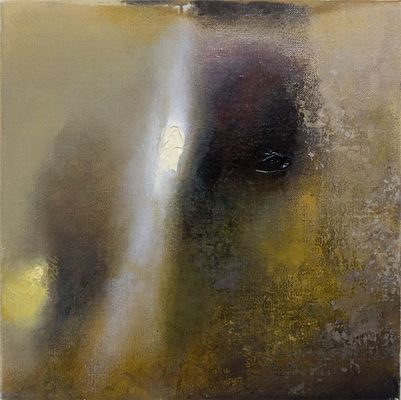
I am not a great reader of poetry but I always return to the work of Melbourne poet, Vincent Buckley (1925- 1988). Perhaps I find his most tantalising piece to be not a finished poem but a fragment left on a scrap of paper discovered on his desk after the poet’s death.
The poetry gathers like oil
In the word-core, and spreads
It has its music meet,
Its music is in movement.
This fragment is more the shell left behind from a volatile thought than a finished poem. I find the last two lines honest but awkward whereas the first two lines work like an arrow. Most likely he could not find a resolution so it was left. Still, in its present form, it remains an eloquent testimony to the ultimate failure of a medium to express mobile thought and sensation, in Buckley’s case, through verbal language. It’s an important matter because this is something all artists have to deal with regardless of the medium.
I have never written a poem, however, I am forever copying fragments from books on paper scraps in a vain effort to fix certain notions in my head. At first, they function as bookmarks that are sometimes returned to when I open the book. But before long, as they accumulate, they fall out littering the table interspersed with A4 photocopies, bills, books and medications.
To return to Buckley’s fragment, the first two lines very much evoke how I paint nowadays. As you age, detail diminishes and patches of light become more luminous and float. I feel the most honest way of dealing with this is by smearing the oil paint on the canvas with the fingers and working close-up, blind. Only if the patches coalesce into an approaching image can the work gain a life.
-
Jonathan Walker was born in Melbourne, Australia and brought up on a dairy farm in Gippsland. In the 1970’s he studied painting at RMIT and won the Harold Wright Scholarship to the British Museum, London. During the 1980’s he exhibited at Pinacotheca Gallery, Richmond and had work shown at the NGV and Heidi City Art Gallery. Over the same period he designed the cover for the “Epigenesi” LP by Giancarlo Toniutti, Italy and conducted a mail exchange work with Achim Wollscheid, Germany. The work with artists through the post resulted in an article published in the bicentenary issue of Art and Australia 1988. He showed in artist run spaces such as WestSpace in the 90’s and 2000’s, and until 2012, taught painting at Victoria University, which is where we (Colleen Ahern and Lisa Radford) as organisers of the exhibition, among many others, had the privilege of being his student.
Walker’s knowledge was imparted to students through the careful selection of music, literature, and artists found in books that he himself had ordered for the library. Walker’s strategy was the generosity of sharing his vast knowledge with references specific to each student and their context.
Walker’s paintings share a similar focus and intimacy.
This exhibition presents a small selection of recent paintings alongside a publication that includes Walker’s writing. Observational and analytical, Walker’s work is a type of material notation — the time of day, colour and how it is blended, the both specific and fleeting location of a reflection on lino or the question of whether a chair leg should be included in a painting.
Please join us on Friday August 21 between 6-8pm to celebrate the opening of the exhibition.
Curated by Colleen Ahern and Lisa Radford.
B. Wurtz
Curated by Nic Tammens
March 26 - April 4, 2015
B.Wurtz works from a basement studio in his home on Manhattan’s Lower East Side.
This local fact is attested to by the plastic shopping bags and newsprint circulars that appear in his work. As formal objects, they don’t make loud claims about their origins but nonetheless transmit street addresses and places of business from the bottom of this long thin island. Like plenty of artists, Wurtz is affected by what is local and what is consumed. His work is underpinned by this ethic. It often speaks from a neighborhood or reads like the contents of a hamper:
“BLACK PLUMS $1.29 lb.”
“Food Bazaar”
“USDA Whole Pork Shoulder Picnic 99c lb.”
“RITE AID Pharmacy, with us it’s personal.”
“H. Brickman & Sons.”
“Sweet Yams 59c lb."
Most of the work in this exhibition was made while the artist was in residence at Dieu Donne, a workshop dedicated to paper craft in Midtown. Here Wurtz fabricated assemblages with paper and objects that are relatively lightweight, with the intention that they would be easily transportable to Australia. This consideration isn’t absolute in Wurtz’s work, but was prescriptive for making the current exhibition light and cheap. Packed in two boxes, these works were sent from a USPS post office on the Lower East Side and delivered to North Melbourne by Australia Post.
Wurtz appears courtesy of Metro Pictures, New York.
Thanks to Rob Halverson, Joshua Petherick, Sari de Mallory, Matt Hinkley, Helen Johnson, Fayen d'Evie, Ask Kilmartin, Lisa Radon, Ellena Savage, Yale Union, and "Elizabeth".
John Nixon
"Archive"
December 15 - January 20, 2014
The presentation of John Nixon's archive offered a rare showcase of this extensive collection of the artist's own publications, catalogues, posters, ephemera, editions and more, from the mid 1980s onwards, alongside a selection of his artworks.
Organized by John Nixon, Joshua Petherick and Matt Hinkley.
<a href=http://wfb.public-office.info/artist/john-nixon>All titles by John Nixon
"Habitat"
at Minerva, Sydney (organised by Joshua Petherick and Matt Hinkley)
November 15 - December 20, 2014
Lupo Borgonovo, Janet Burchill & Jennifer McCamley,
Lewis Fidock, HR Giger, Piero Gilardi, Veit Laurent Kurz,
Cinzia Ruggeri, Michael E. Smith, Lucie Stahl, Daniel Weil, Wols
Press Release:
“...It contained seven objects. The slender fluted bone, surely formed for flight, surely from the wing of some large bird. Three archaic circuitboards, faced with mazes of gold. A smooth white sphere of baked clay. An age-blackened fragment of lace. A fingerlength segment of what she assumed was bone from a human wrist, grayish white, inset smoothly with the silicon shaft of a small instrument that must once have ridden flush with the surface of the skin - but the thing’s face was seared and blackened.”
William Gibson, “Count Zero”, 1986
"Autumn Projects Archive"
Curated by Liza Vasiliou
March 6 - March 15, 2014
World Food Books, in conjunction with the Virgin Australia Melbourne Fashion Festival 2014, presented the Autumn Projects archive, consisting of a selection of early examples in Australian fashion with a particular interest in collecting designers and labels from the period beginning in the 1980’s, who significantly influenced the discourse of Australian Fashion.
Curated by Liza Vasiliou, the exhibition provided a unique opportunity to view pieces by designers Anthea Crawford, Barbara Vandenberg, Geoff Liddell and labels CR Australia, Covers, Jag along with early experimental collage pieces by Prue Acton and Sally Browne’s ‘Fragments’ collection, suspended throughout the functioning World Food Books shop in Melbourne.
H.B. Peace
presented by CENTRE FOR STYLE
November 14, 2013
"Hey Blinky, you say chic, I say same"
Anon 2013
H.B. Peace is a clothing collaboration between great friends Blake Barns and Hugh Egan Westland. Their pieces explore the divergences between 'character’ and ‘personality’ in garments....etc
Special Thanks to Joshua Petherick and Matt Hinkley of WFB and Gillian Mears
and a Very Special Thank you to Audrey Thomas Hayes for her shoe collaboration.
Janet Burchill & Jennifer McCamley
"Aesthetic Suicide"
May 10 - June 8, 2013
The first of our occasional exhibitions in the World Food Books office/shop space in Melbourne, "Aesthetic Suicide" presented a body of new and older works together by artists Janet Burchill & Jennifer McCamley, including videos, prints, a wall work, and publications.
During shop open hours videos played every hour, on the hour.
1998, English / French / Italian
Hardcover + CD (12'23"), 40 pages, 24 x 17 cm
1st Edition, Out of print title / used / very good
Published by
Alga Marghen / Milan
$100.00 - In stock -
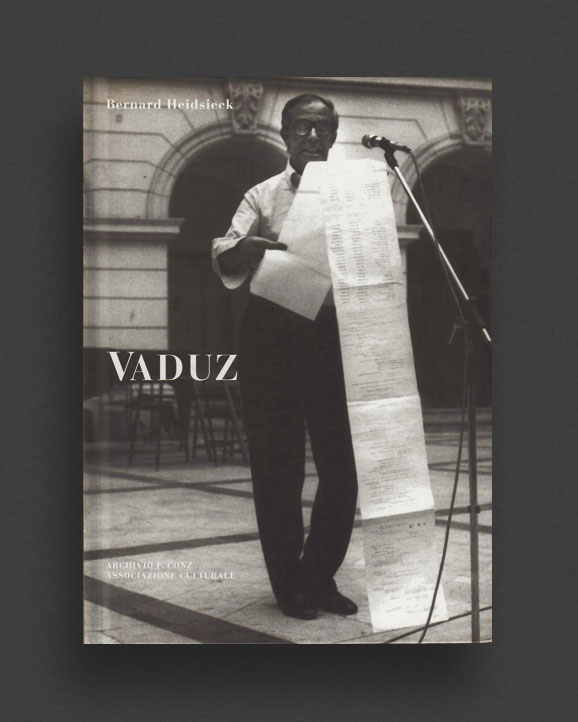
First, 1998 hardcover edition, published and printed in Italy, long out-of-print.
This poem by Bernard Heidsieck starts with Vaduz, the capital of Lichtenstein, and from it, lists all the people and ethnic groups of the world: a great humanist work and an extreme experience of poetry-action. The publication features a recording of the poem, read by Bernard Heidsieck.
Composed June to December 1974 and recorded on a Revox A 700 at author's studio. Commissioned by Roberto Altman in 1974 to celebrate the inauguration of the Art Foundation in Vaduz, capital of the state of Liechtenstein. 40 pages book with CD.
Bernard Heidseick (1928-2014) was a French sound poet, associated with various movements throughout a long career: including Beat, Fluxus, and minimalism. Heidseick decided in the mid-1950s to break off from written poetry, and to bring it outside of books. He opposed passive poetry to active poetry, to an “on its feet” poetry, in his own words. Starting in 1955 he was one of the founders of Sound Poetry, and in 1962 of Action Poetry. As early as 1959 he used a tape recorder as an additional means for writing and retransmitting, opening his research to new experimental fields. While remaining concerned with semantics, Bernard Heidseick became increasingly independent from the constraints of language. He explored all its formal aspects, either by spatializing the text in his written scores, or by the presence of his body in space. He gave sound a formal dimension, notably through an exceptional diction based as much on breathing as on articulating perfectly or on constantly renewing the inflections of his voice. As the years went by he reinvented his writing in order to render our daily life more accurately. Our social, political or economical universe, through its main events, as well as through its extreme ordinariness. In 1955 he developed his first Score-Poems. He then worked continuously on series, with the 13 Biopsies between 1966 and 1969. From 1969 to 1980, he created the 29 Passe-Partout (Catch-alls). From 1978 to 1986, he wrote Derviche/Le Robert (Dervish/Le Robert) composed of 26 sound poems. Then, beginning in 1988, Respirations et brèves rencontres ( Respiration and Brief Encounters) (60 poems created from the archives of recordings of artists' breathing). He organised the first international festival of sound poetry in 1976 and the event Rencontres Internationales 1980 de poésie sonore which took place in Rennes, in Le Havre and at the Pompidou Centre in Paris.
He has organized over 540 public readings of his texts in twenty different countries.
As New, light storage wear only.
2009, French / English
Hardcover (w. audio CD), 90 pages, 21 x 15 cm
Ed. of 350, hand-numbered,
Published by
Alga Marghen / Milan
$60.00 - In stock -
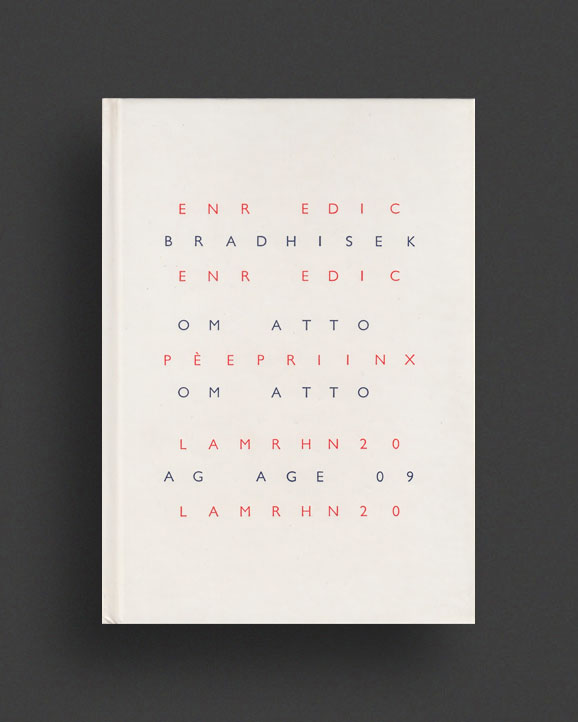
Limited edition book and CD presentation of Bernard Heidsieck's Poème-Partition "X", bound in hardcover in a hand-numbered edition of 350 copies. Recorded 1960, this publication of the work plus CD of the original 1960 recording and later 1962 performance (accompanied by saxophone improvisation by American painter Larry Rivers) were issued in this deluxe volume in 2009 by Alga Marghen, Milan. Heidsieck (1928—2014) was one of the greatest French poets of the 20th century and an originator of the sound poetry movement.
Bernard Heidseick (1928-2014) was a French sound poet, associated with various movements throughout a long career: including Beat, Fluxus, and minimalism. Heidseick decided in the mid-1950s to break off from written poetry, and to bring it outside of books. He opposed passive poetry to active poetry, to an “on its feet” poetry, in his own words. Starting in 1955 he was one of the founders of Sound Poetry, and in 1962 of Action Poetry. As early as 1959 he used a tape recorder as an additional means for writing and retransmitting, opening his research to new experimental fields. While remaining concerned with semantics, Bernard Heidseick became increasingly independent from the constraints of language. He explored all its formal aspects, either by spatializing the text in his written scores, or by the presence of his body in space. He gave sound a formal dimension, notably through an exceptional diction based as much on breathing as on articulating perfectly or on constantly renewing the inflections of his voice. As the years went by he reinvented his writing in order to render our daily life more accurately. Our social, political or economical universe, through its main events, as well as through its extreme ordinariness. In 1955 he developed his first Score-Poems. He then worked continuously on series, with the 13 Biopsies between 1966 and 1969. From 1969 to 1980, he created the 29 Passe-Partout (Catch-alls). From 1978 to 1986, he wrote Derviche/Le Robert (Dervish/Le Robert) composed of 26 sound poems. Then, beginning in 1988, Respirations et brèves rencontres ( Respiration and Brief Encounters) (60 poems created from the archives of recordings of artists' breathing). He organised the first international festival of sound poetry in 1976 and the event Rencontres Internationales 1980 de poésie sonore which took place in Rennes, in Le Havre and at the Pompidou Centre in Paris.
As New.
2001, French
Softcover (w. audio CD + print insert), 64 pages, 21 x 15 cm
Ed. of 500,
1st Edition, Out of print title / as new
Published by
Le Corridor Bleu / Nîmes
$50.00 - In stock -
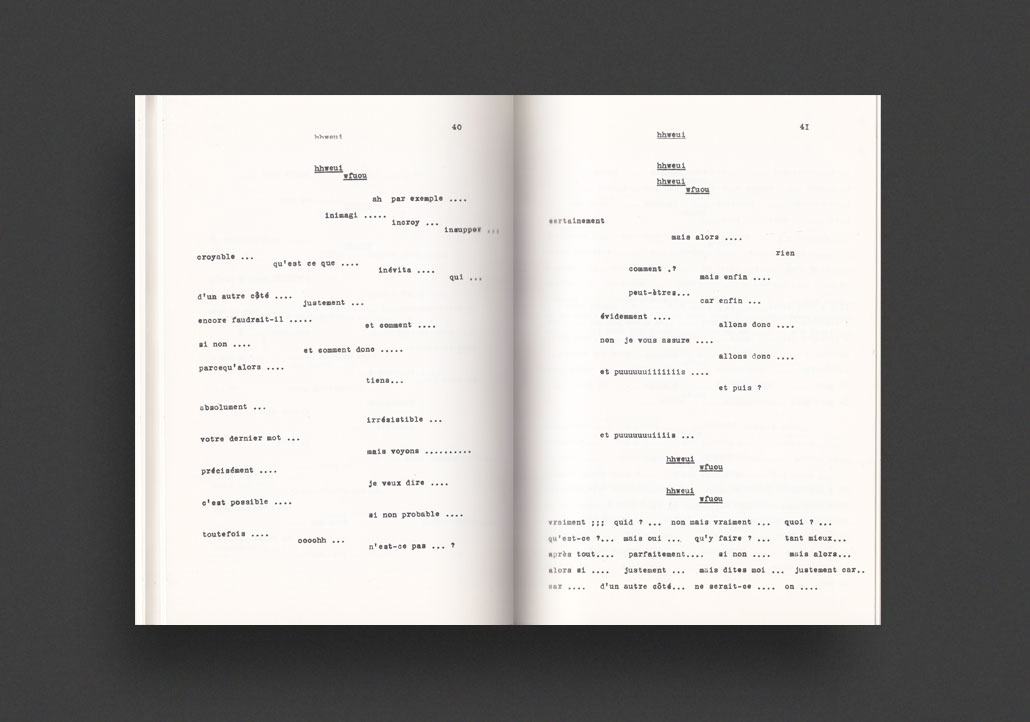
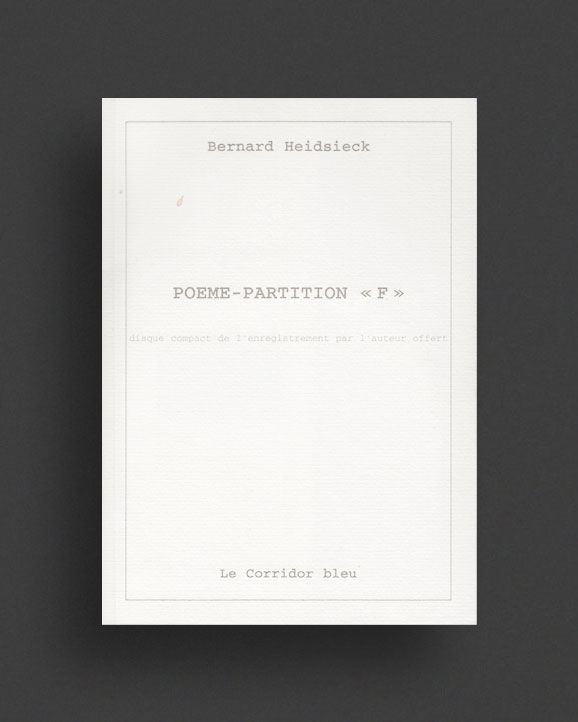
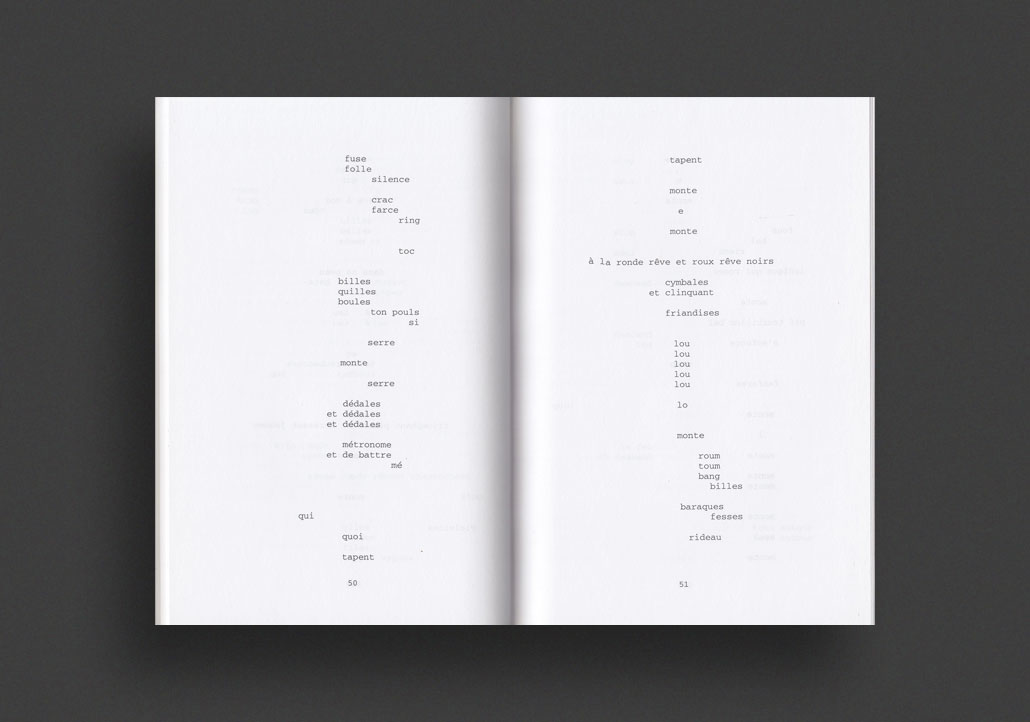
Limited edition book and CD presentation of Bernard Heidsieck's Poème-Partition "F" with print insert. Written 1957 and recorded 1960, this publication was issued in an edition of 500 in 2001 by Le Corridor Bleu, Nîmes. Includes an additional introduction by Heidsieck (1928—2014) himself, one of the greatest French poets of the 20th century, and an originator of the sound poetry movement.
Bernard Heidseick (1928-2014) was a French sound poet, associated with various movements throughout a long career: including Beat, Fluxus, and minimalism. Heidseick decided in the mid-1950s to break off from written poetry, and to bring it outside of books. He opposed passive poetry to active poetry, to an “on its feet” poetry, in his own words. Starting in 1955 he was one of the founders of Sound Poetry, and in 1962 of Action Poetry. As early as 1959 he used a tape recorder as an additional means for writing and retransmitting, opening his research to new experimental fields. While remaining concerned with semantics, Bernard Heidseick became increasingly independent from the constraints of language. He explored all its formal aspects, either by spatializing the text in his written scores, or by the presence of his body in space. He gave sound a formal dimension, notably through an exceptional diction based as much on breathing as on articulating perfectly or on constantly renewing the inflections of his voice. As the years went by he reinvented his writing in order to render our daily life more accurately. Our social, political or economical universe, through its main events, as well as through its extreme ordinariness. In 1955 he developed his first Score-Poems. He then worked continuously on series, with the 13 Biopsies between 1966 and 1969. From 1969 to 1980, he created the 29 Passe-Partout (Catch-alls). From 1978 to 1986, he wrote Derviche/Le Robert (Dervish/Le Robert) composed of 26 sound poems. Then, beginning in 1988, Respirations et brèves rencontres ( Respiration and Brief Encounters) (60 poems created from the archives of recordings of artists' breathing). He organised the first international festival of sound poetry in 1976 and the event Rencontres Internationales 1980 de poésie sonore which took place in Rennes, in Le Havre and at the Pompidou Centre in Paris.
As New with tiny little coffee drip mark to cover.
2025, English
Softcover + flexi–disc, 184 pages, 26 x 19.5 cm
Limited Edition,
Published by
First To Knock / Michigan
$72.00 - In stock -
Limited-edition version with flexi-disc recording of Satie’s “Leit-motiv du Panthée” performed, as intended, as an accompaniment to a reading of Joséphin Péladan’s Le Panthée.
In 1892, Erik Satie was at a crossroads. Despite having already composed some of the finest works ever written for piano, the 26-year-old was still penniless and unappreciated. His artistic ethos—a paradoxical mix of reactionary Medievalism and avant-garde absurdism—could find no quarter in fin-de-siècle Paris. And so, with his musical aspirations dashed and nowhere left to turn, Satie would turn to himself.
His subsequent revolt was as shocking as it was incomprehensible to his contemporaries. Satie announced himself to be “the Parcener,” the head of a new religious order. It was, in fact, a church of his own founding—The Metropolitan Church of Art of Jesus the Conductor.
Transforming his dilapidated apartment into an “Abbatial Church,” Satie began issuing scathing letters to prominent cultural figures who had sought to render judgment upon his Art. Targets of the Parcener’s screeds ranged from the cape-clad mystagogue, Joséphin Péladan, to the pompous composer, Camille Saint-Saëns; from the novelist Octave Mirbeau, who had dared to lampoon the Parcener, to the theatre director Aurélien Lugné-Poe, whose unintentionally nude stage production had offended the Parcener’s moral sensibilities. The fiercest feud was reserved for music critic Henry Gauthier-Villars, whom the Parcener battled in the press for years, until the spat culminated in a physical altercation at a concert. Throughout the 1890s, luminaries, such as these, found themselves excommunicated from a church to which they had not even known they once belonged.
Inscrutable as the author himself, Satie’s writings from this brief period strike a tone that lies somewhere between fervent Catholicism, anarchistic satire, and the righteous rage of the true Artist—leaving readers befuddled as to the composer’s true intent. Yet, despite the impenetrability of his writings, the Parcener’s missives took the Parisian art scene by storm and, as Satie’s crusade grew in intensity, so too did his reputation, making this era as historically crucial as it is bewildering. Nevertheless, the Metropolitan Church was ultimately a solitary undertaking. Despite certain documents indicating that the Church expected to have more than a billion members, history would show that its congregation never grew beyond one: Erik Satie himself.
Know Me To Be Your Superior in Everything is the first book dedicated exclusively to the story of Erik Satie’s Metropolitan Church of Art of Jesus the Conductor. Drawing upon a multitude of firsthand sources—including documents held in the Erik Satie archives in Caen—the book includes new English translations of all known Church publications and correspondence by Satie as the Parcener. Facsimilic translations of Satie’s Church publications are reproduced herein as well, capturing, for the first time in English, the design and typography of the original productions.
Know Me To Be Your Superior in Everything was written by Sam Kunkel, a scholar of 19th century Symbolist literature. Previous to this book, Kunkel has also provided translations for Echoes of a Natural World—Tales of the Strange & Estranged (First To Knock, 2020); A Beam of Sunlight in the Deep Forest—Mystical Prose Works by Édouard Schuré (First To Knock, 2021); as well as The Solar Circus by Gustave Kahn (First To Knock, 2022). Kunkel has also written extensively in French, covering topics such as Joséphin Péladan and religion in fin-de-siècle Paris. His critical reedition of Péladan’s notorious novel, Istar, was published by Éditions du Lérot in 2024, and his book, L’Orphisme et le roman post-romantique, a comparative study of the mystical novel, was released by Éditions Otrante in 2023.
Design by Bryan Cipolla
1969, English
Slipcase portfolio of 64 loose plates, 38.5 x 30 cm
1st Edition, Out of print title / used / good
Published by
Rhinoceros Press / New York
$400.00 - In stock -
Original 1969 deluxe slipcase edition of Tomi Ungerer's controversial classic from 1969, Fornicon, a provocative portfolio of Ungerer's stunning line drawings of mechanophilia — machine sex. The ingenious and diverse pleasure devices seem to symbolize the absurdity of human desire, caricaturing love and lust mechanized by industrial society. One of the most celebrated works of erotic illustration of the 20th Century, and a masterpiece of 1960s counterculture, Fornicon ruffled so many feathers when first published by Ungerer and Richard Kasak that the award-winning French illustrator had to flee New York.
Heavy back slipcase w. gold-foiling contains the complete 64 sheets (62 illustrated plates, 1 double-sided title/colophon page, 1 double-sided text introduction by American poet and literary critic John Hollander).
"Black Power/White Power, with its Kama Sutra suggestion of simultaneous fellatio, has an undeniable sexual undercurrent, but Ungerer also addressed the sexual revolution head-on, assimilating the fluid line and stark patterning of Aubrey Beardsley in wildly phallocratic drawings of baroque pleasure devices and mechanical means of penetration. Published as an expensive folio, The Fornicon, these sprightly images—a literal, if perverse, expression of the desire to make love rather than war—provoked a strong negative reaction, effectively suspending Ungerer’s career as a children’s book artist (his works, he says, were banned from libraries) and precipitating his departure from New York..."—NY Books
Tomi Ungerer (b. 1931) is an award winning French illustrator and a writer in three languages. He has published over 140 books ranging from much loved children's books to controversial adult work; from the fantastic to the autobiographical. He is known for sharp social satire and witty aphorisms. He is renowned for his iconic Advertising campaigns and political posters against the Vietnam War and Racial Injustice which were representative of the burgeoning political consciousness in New York in the 1960’s when he was based at the time. His political engagement has continued to this day in campaigns against Racism and Fascism, for Nuclear disarmament, Ecology and numerous Humanitarian causes.
Good copy with wear to the edges/corners of the slipcase, some discolouration to the gold foil, and several plates have some light foxing and light corner creasing, but majority of contains Very Good. Contents are complete.
199?, Japanese / English
Vinyl sticker, 15 x 10.5 cm
1st Edition, Out of print title / as new
Published by
? / Japan
$150.00 - In stock -
Very rare, ridiculously adorable Takashi Homma "Beware of Dog" sticker. Likely issued around 1996, the same time as his classic Tokyo Teens postcard book, and roughly the same size, designed with Gugi Akiyama. A perfect collector's item by one of Japan's leading photographers, perfectly emblematic of Homma's influential "Tokyo pop" work of the period. Known in the West through Purple magazine, etc., Homma followed in the spirit of Provoke photographers such as Araki, Moriyama, and Nakahira to create a new photographic expression for Tokyo at the end of the century. Homma's photography would become a great influence on the fashionable 1990's girly photo boom of Hiromix and Yurie Nagashima, etc.
As New, unused.
199?, Japanese / English
Vinyl sticker, 15 x 10.5 cm
1st Edition, Out of print title / as new
Published by
? / Japan
$150.00 - In stock -
Very rare, ridiculously adorable Takashi Homma "Beware of Dog" sticker. Likely issued around 1996, the same time as his classic Tokyo Teens postcard book, and roughly the same size, designed with Gugi Akiyama. A perfect collector's item by one of Japan's leading photographers, perfectly emblematic of Homma's influential "Tokyo pop" work of the period. Known in the West through Purple magazine, etc., Homma followed in the spirit of Provoke photographers such as Araki, Moriyama, and Nakahira to create a new photographic expression for Tokyo at the end of the century. Homma's photography would become a great influence on the fashionable 1990's girly photo boom of Hiromix and Yurie Nagashima, etc.
As New, unused.
1983, English/German/Spanish
Softcover, 220 pages, 18.6 x 13 cm
1st Edition, Out of print title / used / very good
Published by
Peter-Rump-Verlag / Bielefeld
Peter-Rump-Verlag
$50.00 - In stock -
Mailart extraordinaire Peter Küstermann's first book, "No War in my City!", independently published in 1983 in a limited edition to accompany a global networked exhibition of Mail–Art by 430 contributing artists, edited by Peter Rump, with foreword by Küstermann, introducing the phenomenon of Mail Art, self–translated into German/English/Spanish. Profusely illustrated in b/w throughout with all of the border breaking artworks spanning the entire globe, sent through the post. A detailed list of all the artists and captions to accompany the artworks are included.
"This "art by mail" is a serious pleasure, various and tongue-in-cheek. It is the duty-free link in an international net of artists and laymen that extends as far as a letter can reach and is continuously growing.
Mail Art gets manifested in exhibitions, catalogues, papers and is becoming more and more popular beyond its traditional homes in Italy, Belgium and the U.S.
Mail Art represents not only a non-commercial El Dorado for literates, thinkers, printers, gluers, painters, protesters, cartoonists from Iceland to Argentina, but it also creates worldwide contacts and helps to better understand each other.
[...]
WHY "MAIL ART FOR PEACE"?
Mail Artists are crazy people - and choose the craziest themes. But they are also very concerned, and they watch the problems in the world around us. Considering the worldwide threat against us all by war and the arms race, mail art seemed to me to be the ideal medium for an international call for peace - from the whole world to the whole world, organized as a travelling exhibition.
"No war in my town!" ... and not in yours, and in nobody else's town! For we are all addressed."
—from the introduction
Peter Küstermann (b. Hagen, Westphalia, 1950) has been a mail artist since 1983 and is also an author, painter, musician, filmmaker, art critic, alternative cultural manager, and gallery owner at the BÜZ cultural center in Minden, located in a former church. Together with Angela Pähler, he holds the Guinness World Record for traveling art mail carriers under the artist name Angela & Peter Netmail.
VG copy with inscription from Angela and Peter to Australian sound composer Warren Burt.
1996, English
Box w. 96 page book + audio CD
1st Edition, Out of print title / used / very good
Published by
Ellipsis Art / New York
$45.00 - In stock -
First 1996 edition of Gravikords, Whirlies & Pyrophones, a boxset publication containing a book and CD that explores "outrageously inventive designers and builders of new and unusual musical instruments". Edited by Bart Hopkin, with a foreword by Tom Waits, the publication showcases various artists who build and play unique, custom-made experimental instruments, exploring sound-makers utilizing fire, air, earth, and electronics, including fire-driven organs (pyrophones), rotating instruments (whirlies), and stringed instruments (gravikords). In-depth texts explore the history, construction, and players of the instruments, featuring Michael Moglia, Harry Partch, Wendy Mae Chambers, Hans Reichel, Fred “Spaceman” Long, Arthur Frick, Don Buchla, Robert Moog, Leon Theremin, William Eaton, Ken Butler, Reed Ghazala, Sarah Hopkins, Leon Theremin, and many more.
Long out–of–print and rarely available in its complete form, this copy also contains the original 73 minute CD of entirely original performances featuring the instruments studied.
Very Good—Near Fine copy all round.
1968, Japanese
5 litho prints in letterpress envelope, 19 x 13 cm
1st Edition, Out of print title / used / very good
Published by
Kodansha Int / Tokyo
$180.00 - In stock -
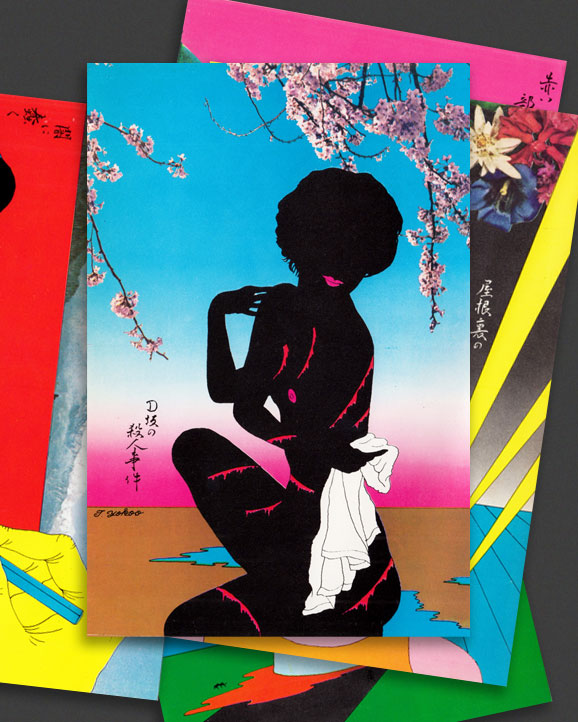
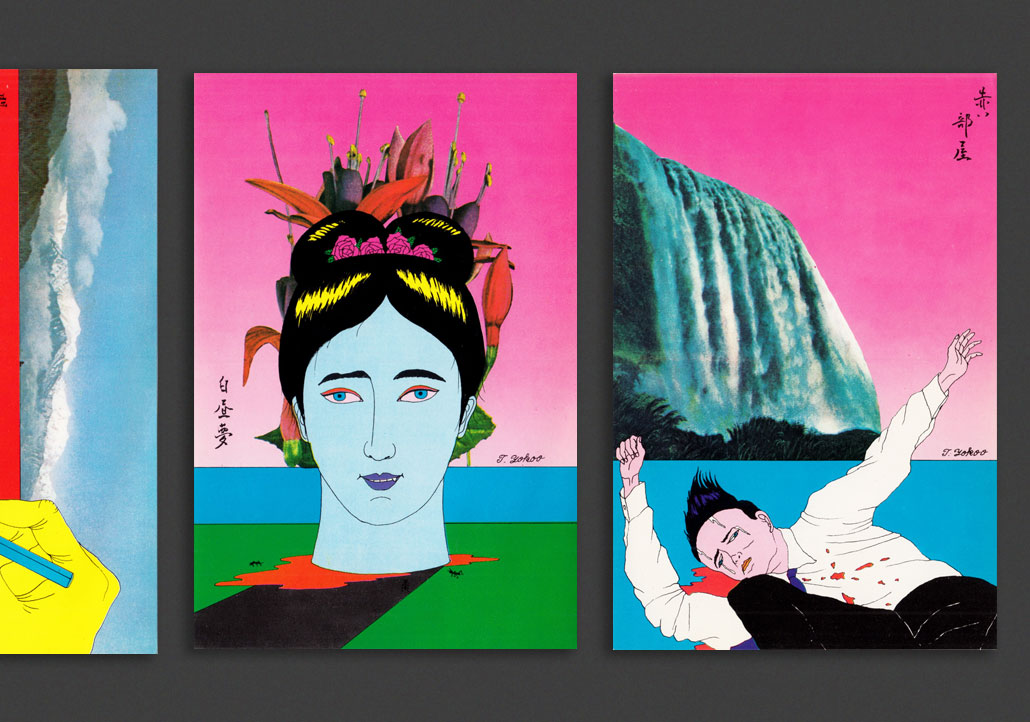
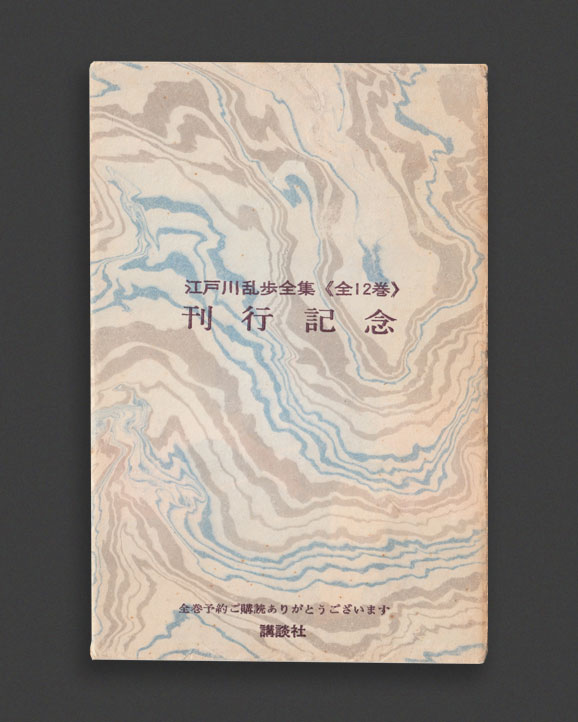
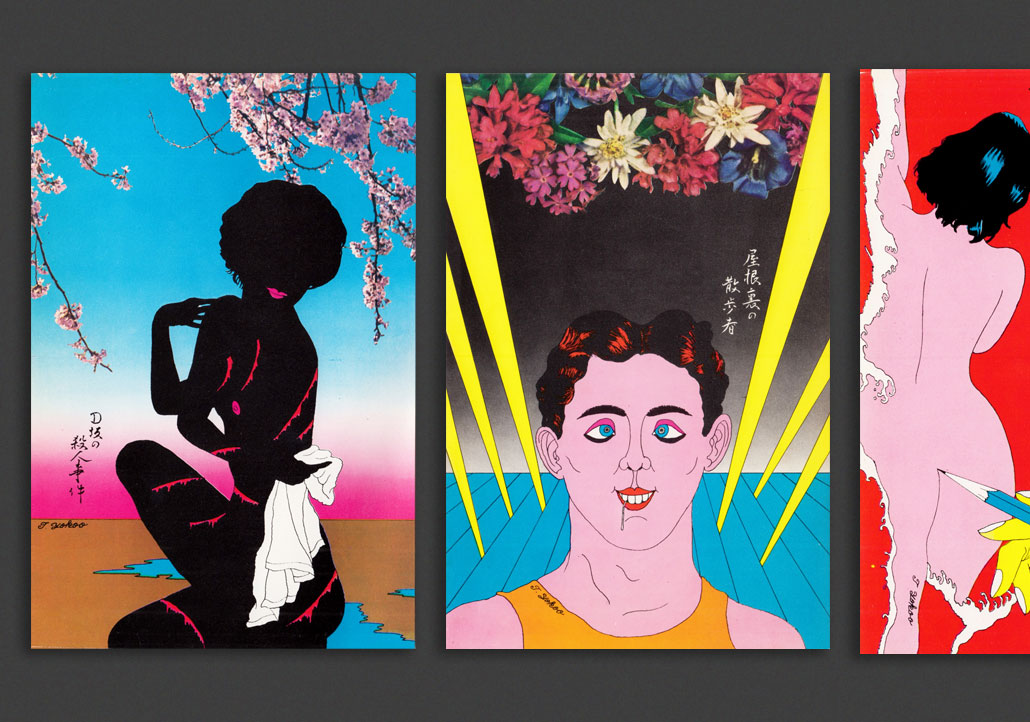
Complete 5 card set of litho prints by legendary Japanese artist Tadanori Yokoo, issued in letterpress, marbled envelope in 1968 to commemorate the release of the complete 12 volume collected works of Japanese author and critic Edogawa Ranpo (1894—1965), who played a major role in the development of Japanese mystery and thriller fiction. Yokoo contributed many illustrations to the book collection, alongside fellow artists Iwami Furusawa and others. This rare folio of prints (roughly the size of post cards) collects five of the finest examples of Yokoo's instantly recognisable 1960's psychedelic work — erotic, grotesque, and esoteric themes rendered in vivid graphic collage and pop colour.
Tadanori Yokoo (b. 1936) is one of Japan's most successful and internationally recognized graphic designers and artists, who began working with painting in 1966. In parallel, Yokoo’s early screenprints experimented with collage and illustration, combining found photographs with the influence of traditional Japanese ukiyo-e and pop art’s flat vibrant colours and overtly sexual and grotesque content, often reflecting on the rapid changes and Westernisation of Japan post-war society. His interests in mysticism and esotericism, deepened by travels to India, influenced his iconic posters with eclectic psychedelic imagery sharing the aesthetics of the underground counterculture he was associated with. In Tokyo Yokoo worked as a stage designer for avant-garde theatre, collaborating extensively with Shūji Terayama and his experimental theater group Tenjō Sajiki. By the late 60s he had already achieved international recognition and in the early 1970s MoMA mounted a solo exhibition of his graphic work. His famous designs for The Beatles, Miles Davis, Carlos Santana and collaborations with friend and iconic Japanese fashion designer Issey Miyake are renowned the world over.
Very Good, perfectly preserved cards in aged envelope with some wear to edges and tanning.
?, English / French / Japanese
Seven postcards (18 x 13 cm) in cotton bag
1st Edition, Out of print title / used / fine
Published by
Maison Martin Margiela / Paris
$200.00 - In stock -
Rare group of seven over-sized Maison Martin Margiela postcards, art directed by Martin Margiela himself and featuring the photography of his long-term collaborator Marina Faust, who worked with Margiela throughout his whole career. Includes the scissors image for Margiela’s "Line 0" (or ⓪), the Artisanal collection, originated in 1989 as the brand's haute couture laboratory focused on deconstruction and reworking found items. The cards come in their original issue cotton Margiela pocket and feature imagery to represent specific product lines, introduced in 1997 with his iconic 0–23 grid. Undated. Double-sided. Published by Maison Martin Margiela.
Fine, very minor tanning to edges.
1973, French
Softcover (fold-out card), 4 pages, 23 x 17 cm
1st Edition, Out of print title / used / very good
Published by
Pâturages-Salle Achille Delattre / Belgium
$35.00 - Out of stock
Rare invitation published to accompany a major retrospective exhibition of self-taught Belgian surrealist Armand Simon (1906–1981) at Pâturages, Salle Achille Delattre, Belgium, in 1973. Illustrated with a single work to the cover, this fold-out invitation includes texts/testimonials on Simon in French by Belgian poet and member of the Hainaut Surrealist group, Achille Chavée (1906—1969), French essayist, literary critic, novelist, and historian, Marcel Brion (1895—1984), Belgian painter, poet and founding member of the Revolutionary Surrealist Group and COBRA, Christian Dotremont (1922—1979), and French poet and art historian, Yves Bonnefoy (1923—2016), along with exhibition details, biography and exhibition history.
Armand Simon (1906–1981) was a self-taught Belgian Surrealist artist, cartoonist and poet known for his dreamlike and thought-provoking works. Born in Mons, Belgium, in 1923 Simon discovered the 'Chants de Maldoror' by Comte de Lautréamont, a text that fascinated him and to which he devoted thousands of drawings. An extremely prolific draftsman, he developed a noir universe nourished by literary sources, of which he proposed "graphic equivalents". Dense and precise, his drawings are based on an automatism to which he remained faithful throughout his life. His ink drawings often featured enigmatic and fantastical elements, exploring themes of the subconscious, dreams, and the absurd. In the mid 1930s Simon joined the Belgian Surrealist group Rupture, established in Hainaut, and alongside Chavée, Dumont and Lefrancq, took part in L'Invention Collective, founded and published by Raoul Ubac (1910-1985) and Rene Magritte (1898-1967) in 1940. He illustrated texts by Monique Watteau and Marcel Brion, as well as Achille Chavée's 'Seven Poems of High Negligence'. Throughout his life, he remained a relatively obscure figure outside of surrealist circles, but his work continues to be appreciated for its unique and devoted contribution to the movement. Simon's legacy is preserved through his art, which remains on display in various collections and museums dedicated to Surrealist art. Simon died in Frameries in 1981.
Very Good copy.
1987, German
Poster, 42 x 49
1st Edition, Out of print title / used / very good
Published by
Gelbe Musik / Berlin
Galerie Vorsetzen / Hamburg
$150.00 - In stock -
Rare original poster produced to accompany the exhibition “Künstlerschallplatten,” organised by Gelbe Musik, Berlin, and presented at Galerie Vorsetzen, Hamburg, March 14 – April 4, 1987, a spatial installation by Claus Böhmler, Hanne Darboven and Stephan von Huene, featuring artist's records and record objects by Joseph Beuys, Henning Christiansen, Jack Goldstein, Philip Corner, Hermann Nitsch, Terry Fox, Charlemagne Palestine, Wolf Vostell, A. R. Penck, Dieter Roth, Yves Klein, Imi Knoebel, John Cage, Alan Kaprow, Rolf Julius, Conrad Schnitzler, Robert Rauschenberg, Harry Bertoia, Claus Böhmler, Hanne Darboven, Jean Dubuffet, Milan Knížák, Nam June Paik, Stuart Sherman, Christian Marclay, Lawrence Weiner, Valie Export, Reiner Ruthenbeck, Zoviet France, Keith Sonnier, Andy Warhol, Albert Oehlen, Sarkis, Arthur Köpcke, Michael Snow, and many more, plus room installations by Claus Böhmler, Hanne Darboven and Stephan von Huene.
Gelbe Musik was a gallery/storefront founded in 1981 by Ursula Block as an offshoot of Galerie Block, operated by her husband René Block (who has published editions by Marina Abramović, Joseph Beuys, Robert Filliou, Alfredo Jaar, On Kawara, Roman Opalka, Nam June Paik, Dieter Roth, Rosemarie Trockel, Ben Vautier Ben, Wolf Vostell Wolf, Lawrence Weiner and countless others). It remained the only record store dedicated to artists' recordings. Ursula Block was also responsible for Broken Music, an early (and still unrivalled) exhibition and catalogue of artists' records from 1989. “Künstlerschallplatten", two years prior, could be seen as the pre-cursor to that exhibition.
Ursula Block is a curator living in Berlin, Germany. From 1981 until 2014, she ran gelbe Musik, a gallery and record shop in Berlin that featured work by artists at the crossroads between music and art.
Very Good copy with light creasing as issued.
1985, Japanese
Softcover (staple-bound), 16 pages, 25.7 x 18.2 cm
1st Edition, Out of print title / used / fine
Published by
? / Japan
$70.00 - Out of stock
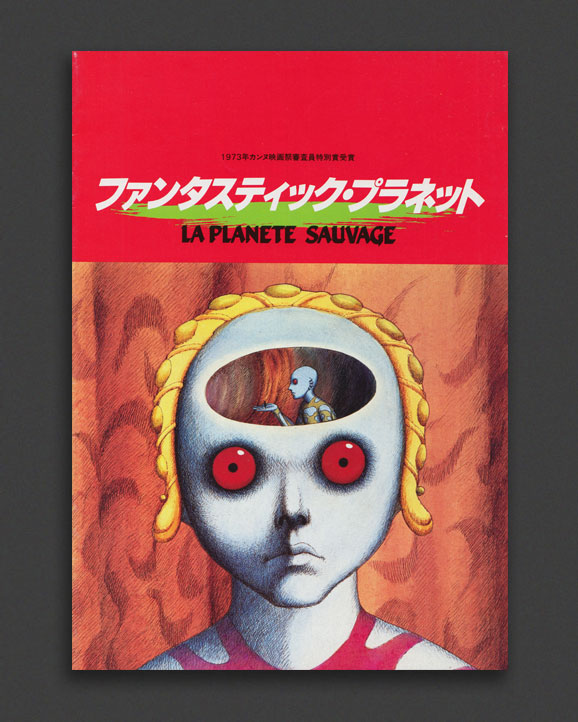
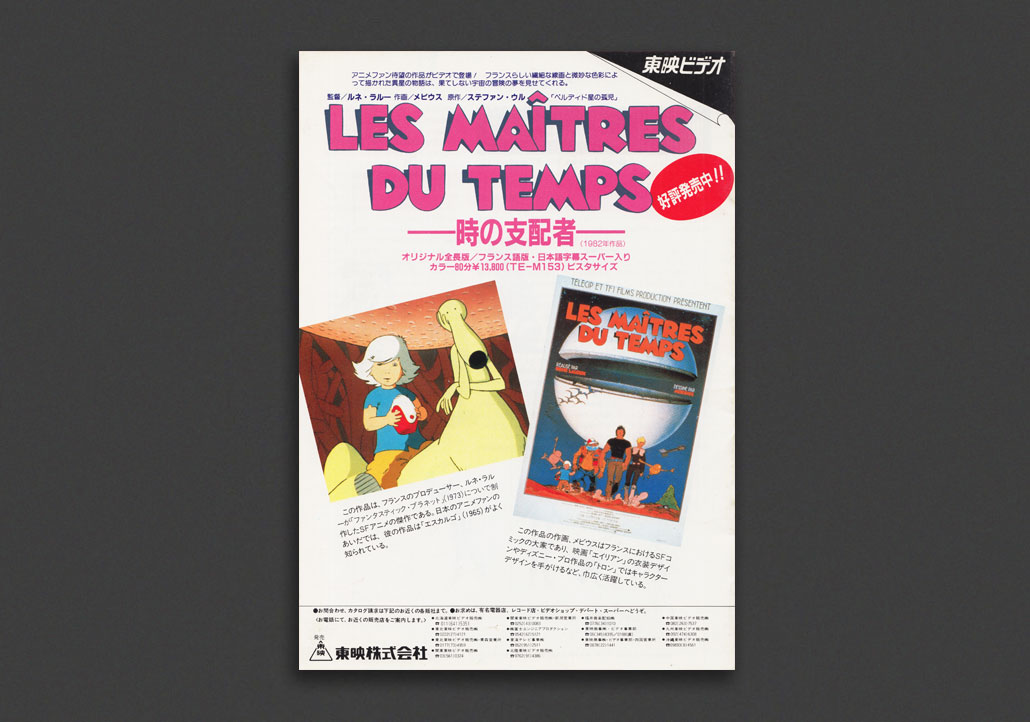
Very rare Japanese brochure from around 1985, promoting the release on VHS (we think!) of La Planete Sauvage (Fantastic Planet), the 1973 French/Czech experimental science fiction animated film, directed by René Laloux and written and designed by Laloux and illustrator Roland Topor. The film was animated at Jiří Trnka Studio in Prague. The allegorical story, set on the distant planet Ygam, is based on the 1957 novel Oms en série by French writer Stefan Wul. Enslaved humans called Oms are the playthings of giant blue native inhabitants, the Draags. Terr, kept as a pet since infancy, escapes from his gigantic child captor and is swept up by a band of radical fellow Oms, who are resisting the Draags’ oppression and violence. La Planete Sauvage was awarded the Grand Prix special jury prize at the 1973 Cannes Film Festival. It is one of the greatest animations ever made.
This collectible brochure gives synopsis and introduction to the film, illustrated throughout with stills, Topor's designs, Japanese texts, cast and catalogue information. A wonderful piece of printed history to René Laloux's chilling psychedelic masterpiece.
Very Good—Fine copy.
2017—2018, English / Japanese
Softcover (staple-bound + fold-out), unpaginated, 42 x 20.4 cm
1st Edition, Out of print title / used / very good
Published by
Comme des Garçons / Tokyo
$60.00 - In stock -
Booklet 5 of the printed collaboration between Rei Kawakubo's Comme des Garçons and the estate of American artist Paul Thek. Issued as mail-outs privately by Comme to announce the arrival of each of their 2017—18 collections, and not commercially available, these gorgeous, over-sized, elaborate fold-out leaflets designed by CDG showcase Thek's artworks (paintings, installations, drawings, sculptures, photography, etc) in a series of graphic collaged publications, made possible by Robert Wilson's Watermill Centre and Alexander and Bonin. Very Good, preserved copies, issued and collected individually, now very scarce.
American artist Paul Thek (1933-1988) was an elusive sculptor, painter, and one of the first artists to create environments or installations, who came to recognition showing his sculpture in New York galleries in the 1960s. The first works exhibited, which he began making in 1964 and called “meat pieces” as they were meant to resemble flesh, were encased in Plexiglas boxes that recall Minimal sculptures. At the end of the sixties, Thek left for Europe, where he created extraordinary environments, incorporating elements from art, literature, theater, and religion, often employing fragile and ephemeral substances, including wax and latex. His work was presented at documenta 4 and 5 in Kassel (1968, 1972), the Stedelijk Museum in Amsterdam (1969), the Moderna Museet in Stockholm (1971), and the Kunstmuseum in Lucerne (1973). He was supported in particular by Harald Szeemann and Jean-Christophe Ammann. In 1977, Suzanne Delehanty curated Processions at the Institute of Contemporary Art in Philadelphia, marking the first solo exhibition of Paul Thek's work in an American institution. At the close of the 1970's Thek changed direction, moved back to New York, and turned to the making of small, sketch-like paintings on canvas, although he continued to create environments in key international exhibitions. With his frequent use of highly perishable materials, Thek accepted the ephemeral nature of his art works—and was aware, as writer Gary Indiana has noted, of “a sense of our own transience and that of everything around us.” Following his death in 1988, his work was mainly shown in Europe (Castello di Rivara, Witte de With, etc). In 2008, the ZKM in Karlsruhe programmed Paul Thek Artist's Artist, which also explored how Thek's work has resonated in the contemporary scene. On the other side of the Atlantic, it wasn't until 2010 that the Whitney Museum in New York dedicated a remarkable retrospective to Thek, whose title, Paul Thek: Diver, emphasized the artist's passion for the sea.
Very Good copy.
2017—2018, English
Softcover (staple-bound + fold-out), unpaginated, 42 x 20.4 cm
1st Edition, Out of print title / used / very good
Published by
Comme des Garçons / Tokyo
$55.00 - In stock -
Booklet 10 of the printed collaboration between Rei Kawakubo's Comme des Garçons and the estate of American artist Paul Thek. Issued as mail-outs privately by Comme to announce the arrival of each of their 2017—18 collections, and not commercially available, these gorgeous, over-sized, elaborate fold-out leaflets designed by CDG showcase Thek's artworks (paintings, installations, drawings, sculptures, photography, etc) in a series of graphic collaged publications, made possible by Robert Wilson's Watermill Centre and Alexander and Bonin. Very Good, preserved copies, issued and collected individually, now very scarce.
American artist Paul Thek (1933-1988) was an elusive sculptor, painter, and one of the first artists to create environments or installations, who came to recognition showing his sculpture in New York galleries in the 1960s. The first works exhibited, which he began making in 1964 and called “meat pieces” as they were meant to resemble flesh, were encased in Plexiglas boxes that recall Minimal sculptures. At the end of the sixties, Thek left for Europe, where he created extraordinary environments, incorporating elements from art, literature, theater, and religion, often employing fragile and ephemeral substances, including wax and latex. His work was presented at documenta 4 and 5 in Kassel (1968, 1972), the Stedelijk Museum in Amsterdam (1969), the Moderna Museet in Stockholm (1971), and the Kunstmuseum in Lucerne (1973). He was supported in particular by Harald Szeemann and Jean-Christophe Ammann. In 1977, Suzanne Delehanty curated Processions at the Institute of Contemporary Art in Philadelphia, marking the first solo exhibition of Paul Thek's work in an American institution. At the close of the 1970's Thek changed direction, moved back to New York, and turned to the making of small, sketch-like paintings on canvas, although he continued to create environments in key international exhibitions. With his frequent use of highly perishable materials, Thek accepted the ephemeral nature of his art works—and was aware, as writer Gary Indiana has noted, of “a sense of our own transience and that of everything around us.” Following his death in 1988, his work was mainly shown in Europe (Castello di Rivara, Witte de With, etc). In 2008, the ZKM in Karlsruhe programmed Paul Thek Artist's Artist, which also explored how Thek's work has resonated in the contemporary scene. On the other side of the Atlantic, it wasn't until 2010 that the Whitney Museum in New York dedicated a remarkable retrospective to Thek, whose title, Paul Thek: Diver, emphasized the artist's passion for the sea.
Very Good copy.
2017—2018, English
Double-sided poster/announcement + CDG envelope, 42 x 20.4 cm
1st Edition, Out of print title / used / very good
Published by
Comme des Garçons / Tokyo
$35.00 - In stock -
2017 Comme des Garçons sale poster/announcement, no 23 of the collaboration series between Rei Kawakubo's Comme des Garçons and the estate of American artist Paul Thek. Issued as mail-outs privately by Comme to announce the arrival of each of their 2017—18 collections, and not commercially available, these gorgeous, over-sized, elaborate fold-out leaflets designed by CDG showcase Thek's artworks (paintings, installations, drawings, sculptures, photography, etc) in a series of graphic collaged publications, made possible by Robert Wilson's Watermill Centre and Alexander and Bonin. Very Good, preserved copies, issued and collected individually, now very scarce.
This doubles-sided poster is to announce the sale of the 2017 Comme collection and comes with the original b/w CDG mailers/envelope it was issued in (not pictured).
American artist Paul Thek (1933-1988) was an elusive sculptor, painter, and one of the first artists to create environments or installations, who came to recognition showing his sculpture in New York galleries in the 1960s. The first works exhibited, which he began making in 1964 and called “meat pieces” as they were meant to resemble flesh, were encased in Plexiglas boxes that recall Minimal sculptures. At the end of the sixties, Thek left for Europe, where he created extraordinary environments, incorporating elements from art, literature, theater, and religion, often employing fragile and ephemeral substances, including wax and latex. His work was presented at documenta 4 and 5 in Kassel (1968, 1972), the Stedelijk Museum in Amsterdam (1969), the Moderna Museet in Stockholm (1971), and the Kunstmuseum in Lucerne (1973). He was supported in particular by Harald Szeemann and Jean-Christophe Ammann. In 1977, Suzanne Delehanty curated Processions at the Institute of Contemporary Art in Philadelphia, marking the first solo exhibition of Paul Thek's work in an American institution. At the close of the 1970's Thek changed direction, moved back to New York, and turned to the making of small, sketch-like paintings on canvas, although he continued to create environments in key international exhibitions. With his frequent use of highly perishable materials, Thek accepted the ephemeral nature of his art works—and was aware, as writer Gary Indiana has noted, of “a sense of our own transience and that of everything around us.” Following his death in 1988, his work was mainly shown in Europe (Castello di Rivara, Witte de With, etc). In 2008, the ZKM in Karlsruhe programmed Paul Thek Artist's Artist, which also explored how Thek's work has resonated in the contemporary scene. On the other side of the Atlantic, it wasn't until 2010 that the Whitney Museum in New York dedicated a remarkable retrospective to Thek, whose title, Paul Thek: Diver, emphasized the artist's passion for the sea.
Very Good copy.
1969, English / Dutch
Illustrated 10-page fold-out (w. loose leaf inserts), 27 × 83 cm
1st Edition, Out of print title / used / very good
Published by
Stedelijk Museum / Amsterdam
$220.00 - In stock -
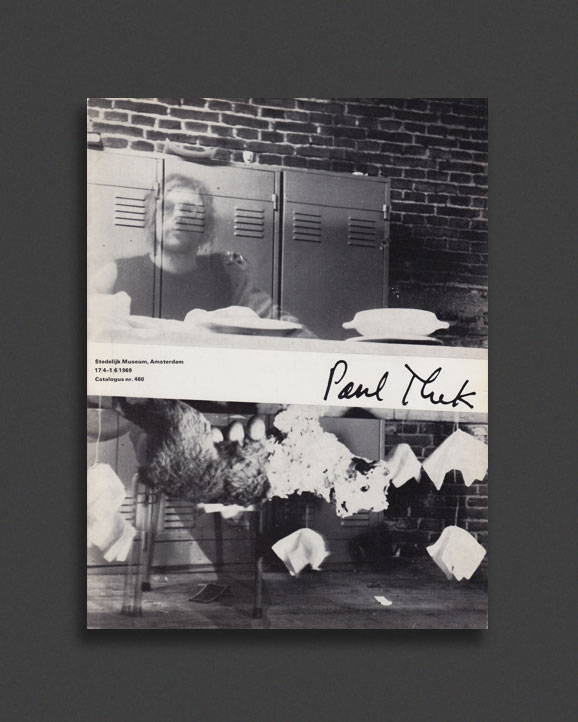
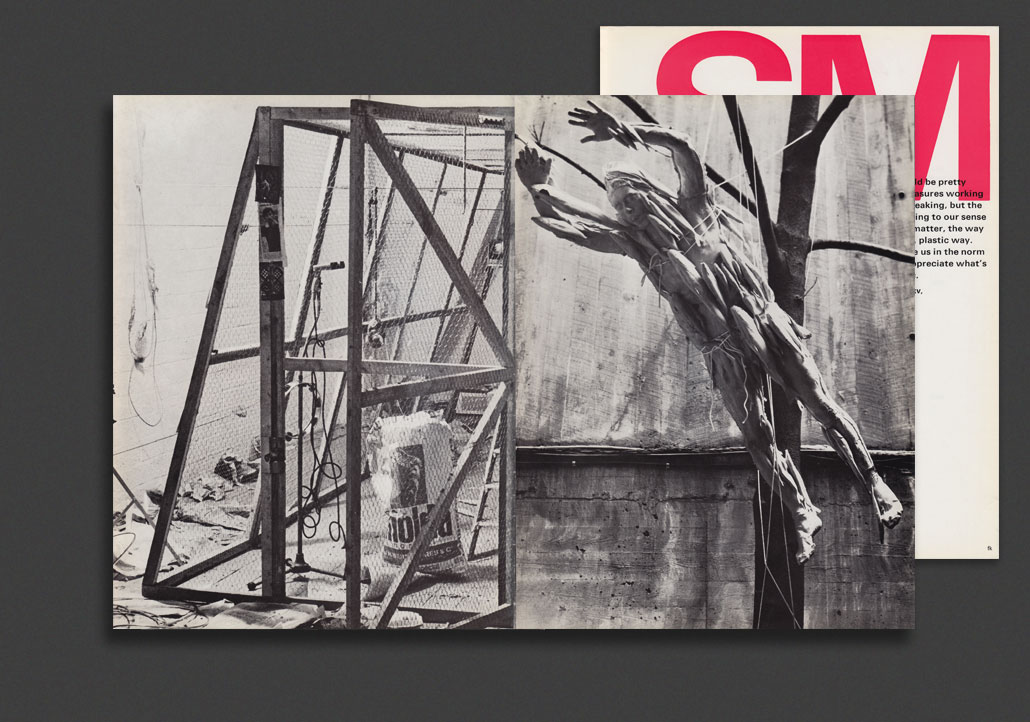
Extremely rare early Paul Thek Stedelijk Museum Amsterdam catalogue, published in 1969. Designed by Wim Crouwel (Total Design) in the form of a 10-page illustrated leporello fold-out of Thek's installations and sculptures and published with SM no. 460. One of the hardest of all Stedelijk Museum catalogues to find, this copy comes complete with the often missing SM biographical/interview/text insert, and also the loose strip inlay with text advertising ‘a document made by Paul Thek and Edwin Klein’ (published that same year), making it a most complete copy available.
Very Good-Fine with all included, preserved in plastic sleeve.
An American sculptor, painter, and installation artist, Paul Thek (1933-1988) is primarily known for hyper-realistic works of human body parts executed in fleshlike beeswax and for his strongly symbolic, room-size installations constructed from transitory materials. A major figure on the 1960s New York art scene, Thek also spent time in Europe, where he paved the way for artists adopting collaborative strategies. Although he gained a large following and was featured in more than one hundred solo and group exhibitions, the anti-establishment "artist's artist" was practically forgotten at the time of his death from AIDS related illness in New York City in 1988, aged 54.
2003, English / Japanese
Flyer (double-sided), 30 x 21 cm
1st Edition, Out of print title / used / very good
Published by
Comme des Garçons / Tokyo
$55.00 - In stock -
Flyer / mini poster produced on the occasion of the 2003 collaboration between American artist Richard Prince and Japanese fashion house Comme des Garçons, for which four t-shirts were release featuring Prince's famous Nurse paintings. It also coincides with an exhibition of Prince's work at Comme des Garçons in Tokyo, in collaboration with Sadie Coles, London, in late 2003. All four paintings are featured on the double-sided flyer, alongside text in English and Japanese.
VG copy.
1976, French / Japanese
Hardcover portfolio + 18 print plates + insert booklet, 30.5 x 23 cm
Hand-numbered of 970 copies,
1st Edition, Out of print title / used / good
Published by
Gakutokan / Japan
$190.00 - In stock -
Lovely 1976 limited edition hardcover portfolio of Franz Von Bayros' "Erzählungen am Toilettentische" (1908) an erotic suite first published privately in 1911, published in Japan by Gakutokan. 18 beautifully produced plates housed in gilded, debossed-plate illustrated hardcover clothbound folio, hand-numbered "454" of 970 copies. One of the finest works of the Austrian graphic artist, illustrator, and painter of the fin de siècle, Franz von Bayros (b. 1866, Zagreb; d. 1924, Vienna), considered one of the great erotomaniacs, alongside Aubrey Beardsley and Félicien Rops. His illustrations for classics of erotic literature are characterized by compositional talent, subtle play with ornament, and a delight in opulent settings.
Born in Zabreb, Croatia, Franz von Bayros (1866–1924) was an Austrian commercial artist, illustrator and painter. A leading figure in the Decadent artistic movement, his work challenged Victorian modesty, exploring phantasmagoric imagery and taboo erotic themes such as lesbian relationships, bestiality and sado-masochism, coupled with a keen sense of humour and warmth given to the subject. Franz’s brilliant draughtsmanship, design sense and his carefully-considered erotic imagination made his work eminently approachable and desirable, both as high-quality art and as a vehicle for exploring the limits of sexual experience, yet the scandalous nature of his work led to his arrest and temporary exile from Germany in 1911, returning to an Austria to face the outbreak of war and alienation.
During his prolific period creating erotic works for limited edition collector's portfolios and rare book prints, Franz Von Bayros created illlustrations for Fleurettens Purpurschnecke (1905), Die Memoiren der Fanny Hill (1906), La Bohème (1906), Im Garten der Aphrodite (In the Garden of Aphrodite) (1907), Les Cent Nouvelles (1907), Die Grenouillère (1907), Die hübsche Andalusierin (1907), Manon Lescaut and the Chevalier des Grieux (1911), Erzählungen am Toilettentische (1911), Le Decameron (1911), amongst many more, as well as a brilliant array of ex-libris bookplate illustration.
Very Good copy.
1976, French / Japanese
Hardcover portfolio + 21 print plates, 30.5 x 23 cm
Hand-numbered of 970 copies,
1st Edition, Out of print title / used / very good
Published by
Gakutokan / Japan
$190.00 - In stock -
Lovely 1976 limited edition hardcover portfolio of Franz Von Bayros' "Im Garten der Aphrodite" (1907) an erotic suite first published privately in 1910, published in Japan by Gakutokan. 21 beautifully produced plates housed in marbled hardcover clothbound folio, hand-numbered "456" of 970 copies. One of the finest works of the Austrian graphic artist, illustrator, and painter of the fin de siècle, Franz von Bayros (b. 1866, Zagreb; d. 1924, Vienna), considered one of the great erotomaniacs, alongside Aubrey Beardsley and Félicien Rops. His illustrations for classics of erotic literature are characterized by compositional talent, subtle play with ornament, and a delight in opulent settings.
Born in Zabreb, Croatia, Franz von Bayros (1866–1924) was an Austrian commercial artist, illustrator and painter. A leading figure in the Decadent artistic movement, his work challenged Victorian modesty, exploring phantasmagoric imagery and taboo erotic themes such as lesbian relationships, bestiality and sado-masochism, coupled with a keen sense of humour and warmth given to the subject. Franz’s brilliant draughtsmanship, design sense and his carefully-considered erotic imagination made his work eminently approachable and desirable, both as high-quality art and as a vehicle for exploring the limits of sexual experience, yet the scandalous nature of his work led to his arrest and temporary exile from Germany in 1911, returning to an Austria to face the outbreak of war and alienation.
During his prolific period creating erotic works for limited edition collector's portfolios and rare book prints, Franz Von Bayros created illlustrations for Fleurettens Purpurschnecke (1905), Die Memoiren der Fanny Hill (1906), La Bohème (1906), Im Garten der Aphrodite (In the Garden of Aphrodite) (1907), Les Cent Nouvelles (1907), Die Grenouillère (1907), Die hübsche Andalusierin (1907), Manon Lescaut and the Chevalier des Grieux (1911), Erzählungen am Toilettentische (1911), Le Decameron (1911), amongst many more, as well as a brilliant array of ex-libris bookplate illustration.
Very Good copy. Some tanning to cloth extremities.
1980?, English
Softcover (staple-bound), 16 pages, 29.5 x 20.8 cm
1st Edition, Out of print title / used / good
Published by
BOY / London
$150.00 - Out of stock
Very rare original BOY London Blackmail catalogue circa early—mid 1980s, featuring all the classic BOY range from one of London’s most iconic original punk shops/fashion labels, founded in 1976 by Stephane Raynor. Likely designed by Peter "Sleazy" Christopherson (Throbbing Gristle/Psychic TV/Coil/Hipgnosis) who designed the BOY logo and much of their visual collateral, his photo catalogue, featuring models from around the London punk scene, was originally privately issued by BOY London to be used for mail-order and wholesale orders. It features all the original Vivienne Westwood and Malcolm McLaren Seditionaries designs, from the t-shirts (Sex Pistols' God Save The Queen, Destroy, Tom of Finland, etc.) to footwear, parachute shirts, bondage trousers and mohair jumpers, which were all sold in BOY after Seditionaries closed in September 1980. It also features BOY's own (equally iconic) designs and wild styling, with amazing hair and make-up by Jalle. Extremely rare piece of London's punk fashion history.
Good copy with light general handling wear/spine pinching.
1997, English / German
Hardcover (cloth-bound) case, 2 x audio cds, 20 page booklet, 28 x 14 cm
1st Edition, Out of print title / used / fine
Published by
Extraplatte / Austria
Steirischer Herbst / Graz
$100.00 - In stock -
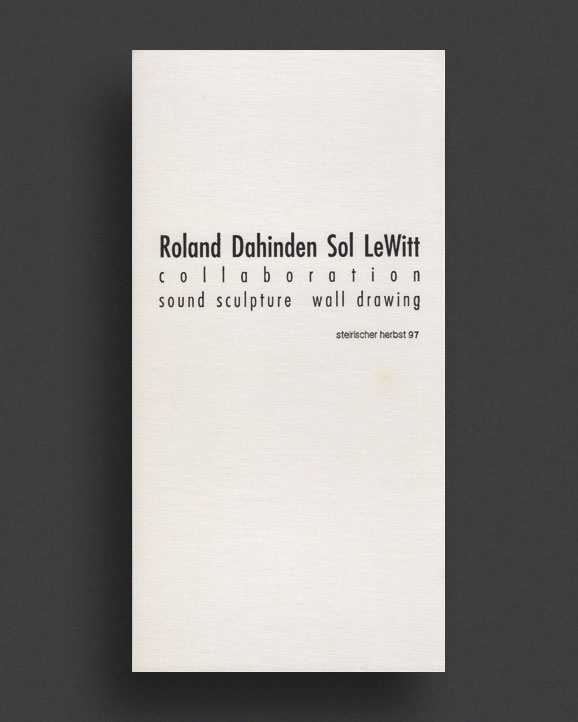
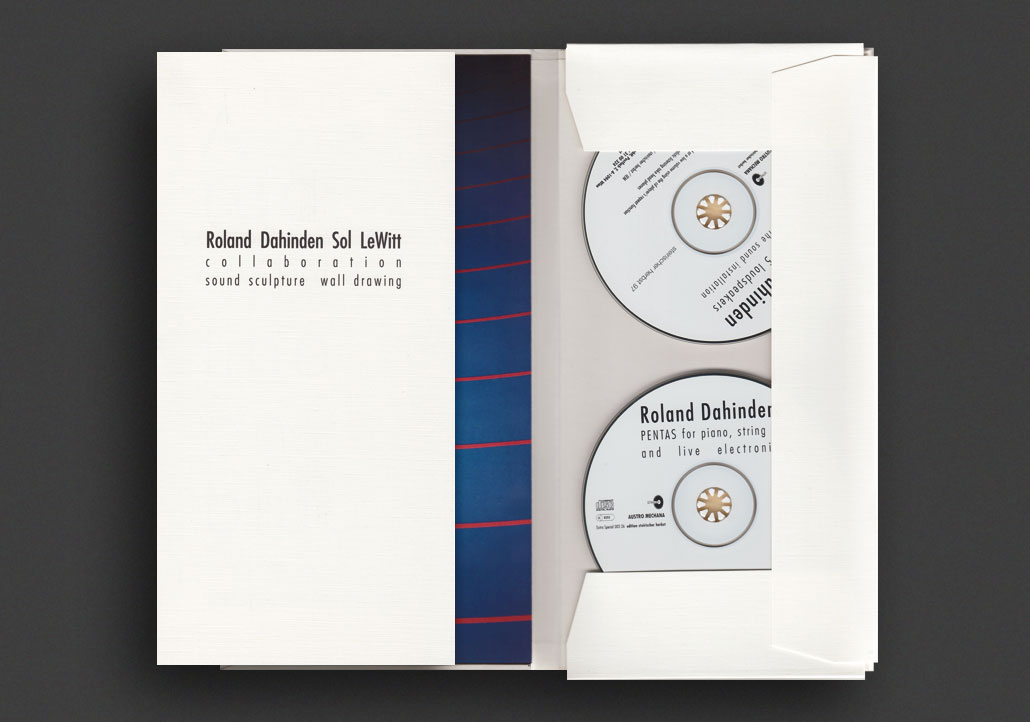
Scarce copy of Roland Dahinden, Sol LeWitt — Collaboration (Sound Sculpture Wall Drawing), a deluxe clothbound 2 x CD and book set published by Extraplatte and Steirischer Herbst, Austria. Commissioned by steirischer herbst 97, Kuppelsaal, Landesmuseum Joanneum, A-8010 Graz, Austria, 5.10. - 3.12. 1997. Includes the works: 1-1 PENTAS For Piano, String 4 And Live Electronics (Robert Höldrich, Tetras Streichquartett, Hildegard Kleeb, Gerhard Hüttl) 52:23; 2-1 PENTAS For 5 Loudspeakers (Remix Of The Sound Installation) (Dimitrios Polisoidis, Robert Höldrich) 1:00:12; Sol LeWitt — wall drawing #832 — Irregular red and blue special. Packaged in a cloth-bound hardcover folder/case, containing the two CDs and book with bi-lingual English/German liner notes. A folded image of Sol Lewitt's wall drawing is glued onto the inner side of the front cover.
Solomon "Sol" LeWitt (1928 – 2007) was one of the most distinctive and influential American artists of the 20th century. He shaped and defined many of the century's most cerebral "isms", notably minimalism and conceptualism.
Roland Dahinden (b. 1962) is a Swiss trombonist and composer specializing in the performance of contemporary music and improvisation/jazz. He studied trombone and composition in Switzerland, Austria, Italy (with Vinko Globokar) and the US (with Alvin Lucier). Composers such as Peter Ablinger, Maria de Alvear, Anthony Braxton, John Cage, Peter Hansen, Hauke Harder, Bernhard Lang, Joelle Léandre, Alvin Lucier, Chris Newman, Pauline Oliveros, Hans Otte, Lars Sandberg, Wolfgang von Schweinitz, Daniel Wolf and Christian Wolff have written especially for him.
Near Fine copy all-round.
1995, English
Softcover (staplebound), 28 pages, 34 x 30 cm
1st Edition, Out of print title / used / very good
Published by
Morpheus International / US
$55.00 - Out of stock
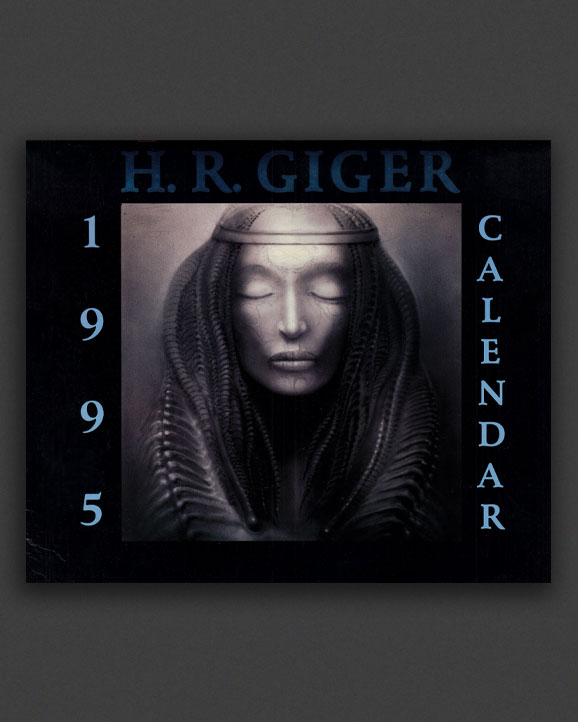
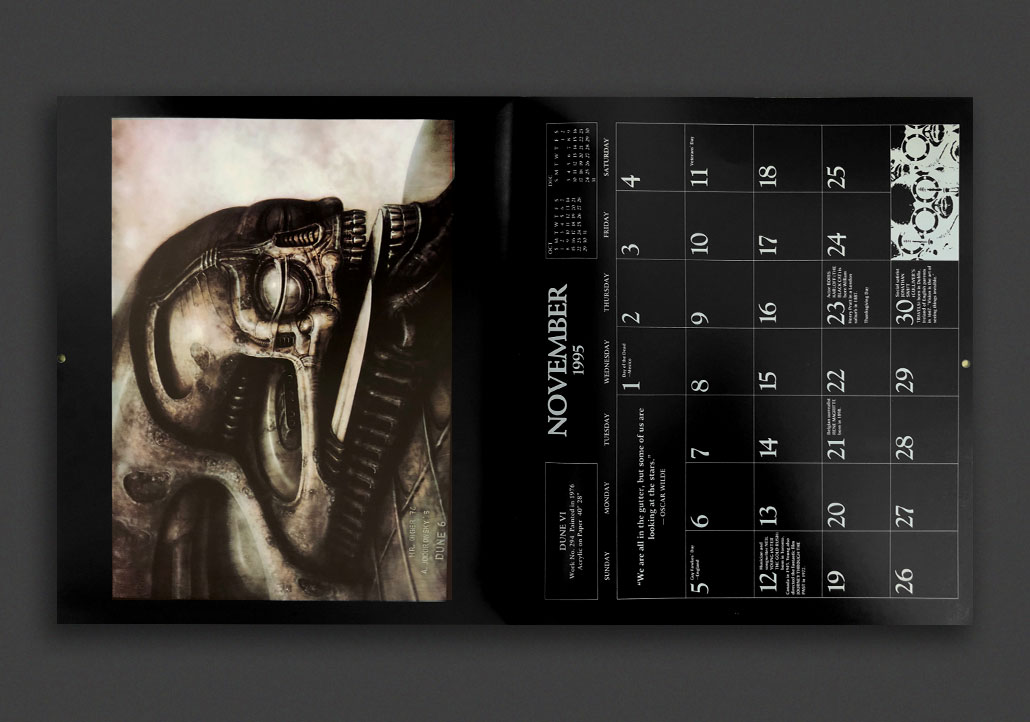
It was a good year, 1995, and with each month a new full-colour depiction of H.R. Giger's universe of the grotesque fantastic. 15 large-format reproductions, including never before published works, his hommage to Gustave Moreau, his Biomechanoids and Biomechanical Landscapes, designs for the unreleased films "The Tourist" and Jodorowsky's "Dune". Unused copy ready for the wall. Live in the past, who cares.
Very Good copy with light wear.